

Girl in Yellow Drapery
John William Godward’s “Girl in Yellow Drapery,” gemaakt in 1901, presents a striking depiction of classical beauty, rendered with masterful detail. Godward, an artist known for his contributions to the Neoklassiek stijl, captured the timeless grace of the ancient world in a manner that emphasizes harmony, schoonheid, and serenity. Godward’s (1861 – 1922) works often reflect his deep admiration for the art of ancient Rome and Greece, blending idealized female forms with the architectural and natural elements of the classical world. His penchant for delicate color palettes, along with his skill in creating lifelike textures, is evident in this painting.

Inhoudsopgave
Het belangrijkste onderwerp: A Sleeping Figure of Serenity
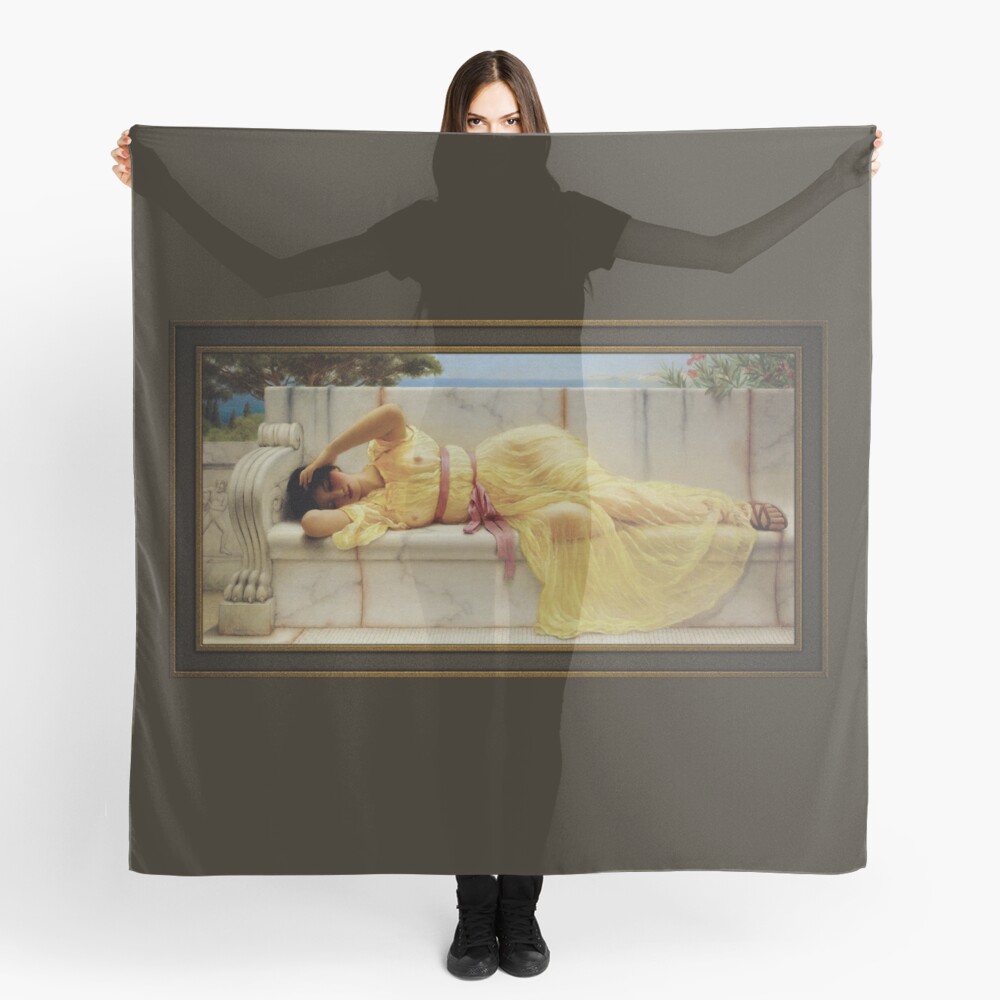
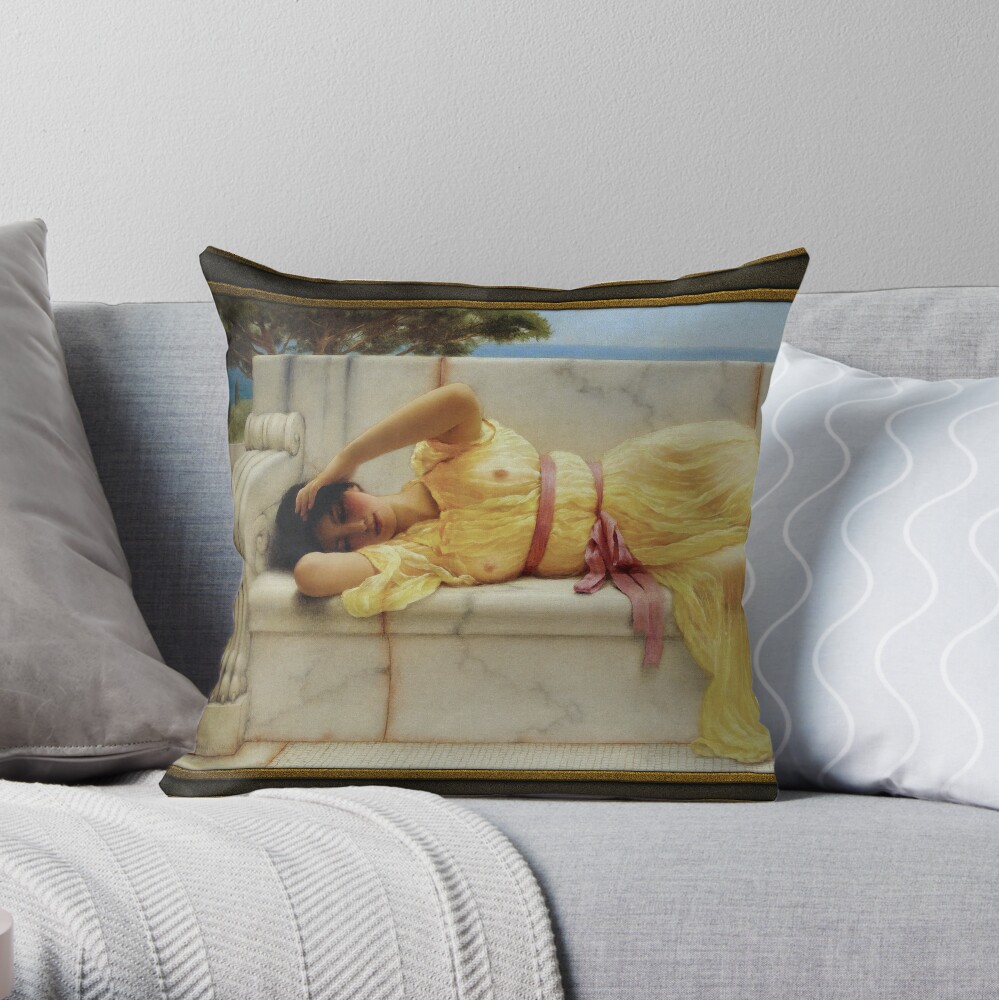
At the heart of the painting is a reclining young woman draped in a soft, flowing yellow gown that contrasts gracefully against the serene landscape. De girl’s pose suggests a moment of quiet rest, her head gently resting on her arm while her other hand lies across her forehead, seemingly shielding her eyes from the soft light.
Her physical form is captured with remarkable finesse, haar gezicht is serene and perfectly sculpted, reflecting the idealized beauty that was a hallmark of Godward’s work. The pale yellow gown she wears is airy, almost translucent, fluttering gently around her form as if caressed by a soft breeze. The drapery, though delicate and light in color, carries with it a sense of weight and depth, a testament to the artist’s careful study of fabric and anatomy.
De sfeer: Tranquil and Timeless
The mood of the painting is one of tranquility, timelessness, en genade. The figure appears to be in a state of deep repose, perhaps in the midst of a nap or daydream, untouched by the concerns of the outside world. De softness of her drapery and the gentle pose of her body evoke an air of peaceful slumber, while the absence of any overt emotion or action leaves the viewer to experience the scene as an invitation to pause and reflect. Godward, in capturing this moment, creates a serene stillness, where time seems suspended.
The Architecture: Classical Influence
Achter de figuur, the scene is framed by a classical stone bench that connects the subject to the world of ancient civilization. De marmer bench, with its slightly weathered, elegant columns and scrollwork, serves as a reminder of the classical heritage that influenced much of Godward’s work. The artist’s attention to architectural detail is remarkable, with the texture of the stone clearly articulated in the subtle shadows and light reflections. De kolommen, designed in the Corinthian style, suggest an elevated cultural and intellectual world, adding to the painting’s timeless quality.
The Natural Landscape: Calm and Expansive
Op de achtergrond, the viewer can see a peaceful vista that stretches out beyond the stone bench. The landscape is bathed in soft light, hinting at a horizon where the sea meets the sky. Although the colors of the sky are muted, de expansive nature of the scene provides a sense of space, suggesting an open, tranquil world that contrasts beautifully with the intimacy of the figure’s repose. Trees with a variety of lush greenery add to the sense of calm, their foliage subtly suggesting the warmth of an ancient Mediterranean climate.
The Medium and Technique: Fine Detail and Texture
Godward’s technical prowess is evident in the exquisite detailing of both the figure and the surrounding elements. The softness of the woman’s yellow gown contrasts with the rigid, almost tactile quality of the marble columns and bench. The use of light and shadow on the fabric emphasizes its delicate, flowing nature while the skin of the figure appears almost lifelike in its natural tone. Godward’s technique in blending light and shadow contributes to the sense of realism and depth, imbuing the work with an almost three-dimensional quality. His meticulous rendering of the textures—whether it is the smoothness of the stone, the transparency of the fabric, or the natural sheen of the skin—demonstrates his mastery of light and texture.
Godward’s Style and Themes: Classical Beauty Revisited
The style of “Girl in Yellow Drapery” embodies the core ideals of Neoclassicisme, a movement that sought to revive the aesthetics and ideals of ancient Greece and Rome. This style is characterized by its focus on idealized beauty, smooth forms, and an emphasis on proportion and harmony. Godward’s work is deeply infused with these principles, especially in his portrayal of the female figure, which is often idealized and posed in tranquil, relaxed settings. His subjects are frequently depicted in lush landscapes or classical architectural settings, as seen in this piece. Dit schilderij, in het bijzonder, encapsulates Godward’s fascination with female beauty and classical antiquity.
The theme of a reclining figure, often a symbol of both sensuality and repose, further emphasizes the artist’s commitment to creating a harmonious, serene world in his works. The image of the young woman in Godward’s painting is not merely of a sleeping figure; it is a vision of calm and perfection, disconnected from the worries of the world and set within a timeless environment. It’s an invitation for the viewer to step into a space where beauty and stillness reign.
Conclusie: The Enduring Legacy of Godward’s Work
John William Godward’s “Girl in Yellow Drapery” is a fine example of the artist’s dedication to the Neoclassical style, illustrating his skill in portraying idealized beauty and his deep admiration for classical art forms. Through the careful depiction of the figure, de architectonische elementen, and the natural world, Godward creates a scene of serene elegance that has continued to captivate audiences long after its creation. His ability to evoke a mood of timeless peace, combined with his technical precision, ensures that this painting remains a significant work in the history of British art.
Girl in Yellow Drapery is a remastered digital art old masters reproduction of a public domain image that is available as a canvas print online.
Deze digitale kunstcreatie, zoals bij alle kunstwerken die op de Xzendor7-website te vinden zijn, is deze online te koop in verschillende materiaalformaten, waaronder canvasafdrukken, acryl afdrukken, metalen prints, hout prints, ingelijste afdrukken, affiches, en zoals opgerolde canvasafdrukken in verschillende maten uit 12 inch tot 72 inch, afhankelijk van de grootte van het daadwerkelijke kunstwerk en de print on demand-winkel waar je de kunst wilt kopen.
Het artwork is ook beschikbaar op een breed scala aan heren- en dameskleding, mokken, bakken, sjaals, notitieboekjes en tijdschriften en veel woondecoratieproducten.
Bio -kunstenaar
Info hieronder van Wikipedia.org
John William Godward was de oudste van vijf kinderen, en is vernoemd naar zijn vader John en grootvader William.
Hij exposeerde op de Koninklijke Academie van 1887. Toen hij met een van zijn modellen naar Italië verhuisde 1912, zijn familie verbrak alle contact met hem en sneed zelfs zijn afbeelding uit familiefoto's. Godward keerde in Engeland terug naar Engeland 1921, overleden in 1922, en wordt begraven op de begraafplaats van Brompton, West-Londen.
Een van zijn bekendste schilderijen is Dolce far Niente (1904), die werd aangekocht voor de collectie van Andrew Lloyd Webber in 1995. Zoals bij verschillende andere schilderijen, Godward schilderde meer dan één versie; in dit geval, een eerder (en minder bekend) 1897 versie met verder 1906 versie.
Hij pleegde zelfmoord op de leeftijd van 61 en er wordt gezegd dat hij dat in zijn afscheidsbrief heeft geschreven “waar de wereld niet groot genoeg voor is [beide] ikzelf en een Picasso”.
Zijn vervreemde familie, die het er niet mee eens was dat hij kunstenaar werd, schaamden zich voor zijn zelfmoord en verbrandden zijn papieren. Er is slechts één foto van Godward bekend die bewaard is gebleven.
Godward was een Victoriaanse neoclassicist, en daarom, in theorie, een volgeling van Frederic Leighton. Echter, hij is stilistisch nauwer verbonden met Sir Lawrence Alma-Tadema, met wie hij een voorliefde deelde voor de weergave van klassieke architectuur - in het bijzonder, statische landschapselementen opgebouwd uit marmer.
De overgrote meerderheid van de bestaande afbeeldingen van Godward toont vrouwen in klassieke kleding, geposeerd tegen landschapselementen; hoewel er enkele halfnaakte en volledig naakte figuren in zijn oeuvre voorkomen, een opmerkelijk voorbeeld is “In het Tepidarium c1913”.
Een titel die wordt gedeeld met een controversieel schilderij van Alma-Tadema met hetzelfde onderwerp dat zich in de “Kunstgalerie Lady Lever”. De titels weerspiegelen de inspiratiebron van Godward; dat was de klassieke beschaving, met name die van het oude Rome; een onderwerp dat Godward artistiek nauw met Alma-Tadema verbindt.
Gegeven het feit dat de klassieke wetenschap tijdens zijn leven wijdverspreider was onder het potentiële publiek voor zijn schilderijen dan tegenwoordig, nauwgezet detailonderzoek was belangrijk om als kunstenaar in dit genre een reputatie te verwerven.
Alma-Tadema was zowel archeoloog als schilder, die historische locaties bezocht en artefacten verzamelde die hij later in zijn schilderijen gebruikte: Godward, te, bestudeerde details als architectuur en kleding, om ervoor te zorgen dat zijn werken het stempel van authenticiteit droegen.
Daarnaast, Godward heeft andere belangrijke kenmerken van zijn schilderijen nauwgezet en nauwgezet weergegeven, dierenhuiden waarvan de beschilderingen “Middagrust c1910” en “Een cool toevluchtsoord c1910” bevat voorbeelden van een dergelijke weergave, evenals wilde bloemen “Nerissa circa 1906” en “Zomerbloemen c1903”.
De verschijning van mooie vrouwen in bestudeerde poses op zoveel van Godward’s doeken zorgt ervoor dat veel nieuwkomers in zijn werken hem ten onrechte categoriseren als Prerafaëlitisch., vooral omdat zijn palet vaak levendig kleurrijk is. De keuze van het onderwerp (oude beschaving versus, bijvoorbeeld, Arthur-legende) is beter gezegd dat van de Victoriaanse neoclassicist.
Net als talrijke schilders uit zijn tijd, Godward was een ‘Hoge Victoriaanse Dromer’, het produceren van beelden van een geïdealiseerde en geromantiseerde wereld, in het geval van zowel Godward als Alma-Tadema, werd bekritiseerd als een wereldbeeld van Victorianen in toga's.
Godward “bouwde al snel een reputatie op vanwege zijn schilderijen van jonge vrouwen in een klassieke setting en zijn vermogen om met gevoeligheid en technisch meesterschap het gevoel van contrasterende texturen van vlees over te brengen, marmer, bont en stoffen.
Godward's voorliefde voor het maken van kunstwerken die zich afspelen in de klassieke periode kwam waarschijnlijk voort uit de periode waarin hij werd geboren; aangezien het de laatste grootschalige klassieke heropleving in de westerse schilderkunst was, die in Engeland bloeide van de jaren 1860 tot de jaren 1890.