

Angelica and Medoro
Angelica and Medoro: A Rococo Dreamscape by François Boucher
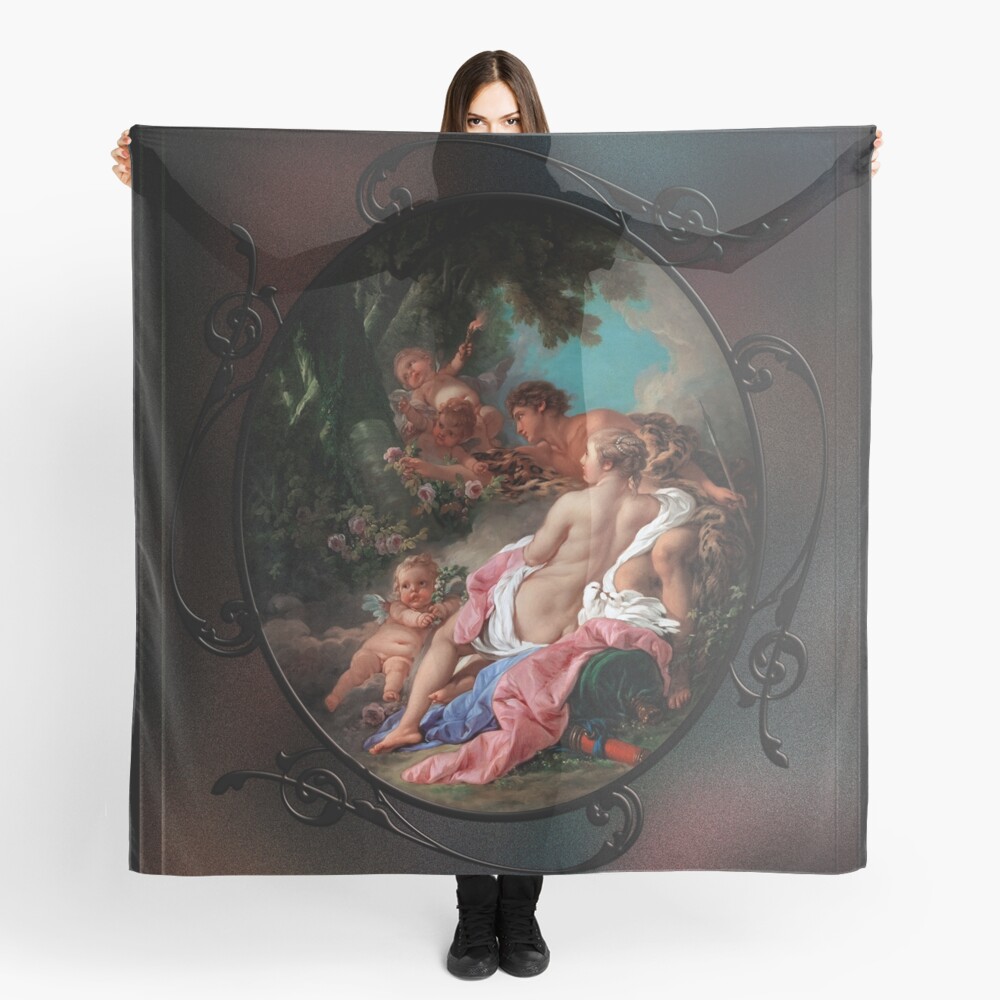
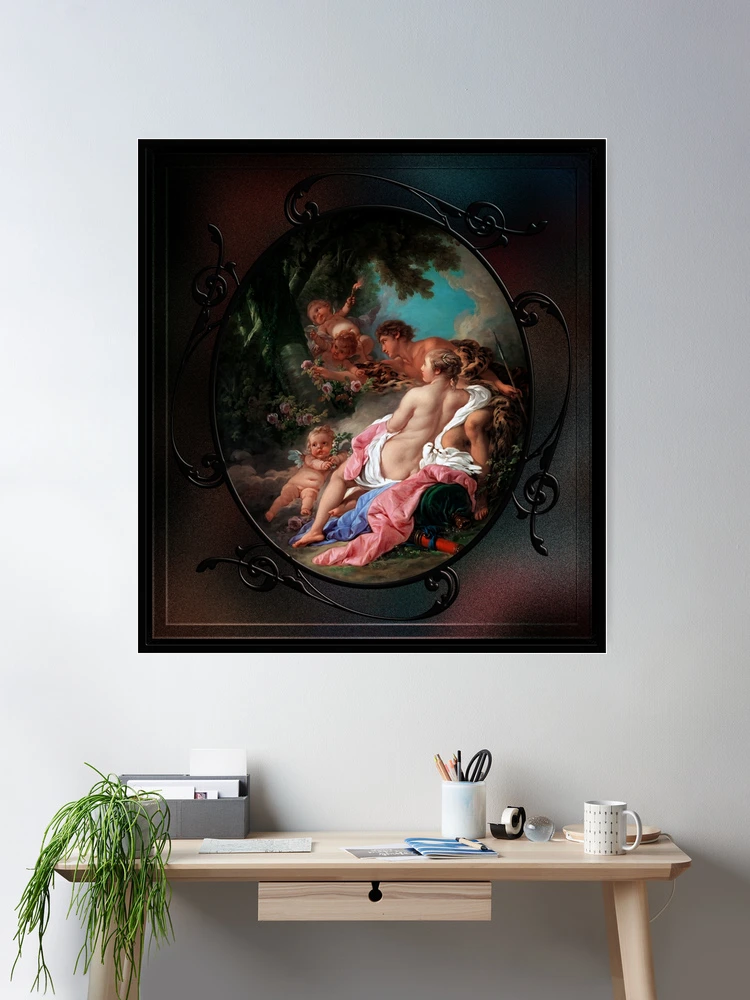
François Boucher’s “Angelica and Medoro,"Gemoolt ronderëm 1763, exemplifies the height of the Rococo style in French art. This captivating work, currently housed at the Musée du Louvre, transports viewers to a realm of idyllic beauty and sensual delight, characteristic of Boucher’s artistic vision. The painting depicts a scene drawn from Ariosto’s epic poem Orlando Furioso, where Angelica, a beautiful pagan princess, has fallen asleep in a woodland glade, attended by playful putti and the captive knight Medoro.
Inhaltsverzeechnes
Kompositiounsharmonie & Narrativ Kontext
The composition is carefully orchestrated to create a sense of harmonious balance and visual pleasure. Boucher employs a pyramidal structure, with Angelica at its apex, drawing the eye immediately to her figure. The lush foliage forms a verdant backdrop, framing the central figures and enhancing the feeling of seclusion and enchantment. Medoro sits beside Angelica, his gaze fixed upon her face, conveying a sense of tender devotion. He is partially draped in armor, hinting at his former role as a warrior, now softened by his proximity to the sleeping princess. The scene unfolds within a dense forest setting; trees with vibrant green foliage create an immersive atmosphere.
Figures and Their Representation
Angelica’s portrayal embodies the Rococo ideal of feminine beauty: soft skin, fléissend Hoer, and a languid pose that suggests both vulnerability and allure. Hirem Kleed, rendered in delicate pinks and whites, cascades around her form, emphasizing her graceful contours. The artist’s masterful use of light and shadow sculpts her body, highlighting its curves and creating a sense of ethereal beauty. Medoro is depicted with a more muscular physique, yet his posture is relaxed and gentle as he gazes at Angelica. His attire blends elements of armor and softer fabrics, reflecting his transition from warrior to lover.
The Role of the Putti
Adding to the scene’s whimsical charm are several putti – cherubic figures often associated with love and playfulness in Renaissance and Baroque art. These small figures frolic around Angelica and Medoro, scattering flowers and engaging in playful antics. Their presence reinforces the painting’s overall atmosphere of carefree joy and sensual indulgence. One putto sits at Angelica’s feet, gently touching her hand, while others playfully toss blossoms into the air. The putti are rendered with a delicate touch, their forms soft and rounded, further contributing to the painting’s aesthetic appeal.
Boucher’s Artistic Technique & Stil
Boucher’s technique is characterized by his fluid brushstrokes, subtle gradations of color, and an emphasis on texture. He skillfully employs sfumato, a technique popularized by Leonardo da Vinci, to soften edges and create a hazy, dreamlike Qualitéit. The colors are rich and vibrant, with a particular focus on pastel hues – pinks, blues, Greener, and creams – that evoke the atmosphere of a sun-drenched garden. Boucher’s style is distinctly Rococo; it prioritizes elegance, Graf, and sensual pleasure over realism or historical accuracy. He was known for his decorative paintings intended to adorn the homes of wealthy patrons, and “Angelica and Medoro” perfectly embodies this aesthetic.
Liicht & Atmosphär
D'Beliichtung an “Angelica and Medoro” is soft and diffused, creating a gentle glow that bathes the scene in warmth. The light source appears to be coming from above, illuminating Angelica’s face and highlighting her delicate features. This creates a sense of intimacy and tranquility, drawing the viewer into the idyllic setting. The atmospheric perspective – the gradual blurring of details in the background – enhances the feeling of depth and distance, de Betrachter weider an d'Welt vum Bild ënnerzegoen.
Allgemeng Androck & LegMacat
“Angelica and Medoro” ass méi wéi nëmmen eng Duerstellung vun enger literarescher Szen; et ass eng Ausféierung vu Rokoko Idealer - Schéinheet, Genoss, an eskapismus. Dem Boucher seng Meeschtesch Technik an evokativ Bildmaterial hunn dëst Bild zu engem vu senge gefeiertste Wierker gemaach, an e quintessent Beispill vum Rokoko-Stil. Et setzt d'Publikum weider mat senger exquisite Schéinheet an zäitloser Appel, bitt en Abléck an d'Welt vun der franséischer Konscht a Kultur aus dem 18. Joerhonnert. Déi dauerhaft Popularitéit vum Wierk staamt vu senger Fäegkeet fir Gefiller vu Romantik z'erwächen, Rou, a sensual Freed, Qualitéiten déi och haut héich geschätzt bleiwen.
Dekorativ Akzenter, déi an dësem Stéck benotzt ginn, sinn verfügbar bei HeritageType
Kënschtler Bio ofgeleet vun Wikipedia.org
Eng gebierteg vu Paräis, De Boucher war de Jong vun engem manner bekannte Moler Nicolas Boucher, deen him seng éischt artistesch Ausbildung ginn huet. Am Alter vu siwwenzéng, e Bild vum Boucher gouf vum Moler François Lemoyne bewonnert. De Lemoyne huet spéider de Boucher als seng Léierin ernannt, awer no nëmmen dräi Méint, hien ass fir de Gravure Jean-François Cars ze schaffen.
An 1720, hien huet den Elite Grand Prix de Rome fir Molerei gewonnen, awer huet déi konsequent Geleeënheet net geholl fir an Italien ze studéieren bis fënnef Joer méi spéit, wéinst finanzielle Problemer op der Royal Academy of Painting and Sculpture.[1] Beim Retour vum Studium an Italien gouf hien an d'Refounded Académie de peinture et de sculpture opgeholl 24 November 1731. Säi Empfangsstéck (Empfangstéck) war säi Rinaldo an den Armida vum 1734.
Boucher bestuet Marie-Jeanne Buzeau am 1733. D'Koppel hat dräi Kanner zesummen. Boucher gouf e Fakultéit Member an 1734 a seng Karriär huet vun dësem Punkt beschleunegt wéi hie Professer gefördert gouf dann de Rektor vun der Akademie, Inspekter bei der Royal Gobelins Fabrik ginn a schlussendlech Premier Peintre du Roi (Éischte Moler vum Kinnek) an 1765. Portrait vum Marie-Louise O'Murphy c. 1752
Boucher gestuerwen den 30 Mee 1770 a sengem Heemechtsland Paräis. Säin Numm, zesumme mat deem vu sengem Patréiner Madame de Pompadour, war synonym fir de franséische Rokokostil ginn, féiert de Goncourt Bridder ze schreiwen: “De Boucher ass ee vun deene Männer, déi de Goût vun engem Joerhonnert duerstellen, déi ausdrécken, personifizéieren a beliichten.”
De Boucher ass berühmt fir ze soen datt d'Natur ass “ze gréng a schlecht beliicht” (ze gréng a schlecht beliicht).
De Boucher war mam Edelsteengraver Jacques Guay verbonnen, deen hien geléiert huet ze molen. Hie mentoréiert och de moravesch-éisträichesche Moler Martin Ferdinand Quadal souwéi den neoklassesche Moler Jacques-Louis David am 1767.[4] Méi spéit, De Boucher huet eng Serie vun Zeechnunge vu Wierker vum Guay gemaach, déi d'Madame de Pompadour duerno gravéiert a verdeelt huet als e flott gebonnen Volumen un favoriséiert Haffbierger