

Ariane
Ariane c1831-35 par peintre américain & Graveur Brun cendré Durand (1796 – 1886) faisait partie du mouvement artistique du romantisme et était diplômé de la Hudson River School. Asher se concentrait principalement sur les peintures de paysage.
Cette peinture de Ariane par Asher est d'une copie d'une peinture de John Vanderlyn (1776 – 1852) ce qu'il a fait en préparation de la gravure qu'il a réalisée comme c'était souvent le cas; il créerait une toile à l'huile de la taille de la gravure prévue.
Ariane est la princesse crétoise de la mythologie grecque qui a été brièvement aimée par Thésée (le roi mythique et héros fondateur d'Athènes), who abandoned her on the island of Naxos after he tired of her company.
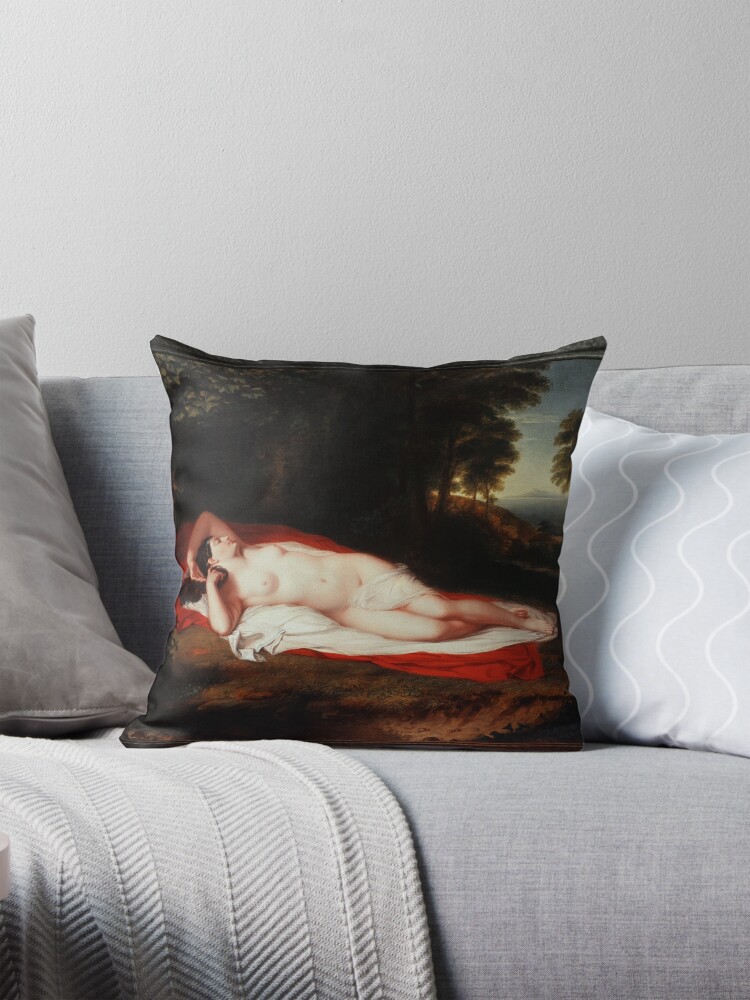
Table des matières
Overview of “Ariane” by Asher Brown Durand
Brun cendré Durand, an American painter and engraver, is widely regarded as one of the central figures in the Hudson River School of landscape painting, a movement that celebrated the natural beauty of the American landscape. pourtant, Durand’s work often extended beyond landscapes, as seen in his 1831 – 1835 La peinture Ariane. This piece reveals Durand’s mastery not only in capturing natural forms but also in his ability to imbue his subjects with an ethereal, almost mythological presence.
The Subject of the Artwork: Ariane
At the center of Durand’s Ariane stands a woman in repose, surrounded by the lush, undisturbed wilderness of an ancient, almost idyllic landscape. The subject of the painting is Ariadne, a figure from Greek mythology, known for her connection to the myth of Theseus and the Minotaur. Ariadne is often depicted as a symbol of love, perte, and betrayal, and Durand captures her at a moment of serene contemplation.
Ariadne’s pose is languid and contemplative, lying on a bed of red drapery that contrasts with the soft hues of the surrounding natural world. The figure appears relaxed, almost sleeping, with her head gently turned to the side. Her body is draped in a flowing, translucent white cloth, with the rich crimson fabric beneath her evoking a sense of luxury and opulence. Despite her reclined position, the contours of her body remain graceful, with the painter capturing the natural curves of her form with great care and sensitivity. Son visage, though partially obscured by her positioning, seems peaceful, suggesting a deep inner calm or introspection.
The Landscape and Natural Setting
The backdrop of the painting is a lush, verdant landscape that stretches into the distance, bathed in the soft glow of an evening or early morning light. The scene is characterized by gently rolling hills, dense trees, and a distant body of water. Durand’s attention to detail in the depiction of nature reflects his dedication to the principles of the Hudson River School, where the natural world was revered and idealized. The foliage is painted in rich, deep greens, while the sky above is a delicate blend of soft blues and warm yellows, contributing to an atmosphere of tranquility and nostalgia.
The distant view across the water provides a sense of depth and space, inviting the viewer to imagine the vastness of the scene. The use of light in this painting is particularly notable; the artist’s careful rendering of shadows and highlights creates a sense of volume and texture, lending an almost three-dimensional quality to both the figure of Ariadne and the surrounding landscape. The light appears to envelop the figure, casting a soft glow on her skin and the folds of her drapery, while the shadowed areas deepen the sense of solitude and reflection.
The Symbolism of the Drapery
The red drapery beneath Ariadne is not just a visual element but also a symbolic one. In classical art, drapery often served as a vehicle for expressing both the subject’s emotional state and their physical form. Dans ce cas, the deep red fabric can be interpreted as a symbol of passion, l'amour, or even sacrifice. Ariane, having been abandoned by Theseus after helping him escape the labyrinth, might be seen as embodying themes of loss and emotional turmoil, yet her peaceful repose and the lush, fertile landscape around her suggest a kind of quiet resolution or acceptance.
The white cloth she is draped in can be viewed as a symbol of purity or a new beginning, which is fitting given that the myth of Ariadne is often associated with transformation; both in the literal sense of her life being changed by her relationship with Theseus and in the mythological sense, where her fate takes a turn after her abandonment.
Le style artistique et la technique
Durand’s Ariane is painted in a classical Romantic style, where realism and idealism merge to create a vision of beauty that transcends the ordinary. The artist employs a fine balance of realism in the portrayal of both the figure and the landscape, yet there is an underlying idealization that makes the scene feel timeless. Durand’s technical skill is evident in the delicate rendering of light and shadow, the softness of the fabric, and the naturalistic details of the landscape.
The figures and forms are modeled with great precision, and the soft transitions of color suggest the artist’s deep understanding of the human body and the play of light across different surfaces. Durand’s fine attention to detail extends beyond the human form to the natural environment, where every leaf, branch, and rock is meticulously painted, contributing to the painting’s overall sense of realism and harmony.
Mood and Emotional Atmosphere
L'ambiance de Ariane est celui de la tranquillité, solitude, and quiet reflection. The soft light, gentle landscape, and languid pose of the subject all combine to create an atmosphere of serene contemplation. There is a sense of quiet beauty in the way the figure rests within the natural surroundings, suggesting both an intimate connection to nature and a contemplative escape from the tumult of the mythological world.
While the figure of Ariadne is deeply associated with themes of abandonment, betrayal, and emotional pain in the myth, Durand’s portrayal focuses on a more introspective aspect of her character. The absence of a direct narrative moment, such as her abandonment or subsequent marriage to Dionysus, allows the viewer to contemplate Ariadne in a state of quiet resolution. Her calm expression and relaxed pose suggest an emotional distance from her previous life’s trials and tribulations, allowing for a more meditative engagement with her figure.
Conclusion
Dans Ariane, Asher Brown Durand merges his skill in landscape painting with his sensitivity to human emotion, producing a work that is both visually stunning and emotionally resonant. The painting is a delicate balance of idealized beauty and reflective solitude, drawing upon the classical traditions of mythology and landscape painting while imbuing the scene with a uniquely Romantic sensibility. Through this piece, Durand invites the viewer to contemplate not only the mythical figure of Ariadne but also the eternal beauty of the natural world, which offers a quiet sanctuary from the tumult of human life.

En arrière-plan, après les arbres et la colline sur laquelle elle repose, nous pouvons voir un bateau sur la rive d'un lac, des gens et un chien sur le rivage, avec la fumée d'un feu de camp s'élevant dans l'air; enfin au loin, nous pouvons voir ce qui semble être une grande île.
Il s'agit d'une reproduction de maîtres anciens d'art numérique retouchée d'une image du domaine public que vous pouvez acheter en tant que Les Monuments de Paris par Hubert Robert.
Info ci-dessous de Wikipedia.org
Durand est né et est finalement décédé à Maplewood, New Jersey (alors appelé Jefferson Village). Il était le huitième de onze enfants. Le père de Durand était horloger et orfèvre.
Durand fut apprenti chez un graveur de 1812 à 1817 et a ensuite conclu un partenariat avec le propriétaire de l'entreprise, Charles Cushing Wright (1796–1854), qui lui a demandé de diriger le bureau de New York de l'entreprise.
Il a gravé la Déclaration d'Indépendance de John Trumbull pendant 1823, qui a établi la réputation de Durand comme l'un des meilleurs graveurs du pays.
Durand a aidé à organiser la New York Drawing Association pendant 1825, qui deviendra la National Academy of Design; il servirait l'organisation en tant que président de 1845 à 1861.
Les gravures d'Asher sur les billets de banque ont été utilisées comme portraits pour les premiers timbres-poste américains, les 1847 séries. Avec son frère Cyrus, il a également gravé certaines des 1851 problèmes.
Son intérêt principal est passé de la gravure à la peinture à l'huile sur 1830 avec les encouragements de son patron, Roseau Luman. Durant 1837, il a accompagné son ami Thomas Cole lors d'une expédition de croquis au lac Schroon dans les montagnes Adirondacks et peu de temps après, il a commencé à se concentrer sur la peinture de paysage.
Il a passé des étés à dessiner dans les Catskills, Adirondacks, et les Montagnes Blanches du New Hampshire, faire des centaines de dessins et d'esquisses à l'huile qui ont ensuite été incorporés dans des pièces finies de l'académie qui ont contribué à définir l'Hudson River School.
Durand est particulièrement connu pour ses représentations détaillées d'arbres, rochers, et feuillage. Il était un défenseur du dessin directement de la nature avec le plus de réalisme possible. Durand a écrit, “Laisser [l'artiste] accepter scrupuleusement tout [la nature] le présente jusqu'à ce qu'il, dans un diplôme, sont devenus intimes avec son infinité… ne le laissez jamais profaner son caractère sacré en s'écartant volontairement de la vérité.”
Comme d'autres artistes de l'Hudson River School, Durand croyait aussi que la nature était une manifestation ineffable de Dieu. Il a exprimé ce sentiment et ses opinions générales sur l'art dans son essai “Lettres sur la peinture de paysage” dans Le Crayon, un périodique d'art new-yorkais du milieu du XIXe siècle. A écrit Durand, “[T]a vraie province de l'Art du Paysage est la représentation de l'œuvre de Dieu dans la création visible…”
Durand est connu pour son 1849 peinture Kindred Spirits qui montre un autre artiste de l'Hudson River School Thomas Cole et le poète William Cullen Bryant dans un paysage des montagnes Catskills. Cela a été peint en hommage à Cole à la mort de Cole pendant 1848, et en cadeau à Bryant.