

Ariadne Engraving
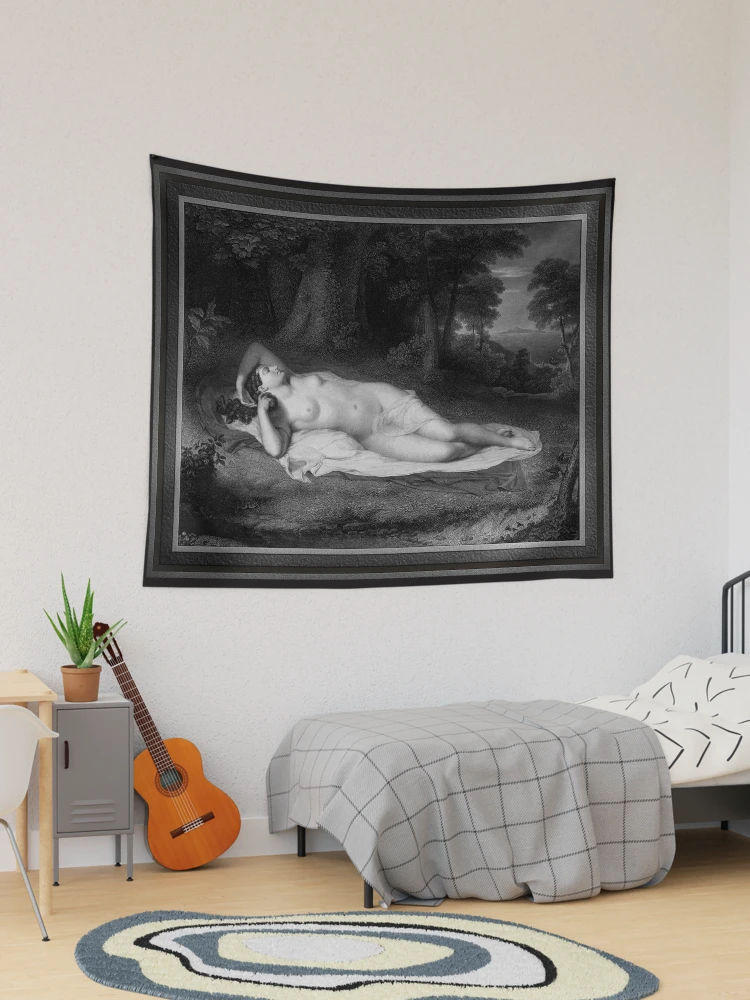
Ariadne Engraving c1835 by American Painter & Gravador Asher Brown Durand (1796 – 1886) va formar part del Romanticism Art Movement i es va graduar a la Hudson River School. Asher es va centrar principalment en les pintures de paisatges.
Visió general
The Ariadne engraving by Asher is from a copy of a painting he made from an original painting by John Vanderlyn (1776 – 1852). Ariadne is the Cretan Princess who was briefly loved by Theseus (el mític rei i fundador-heroi d’Atenes), who abandoned her on the island of Naxos.
“Ariadna” is an exquisite engraving created by Asher Brown Durand, one of the prominent American artists and engravers of the 19th century. Aquesta obra d'art, completed circa 1835, is a masterful interpretation of classical themes in the Neoclassical style.
The subject of this engraving, Ariadna, is a figure from Greek mythology, whose image has been captured through Durand’s engraving with remarkable sensitivity and depth. L'estat d'ànim i la narrativa que transmeten aquesta peça estan profundament entrellaçats amb els temes de l'abandonament, soledat, i enyorança, presentant Ariadna com un símbol de la malenconia romàntica.
Taula de continguts
El tema i la composició
Al cor de la composició hi ha Ariadna, la figura central que sovint es representa als mites antics com l'amant abandonat de Teseu. Durand l'ha deixat estirada a terra, envoltat de suau, draps fluids que semblen fusionar-se amb el món natural que l'envolta.
La seva postura suggereix una sensació de relaxació o fins i tot resignació, amb un braç recolzat darrere del seu cap, mentre que l'altra s'estira amb gràcia sobre el seu tors. La seva cara, serena però llunyana, looks toward the horizon as though lost in thought or perhaps anticipating the return of her lover, a theme which resonates with the classical myths of lost love and abandonment.
The depiction of Ariadne in this engraving speaks volumes about Durand’s understanding of the human form, especially in the rendering of the female body. The curves of her limbs, the delicate folding of the fabric, and the naturalistic contours of her face all contribute to the timeless beauty and vulnerability of the figure. Durand’s use of shading and fine details in the engraving enhances the texture of the flesh and the fabric, lending a sense of life to the image despite its static nature.
L'entorn i l'entorn
The background and setting of the engraving contribute significantly to its thematic weight. Ariadne is positioned in a lush, idyllic natural setting—likely an open glade or secluded forest. El terreny, gently sloping and dotted with trees, provides a soft contrast to the hard, chiseled forms of the figure.
A distant view of rolling hills and a river suggest a harmonious integration of human and natural elements. The setting appears to be at the cusp of day and night, as a hazy light filters through the trees, subtly illuminating Ariadne’s form while casting the landscape in a soft, dreamlike glow.
The artist skillfully renders the trees and foliage with intricate lines, creating a sense of depth and dimension. The distant hills add a sense of scale to the composition, further enhancing the naturalistic style that Durand excelled at. The fine linework and delicate shading are characteristic of the engraving medium, a technique that requires patience and precision, both of which Durand applied expertly to bring the landscape into harmonious balance with the figure of Ariadne.
El Mitjà: Gravat
Com a gravat, this piece is executed with meticulous attention to detail. Durand, known for his skill in this medium, uses sharp, clear lines and intricate crosshatching to achieve a wide range of tonal values. The engraving’s fine lines lend it a delicate quality, but the use of contrast and shadow provides a deep, almost three-dimensional sense of volume. Durand’s technique is particularly adept at capturing textures, from the softness of Ariadne’s skin to the rough bark of the trees surrounding her.
The use of engraving as a medium also reflects Durand’s engagement with the tradition of classical art and his desire to produce works that could be widely disseminated, popularizing such mythological themes among American and European audiences. Gravat, being more accessible than original paintings, allowed for greater distribution of this image, making it not only an artistic achievement but also a vehicle for promoting classical ideals.
Temes i simbolisme
The figure of Ariadne in this engraving embodies themes of isolation, abandonment, i el pas del temps. En la mitologia grega, Ariadne helps Theseus escape the Labyrinth, only to be later abandoned by him on the island of Naxos. This image captures her at a moment of quiet reflection, perhaps contemplating her fate or lost love.
The serene expression on her face juxtaposes with the emotional turmoil that her myth entails. The soft folds of her drapery and the calm surroundings may symbolize a fleeting moment of peace before the inevitable sorrow that comes with being left alone.
A més, the natural setting of the piece complements these themes. The trees and foliage suggest a timeless, unchanging world, while Ariadne’s figure contrasts with this permanence, hinting at the transient nature of human life and emotion. Her presence in such a setting evokes the tension between humanity and nature, a theme that is deeply ingrained in classical art and literature.
Estat d'ànim i atmosfera
L'estat d'ànim de “Ariadna” is deeply melancholic. Durand has chosen to portray the moment of Ariadne’s solitude after her abandonment, and the peaceful yet somber expression on her face enhances this emotional atmosphere. The engraving’s lighting, with its soft contrast between light and shadow, imbues the piece with a quiet, qualitat gairebé etèria. The trees in the background create a feeling of shelter, yet their distance and the softness of their outlines evoke a sense of isolation, reinforcing the emotional undercurrent of the narrative.
While the scene is bathed in the calm of nature, there is an undercurrent of sadness that is palpable. The solitude of the figure, combined with the longing gaze and the distant landscape, creates an atmosphere that is both tender and tragic. It speaks to the human experience of abandonment and the quiet resignation that often accompanies it.
Conclusió
Asher Brown Durand’s “Ariadna” stands as a fine example of 19th-century American engraving and a representation of classical themes through a Neoclassical lens. The serene yet poignant depiction of Ariadne, set against a natural backdrop, invites the viewer to contemplate the fragility of human emotion, el pas del temps, and the isolation that often accompanies love and loss. The technical mastery and emotional depth of this work, combined with the delicate interplay of light and shadow, make it a timeless piece of art.
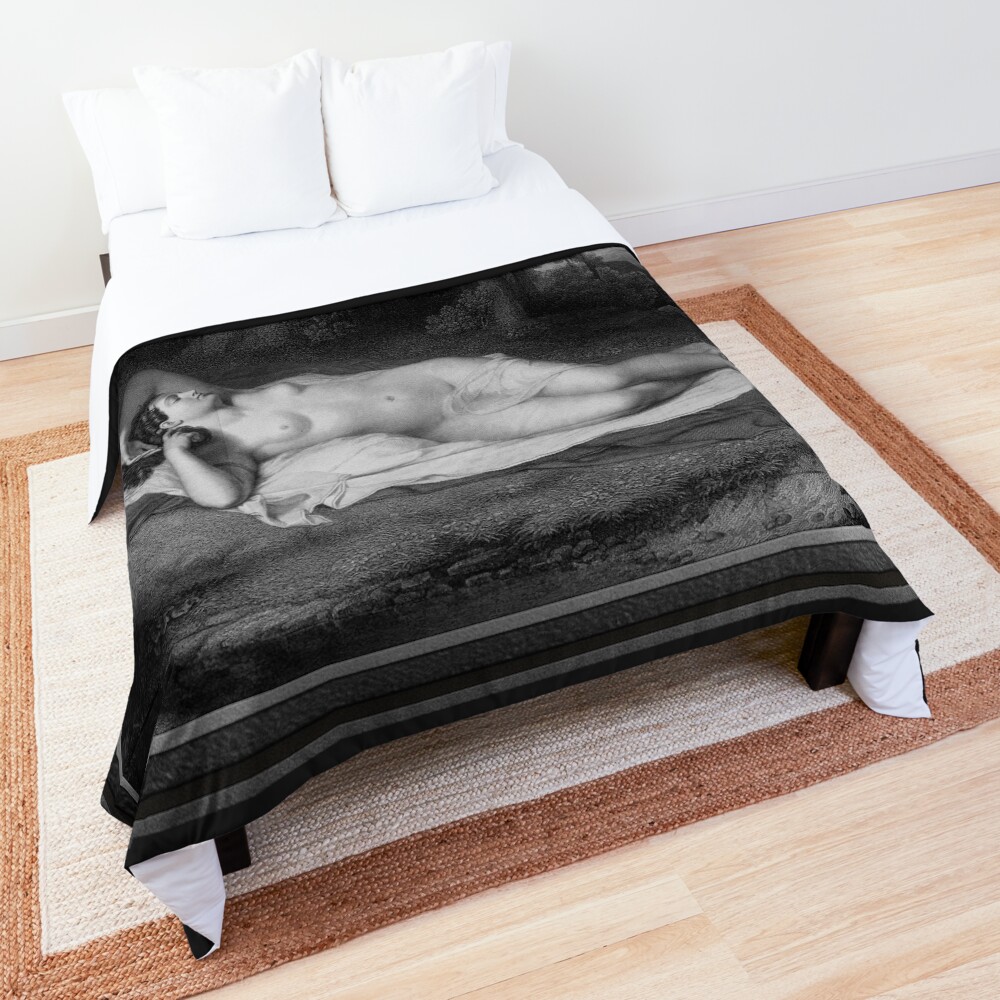
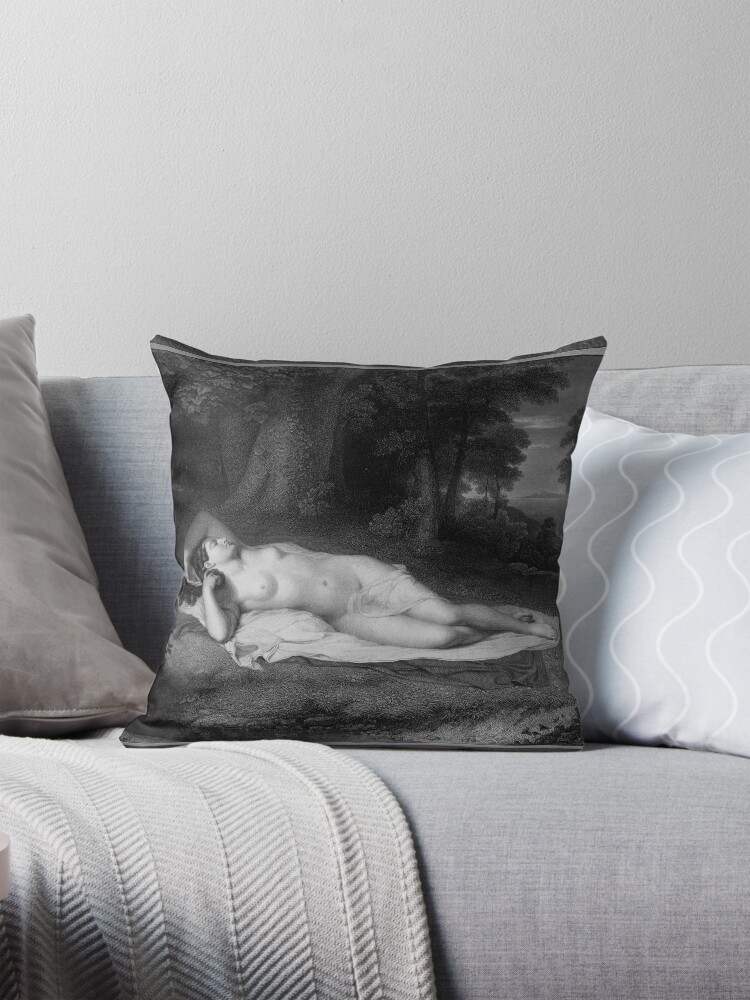
Ariadne Engraving depicts Ariadne laying down in the forest, damunt d'un feix de roba parcialment nu per un raig amb el braç esquerre posicionat sobre el cap i la mà dreta agafant els cabells mentre descansava a la part posterior del coll.
In the background of the Ariadne Engraving past the trees and the hill she is resting on, we can see a boat on the bank of a lake, and in the far distance we can see what appears to be a large island.
Aquest gravat d'Ariadne és una reproducció d'antics mestres d'art digital retocada d'una imatge de domini públic.
Informació a continuació de Wikipedia.org
Durand va néixer a i finalment va morir a Maplewood, Nova Jersey (llavors anomenat Jefferson Village). Era el vuitè d’onze fills. El pare de Durand era rellotger i argenter.
Durand va ser aprenent d'un gravador de 1812 a 1817 i més endavant va establir una associació amb el propietari de l'empresa, Charles Cushing Wright (1796–1854), que li va demanar que gestionés l’oficina de Nova York de l’empresa.
Va gravar la Declaració d'Independència per a John Trumbull durant 1823, que va establir la reputació de Durand com un dels millors gravadors del país.
Durand va ajudar a organitzar la New York Drawing Association durant 1825, que es convertiria en l'Acadèmia Nacional de Disseny; exerciria l'organització com a president de 1845 a 1861.
Els gravats d’Asher en bitllets de banc es van utilitzar com a retrats dels primers segells postals d’Amèrica, el 1847 sèrie. Juntament amb el seu germà Cyrus també va gravar alguns dels successius 1851 problemes.
El seu principal interès va passar del gravat a la pintura a l'oli 1830 amb l’ànim del seu patró, Luman Reed. Durant 1837, va acompanyar el seu amic Thomas Cole en una expedició de dibuixos al llac Schroon a les muntanyes Adirondacks i poc després va començar a concentrar-se en la pintura de paisatges..
Va passar els estius fent dibuixos als Catskills, Adirondacks, i les muntanyes blanques de New Hampshire, fent centenars de dibuixos i esbossos a l'oli que més tard es van incorporar a peces acabades de l'acadèmia que van ajudar a definir l'escola del riu Hudson.
Durand és recordat especialment pels seus detallats retrats dels arbres, roques, i fullatge. Va ser un defensor de dibuixar directament de la natura amb el màxim de realisme possible. Durand va escriure, “Deixa [l'artista] acceptar escrupolosament el que sigui [natura] el presenta fins que ho farà, en un grau, s'han fet íntim amb la seva infinitat... mai el deixis profanar la seva sacralitat amb una allunyada deliberada de la veritat.”
Com altres artistes de l'escola Hudson River, Durand també creia que la natura era una manifestació inefable de Déu. Va expressar aquest sentiment i les seves opinions generals sobre l'art en el seu assaig “Cartes sobre pintura de paisatge” a The Crayon, una revista d'art novaiorquesa de mitjans del segle XIX. Va escriure en Durand, “[T]La veritable província de l'art del paisatge és la representació de l'obra de Déu en la creació visible...”
Durand és conegut per la seva 1849 pintant Kindred Spirits que mostra el seu també artista de l'escola del riu Hudson Thomas Cole i el poeta William Cullen Bryant en un paisatge de les muntanyes de Catskills. Això va ser pintat com un homenatge a Cole després de la mort de Cole durant 1848, i com a regal a Bryant.