

Bouquet Of Flowers In An Urn c1724
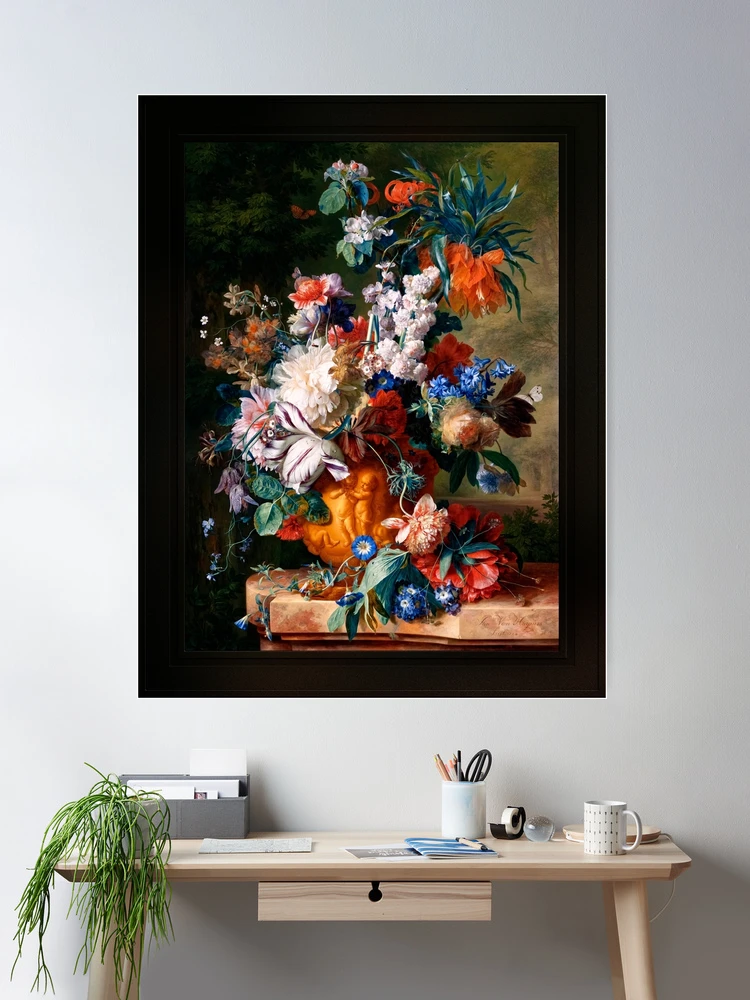
Jan van Huysum “Bouquet of Flowers in an Urn,” erstallt an 1724, stands as a prime example of the Dutch Golden Age’s mastery of still life painting. Known for his exceptional skill in rendering florals with lifelike detail and vibrant color, van Huysum (1682 – 1749) captured the beauty of nature with an extraordinary level of finesse.
This particular painting features a large, ornate urn brimming with a diverse and carefully arranged assortment of flowers, capturing the delicate interplay between light and shadow, the textures of petals, and the intricate details of each bloom. The work embodies the flourishing Dutch Baroque style, where floral still lifes were not only symbolic of wealth and prestige but also a testament to the artist’s virtuosity.
Inhaltsverzeechnes
Haaptthemium: The Flower Bouquet
At the heart of the composition lies a stunning bouquet, overflowing from the mouth of a classical urn. The flowers are presented in vivid detail, with each petal, blatt, and stem rendered in a naturalistic style that blurs the line between painting and reality.
The centerpiece of the bouquet includes lilies, tulips, rosen, a Veilchen, each flower meticulously painted to showcase its texture and fragility. The delicacy of the petals contrasts beautifully with the rich, lush tones of the surrounding foliage, demonstrating van Huysum’s exceptional ability to portray both the softness of flowers and the robustness of their greenery.
Among the notable elements in the arrangement, the bright red-orange lily stands out, drawing the viewer’s eye due to its size and vibrant hue. Its contrasting colors, alongside the soft whites and purples of the smaller flowers, create a harmonious visual balance.
The inclusion of several varieties of flowers, some in full bloom, others just beginning to open, adds depth and variety, giving the painting a sense of dynamic movement as if the bouquet were alive and flourishing. The artist’s meticulous attention to detail is evident in the veins of the leaves, the way the light reflects off the dew drops on the petals, and the subtle shading that adds three-dimensionality to the composition.
The Urn: Symbolism and Structure
The urn that holds the bouquet is not merely a vessel but a symbol of wealth, taste, a Raffinesséierung. Its classical form, decorated with intricate motifs, serves as a nod to ancient Greek and Roman art, drawing a link between the florals and the timelessness of classical antiquity.
The urn itself is set on a stone pedestal, which emphasizes its importance within the composition. Déi déif, golden yellow hue of the urn contrasts beautifully with the colorful flowers, while the urn’s smooth texture creates a sense of permanence, a subtle counterpoint to the ephemeral nature of the blooms it holds.
The urn’s material seems to have a soft gleam, almost as though it were made of fine porcelain or terracotta, adding a realistic texture that invites closer inspection. Two cherub-like figures decorate the urn’s surface, their cherubic forms subtly molded into the ceramic. These figures are rendered with graceful fluidity, their childlike faces framed by delicate foliage, acting as a soft visual link between the natural world of the flowers and the artistic world of sculpture.
Terrain an Hannergrond
Am Hannergrond, the artist paints a soft, distant landscape of verdant trees and foliage, which gently fade into a haze of light. This gives the impression of a lush garden or private estate, adding a sense of depth and space to the painting.
The outdoor scene contrasts with the indoor focus on the flowers, suggesting that the bouquet might have been picked from a garden and brought indoors to be admired. The light that spills across the scene highlights the freshness of the flowers, creating a play between the natural world outside and the curated beauty inside the vase.
The backdrop is not overly detailed but suggests an idealized view of nature, green and flourishing, untouched and serene. This peaceful terrain serves to enhance the visual splendor of the flowers in the foreground, making them appear even more exquisite in comparison.
Materialien an Technik
Jan van Huysum employed oil paints, a medium that allowed him to capture the fine textures and complex interplay of light and shadow. His technique involved layering thin glazes to create depth, d'Uewerfläch opzebauen sou datt d'Liicht vun all eenzel Blummenbléieblieder mat engem naturalistesche Glanz reflektéiere konnt.
Déi fein Detailer an de Blieder, Bléieblieder, an Urn weisen e Meeschter um Textur an Transparenz. Déi glat Iwwergäng tëscht hell an donkel, sou wéi déi fein Highlighten an delikat Schatten op all Uewerfläch, dem Van Huysum seng Virtuositéit mat der Uelegmolerei Technik opzeweisen.
D'Benotzung vum Kënschtler vu Liicht ass besonnesch opfälleg an dësem Stéck. Hien beschäftegt eng mëll, diffus Luucht, dat schéngt déi ganz Kompositioun ze bueden, Hëtzt derbäi a betount déi üppig Vibranz vun de Blummen.
Dës kompetent Behandlung vu Liicht a Schiet mécht de Bouquet lieweg, invitéiert de Betrachter op d'Bild ze bleiwen, Staunen iwwer déi realistesch Rendering vun all Bléieblieder, blatt, a bléie. The overall effect is both calming and awe-inspiring, conveying a deep appreciation for the fleeting beauty of nature.
Stil, Thema, a Stëmmung
The Dutch Baroque style, with its focus on intricate detail and realism, is fully embodied in this work. The theme of transience is hinted at through the depiction of flowers, symbols of fleeting beauty and mortality.
Van Huysum’s bouquet, with its variety of blooms, presents a visual celebration of life’s ephemeral nature. Trotzdem, it also speaks to the triumph of the artist’s skill, as if capturing this temporary beauty in paint allows it to endure forever.
D'Stëmmung vum Bild ass eng vu roueger Iwwerleeung. There is a quiet elegance in the way the flowers are arranged and displayed, and the viewer is drawn into a world where nature’s beauty is appreciated and preserved in the stillness of the canvas. The juxtaposition of the fragile flowers and the enduring urn evokes a sense of quiet dignity and timelessness.
Bouquet vu Blummen an enger Urn c1724 vum hollännesche Moler Jan van Huysum (1682 – 1749), deen am Rokoko gemoolt huet, Post-Impressionismus a Renaissance Stiler.
Dëst ass eng schéin still life scene of a large bouquet of flowers of all different types comprising red flowers, white flowers, orange flowers, blo Blummen, violet flowers, gold roses, white and purple orchids, Rebe, and green plants; that have been placed in a large ceramic urn that is embossed around its perimeter with Putti (a chubby little male child, usually nude in a work of art).
The urn or vase sits on a brown and tan sculpted marble table that has been placed in a large garden or forest with trees behind it on the left and more trees on the right that are slightly faded from view along a path to indicate distance.
On the flowers and flying around them we can see several species of butterflies, ants and wasp; with some of the flowers having clearly defined droplets of water on them.
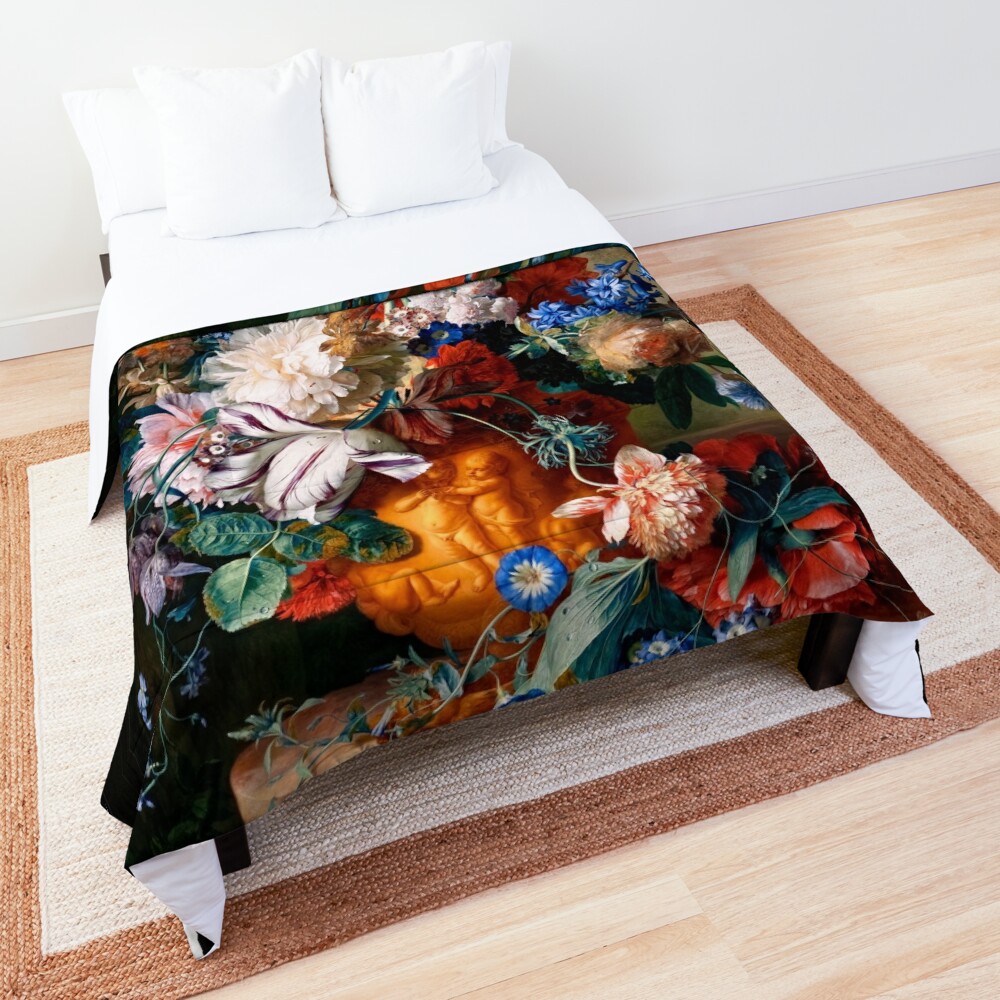
Dëst ass eng remastered digital Konscht al Master Reproduktioun vun engem Public Domain Bild dat als Canvas Print online verfügbar ass.
Kënschtler Bio
Info drënner ofgeleet vun Wikipedia.org an Britannica.com
De Jan van Huysum war den eelste Jong vum hollännesche Golden Age Blummemoler Justus van Huysum (1659 – 1716), a koum aus enger Famill vu Kënschtler.
Säi jéngere Brudder deen am Alter gestuerwen ass 22 war och eng erfollegräich Moler wéi seng Schwëster Maria; a seng Duechter Francina Margaretha van Huysum (1707 – 1789) war och Blummemoler.
De Jan huet ënner der Mentorschaft vu sengem Papp studéiert an ass qualifizéiert entwéckelt wäert spéider d'Fäegkeete vu sengem Papp iwwertreffen.
Seng Spezialitéit war an der Molerei vun iwwerflësseg Blummen Arrangementer, déi hien mat extremer Präzisioun an Delikatesse erstallt huet.