

Calliope, Muse of Epic Poetry
The Voice of Heroes: Examining Charles Meynier’s “Calliope, Muse of Epic Poetry”
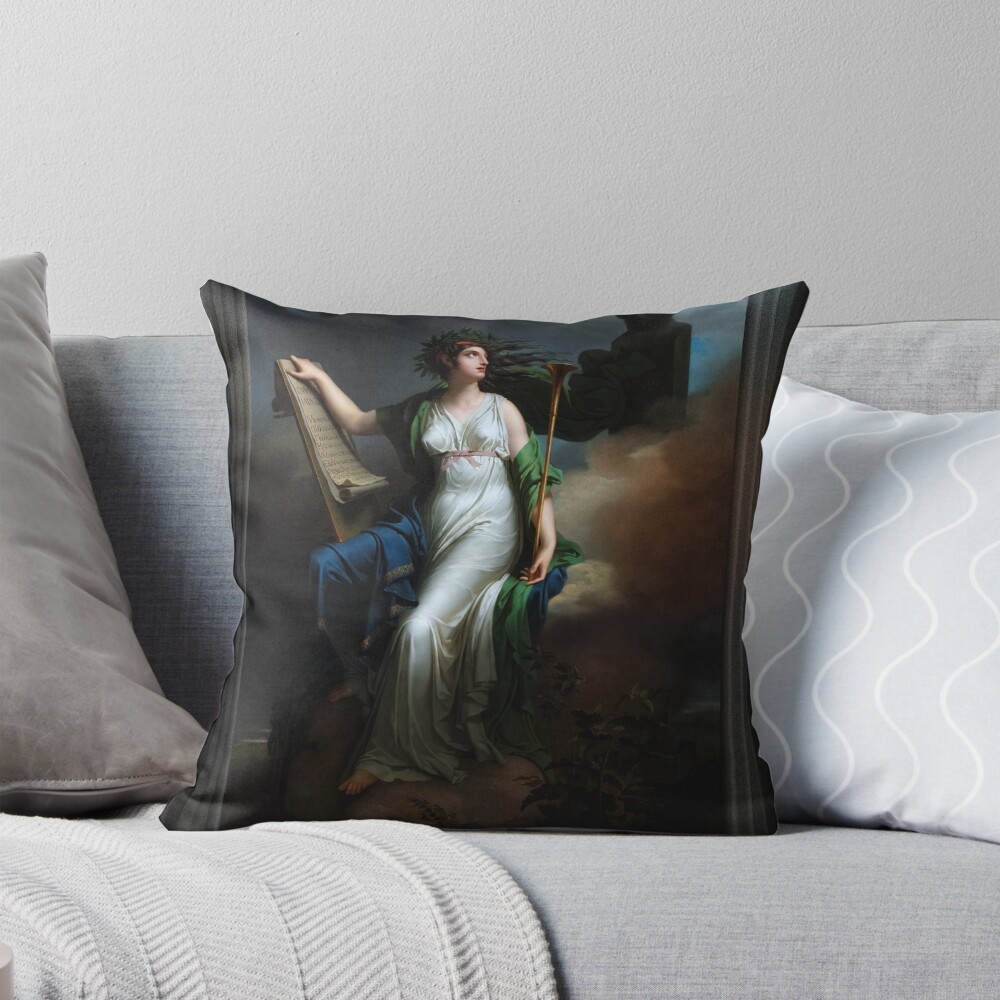
Charles Meiner'S (1763 oder 68 – 1832) “Calliope, Muse of Epic Poetry,” ronderëm gemoolt 1798, is a striking allegorical representation of the Greek goddess responsible for inspiring heroic narratives. The artwork portrays Calliope seated upon a rocky outcrop amidst swirling clouds, holding a scroll and a laurel-crowned staff—symbols of her role as the patroness of epic poetry. Meynier’s skillful use of dramatic lighting and classical composition creates an atmosphere of grandeur and timeless significance.
Inhaltsverzeechnes
Zesummesetzung & Symbolic Representation
The painting’s composition is carefully structured to emphasize Calliope’s elevated status and divine nature. She occupies a central position within the frame, seated on a rugged rock formation that rises above a sea of swirling clouds. This placement suggests her dominion over both earthly and celestial realms. Hannert hatt, partially obscured by mist, stands a bust of Homer—the legendary author of the Iliad an den Odyssey, further reinforcing Calliope’s association with epic poetry. The scroll she holds displays fragments of text, presumably excerpts from heroic tales, while the laurel-crowned staff symbolizes victory and artistic achievement.
Faarfpalette & Atmosphäresch Effekter
D'Faarfpalette an “Calliope, Muse of Epic Poetry” is dominated by cool tones—blues, groer, and whites—which evoke a sense of solemnity and grandeur. Calliope’s flowing white gown contrasts sharply with the dark background, drawing attention to her figure as the focal point of the composition. Meynier masterfully uses chiaroscuro—the contrast between light and dark—to create depth and drama within the scene. The swirling clouds and misty atmosphere contribute to a sense of ethereal beauty and timelessness.
Calliope: Goddess of Inspiration & Narrative Power
Calliope, in Greek mythology, is the eldest of the nine Muses, each representing a different art or science. As the muse of epic poetry, she was believed to inspire poets with tales of heroic deeds, divine interventions, and grand adventures. Meynier’s portrayal captures her essence as a source of creative inspiration—a figure who embodies the power of storytelling and the enduring legacy of classical literature. The artwork serves as a tribute to the art of epic poetry and its ability to transport audiences to worlds beyond their own.
Kënschtleresch Afloss & Historesch Kontext
Charles Meynier was a French painter known for his neoclassical style, which drew inspiration from ancient Greek and Roman art. His work often featured allegorical subjects and historical scenes rendered with meticulous detail and classical elegance. “Calliope, Muse of Epic Poetry” illustréiert dës Qualitéiten; it reflects the artistic trends of the late 18th and early 19th centuries, a period marked by renewed interest in classical antiquity. The painting’s creation coincides with a time of significant political and social upheaval in France—the French Revolution and Napoleonic era—during which artists often turned to classical themes for inspiration and solace.
Technesch Detailer & Material
D'Konschtwierk gëtt mat Uelegfaarwen op Leinwand ausgefouert, erlaabt räich Faarfsättigung a subtile Toungradatiounen. Meynier’s technique involves meticulous attention to detail, particularly evident in the rendering of Calliope’s drapery, facial features, and the textures of the rocks and clouds. Enk Untersuchung weist e Meeschter um Pinselaarbecht; et ass glat a kontrolléiert, bäidroen zum allgemenge Sënn vun Eleganz a Verfeinerung. De Canvas selwer schéngt gutt virbereet, eng gëeegent Uewerfläch fir de Kënschtler seng kompetent Uwendung vu Faarwen ubidden.
Kënschtler Bio ofgeleet vun Wikipedia.org
De Meynier war de Jong vun engem Schneider; an e jonken Alter huet en Talent fir Konscht gewisen, an huet seng Ausbildung ënner der Mentorschaft vum franséischen Zeechner an Engraver Pierre-Philippe Choffard ugefaang *1731 – 1809).
Als Student vum franséischen neoklasseschen an historesche Moler François-André Vincent (1746 – 1816), De Meynier huet den zweete Präis an der 1789 Prix de Rome Concours; während d'Anne-Louis Girodet de Roussy-Trioson den éischte Präis krut. Véier Joer méi spéit an 1793 Meynier zréck op Paräis.
An 1815 De Meynier gouf Member vun der Académie de France zu Roum; an während der Period tëscht 1819 an 1822, hien huet déi grouss Dekoratioun fir d'Plafong vum Louvre erstallt; wéi och vill Wierker erstallt, déi d'Napoleonesch Legend verherrlecht hunn, déi zum gréissten Deel am Château de Versailles bleift.
Hien huet och Motiver fir d'Bas-Reliefs a Statuen um Arc de Triomphe du Carrousel an der Bourse vu Paräis gemaach.. Vun 1816 weider, De Meynier war Member vun der Académie des Beaux-Arts; an an 1819 Hie gouf zum Enseignant an der École des Beaux-Arts ernannt.
This is a retouched digital art old masters reproduction of a public domain image that is available for print on multiple products, as well as a Leinwandprint online.