

Calíope, Muse de poesia épica
The Voice of Heroes: Examining Charles Meynier’s “Calliope, Muse of Epic Poetry”
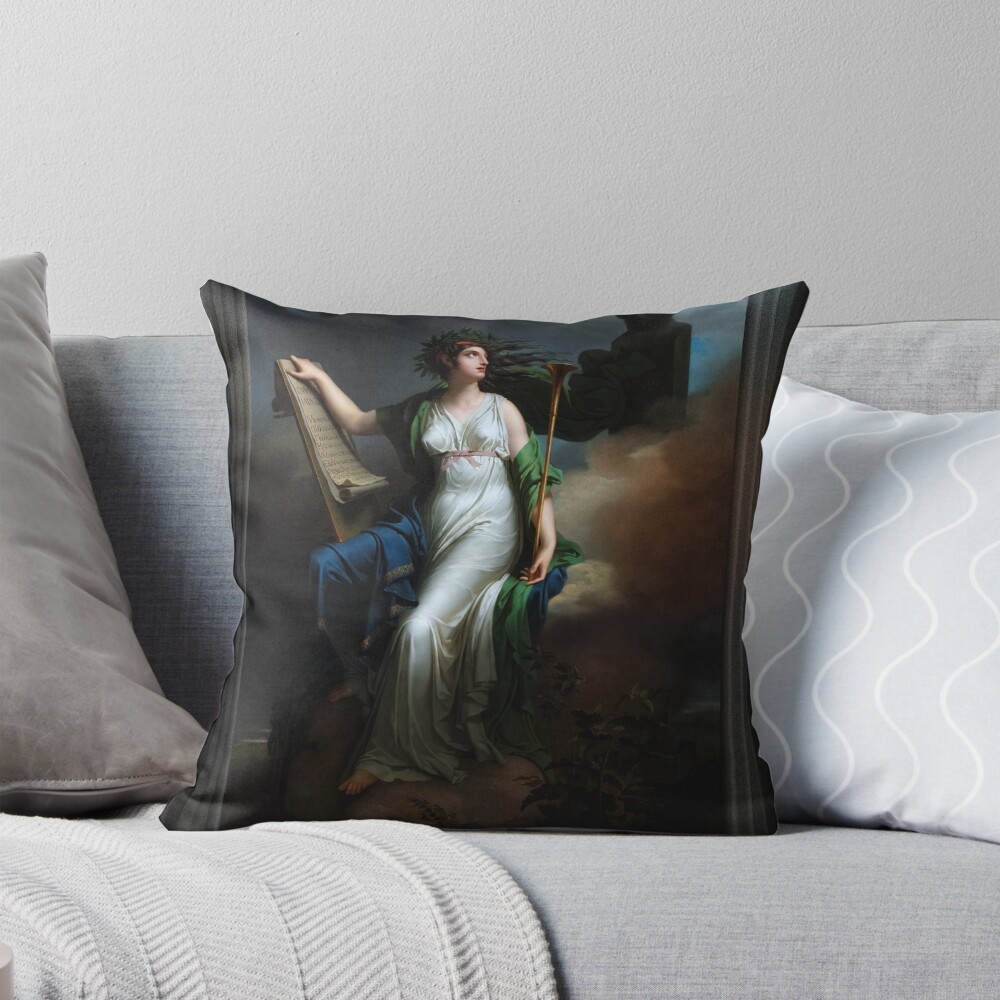
Charles Meynier‘s (1763 ou 68 – 1832) “Calíope, Muse de poesia épica,” pintado ao redor 1798, is a striking allegorical representation of the Greek goddess responsible for inspiring heroic narratives. The artwork portrays Calliope seated upon a rocky outcrop amidst swirling clouds, holding a scroll and a laurel-crowned staff—symbols of her role as the patroness of epic poetry. Meynier’s skillful use of dramatic lighting and classical composition creates an atmosphere of grandeur and timeless significance.
Índice
Elementos Composicionais & Symbolic Representation
The painting’s composition is carefully structured to emphasize Calliope’s elevated status and divine nature. She occupies a central position within the frame, seated on a rugged rock formation that rises above a sea of swirling clouds. This placement suggests her dominion over both earthly and celestial realms. Atrás dela, partially obscured by mist, stands a bust of Homer—the legendary author of the Iliad e a Odyssey, further reinforcing Calliope’s association with epic poetry. The scroll she holds displays fragments of text, presumably excerpts from heroic tales, while the laurel-crowned staff symbolizes victory and artistic achievement.
Paleta de cores & Atmospheric Effects
The color palette in “Calíope, Muse de poesia épica” is dominated by cool tones—blues, cinzas, and whites—which evoke a sense of solemnity and grandeur. Calliope’s flowing white gown contrasts sharply with the dark background, drawing attention to her figure as the focal point of the composition. Meynier masterfully uses chiaroscuro—the contrast between light and dark—to create depth and drama within the scene. The swirling clouds and misty atmosphere contribute to a sense of ethereal beauty and timelessness.
Calíope: Goddess of Inspiration & Narrative Power
Calíope, in Greek mythology, is the eldest of the nine Muses, each representing a different art or science. As the muse of epic poetry, she was believed to inspire poets with tales of heroic deeds, divine interventions, and grand adventures. Meynier’s portrayal captures her essence as a source of creative inspiration—a figure who embodies the power of storytelling and the enduring legacy of classical literature. The artwork serves as a tribute to the art of epic poetry and its ability to transport audiences to worlds beyond their own.
Influências artísticas & Historical Context
Charles Meynier was a French painter known for his neoclassical style, which drew inspiration from ancient Greek and Roman art. His work often featured allegorical subjects and historical scenes rendered with meticulous detail and classical elegance. “Calíope, Muse de poesia épica” exemplifies these qualities; it reflects the artistic trends of the late 18th and early 19th centuries, a period marked by renewed interest in classical antiquity. The painting’s creation coincides with a time of significant political and social upheaval in France—the French Revolution and Napoleonic era—during which artists often turned to classical themes for inspiration and solace.
Technical Details & Materiais
The artwork is executed with oil paints on canvas, allowing for rich color saturation and subtle gradations of tone. Meynier’s technique involves meticulous attention to detail, particularly evident in the rendering of Calliope’s drapery, facial features, and the textures of the rocks and clouds. Close examination reveals a mastery of brushwork; it’s smooth and controlled, contributing to the overall sense of elegance and refinement. The canvas itself appears well-prepared, providing a suitable surface for the artist’s skillful application of paint.
BIO do artista derivado de Wikipedia.org
Meynier era filho de um alfaiate; e desde tenra idade mostrou talento para a arte, e iniciou sua formação sob a orientação do desenhista e gravador francês Pierre-Philippe Choffard *1731 – 1809).
Como aluno do pintor neoclássico e histórico francês François-André Vincent (1746 – 1816), Meynier ganhou o segundo prêmio no 1789 Competição do Prêmio de Roma; enquanto Anne-Louis Girodet de Roussy-Trioson ficou com o primeiro prêmio. Quatro anos depois em 1793 Meynier voltou a Paris.
Dentro 1815 Meynier tornou-se membro da Académie de France em Roma; e durante o período entre 1819 para 1822, ele criou a grande decoração do teto do Louvre; além de criar inúmeras obras que glorificaram a lenda napoleônica, que em sua maior parte permanece no Castelo de Versalhes.
Ele também fez projetos para os baixos-relevos e estátuas do Arco do Triunfo do Carrossel e da Bolsa de Paris.. A partir de 1816 em diante, Meynier foi membro da Académie des Beaux-Arts; e em 1819 foi nomeado professor na École des Beaux-Arts.
Esta é uma reprodução de mestres antigos de arte digital retocada de uma imagem de domínio público disponível para impressão em vários produtos, bem como um impressão em tela.