

Capriccio With Elegant Figures
Capriccio With Elegant Figures c1750 by Italian Painter Antonio Joli (1700 – 1777); bekannt für seine Veduten- und Capricci-Szenenbilder.
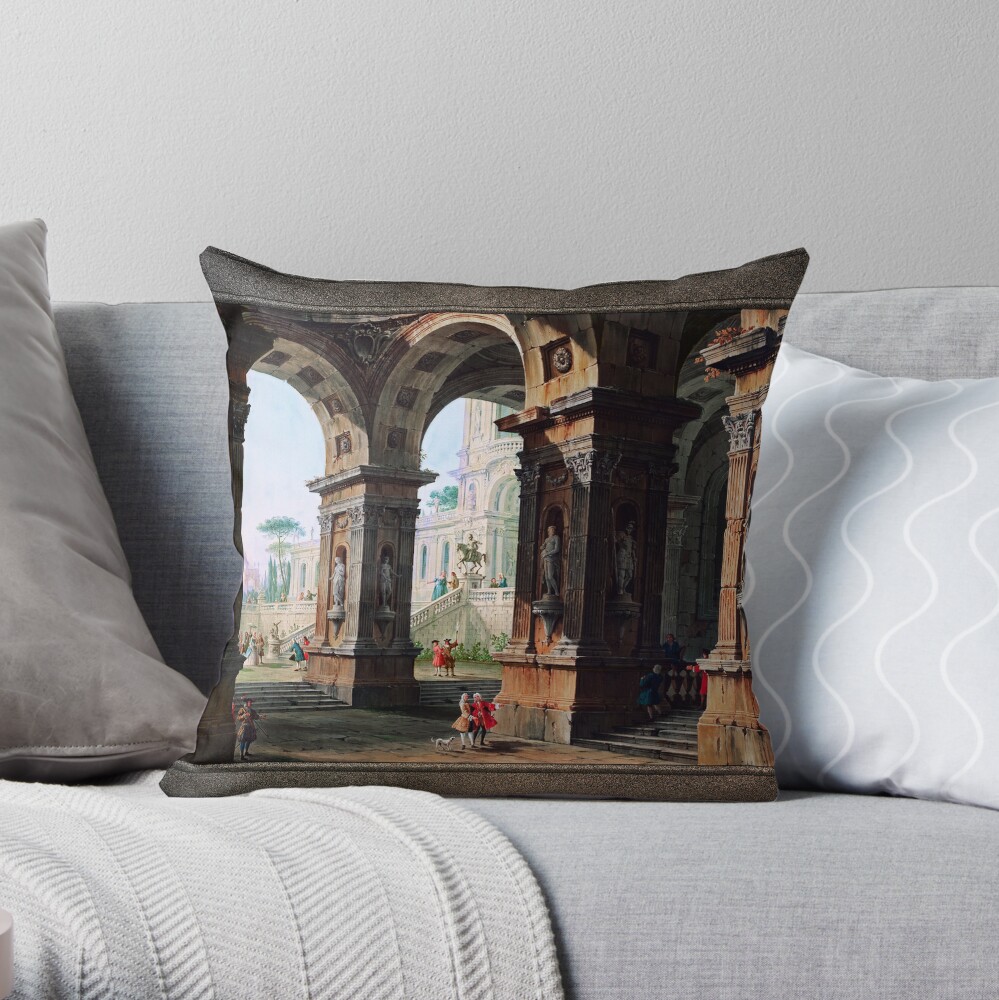
Das ist ein wunderbarer capricci painting showing people of the upper class of the time in an old Roman palace.
We ca see in the foreground two men who are walking with a white dog beside them in conversation, with a possible guard and another man near a large pillar that has a statue of a goddess standing on a pedestal.
These goddesses can be seen through the palace on all four sides of the four major columns in the scene; and up the stairs where the two men and the dog are, we can see more people that have gathered by a Roman statue in the main column of the scene.
In the open area we can see a lush garden, where there are steps that lead to the main building with statues at the base and a horse statue and rider at the top; we see what is most likely a nobleman and noblewoman, walking with a man behind lady holding a parasol above her head, and what appears to be a servant carry the blue part of her dress above the floor.
Photo Retouching Video Of Capriccio With Elegant Figures by Antonio Joli
Behind the noble couple is their entourage and along the balcony of the main building are other men and women conversing and enjoying the beautiful sunny clear day.
Capriccio With Elegant Figures is a remastered digital art old masters reproduction of a public domain image that is available as a Leinwanddruck online.
Die folgenden Informationen stammen von Wikipedia.org
Antonio wurde in Modena geboren, Italien im März 13, 1700 und ging zunächst bei Rafaello Rinaldi in die Lehre, der auch als Il Menia bekannt war, sowie Arbeit im Atelier der Galli da Bibbiena; die eine Familie italienischer Bühnenkünstler des 17. und 18. Jahrhunderts waren, die sich über 1800 erstreckte 1625 – 1787.
Er begann seine Karriere als Maler von Bühnenbildern in Modena und Perugia, und im Alter von 32 zog nach Venedig, wo er als Bühnenmaler für die Opernproduktionen am Teatro di San Giovanni Grisostomo und am Teatro San Samuele der Familie Grimani arbeitete.
Im 1742 er reiste nach Dresden, Deutschland und dann nach London, England, wo er geblieben ist 1744 zu 1748, dann nach Madrid, Spanien aus 1750 – 1754.
Während er in London lebte und arbeitete, dekorierte er das Richmond-Herrenhaus des Schweizer Grafen John James Heidegger (1666 – 1749), dann der Direktor des King’s Theatre (ein West End-Theater am Haymarket in der City of Westminster, London).
Während seines Aufenthaltes in Madrid war er auch als Bühnenmaler für den königlichen Hof tätig; sowie für das kleinere Opernhaus oder den Palast von Aranjuez. Er schuf auch großformatige Gemälde der Esquadra del Tajo, die Flotte königlicher Lastkähne und anderer Schiffe auf dem Fluss Tajo bei Aranjuez.
Im 1754 Antonio kehrte aus Venedig zurück, Italien und wurde eines der Gründungsmitglieder der Accademia di Belle Arti di Venezia (Akademie der Schönen Künste von Venedig); Sieben Jahre später zog er an den Bourbonenhof von Neapel, wo er bis zu seinem Tod im April bleiben würde 29, 1777.