

Slottets vinterlandskap med åkare på en frusen flod
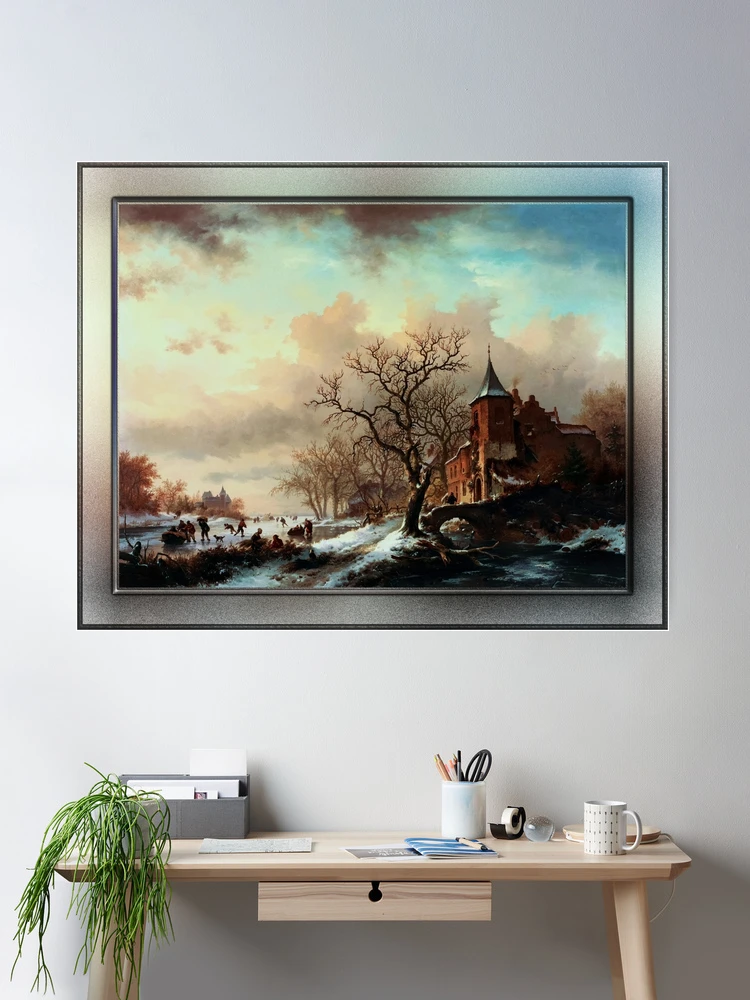
Slottets vinterlandskap med åkare på en frusen flod skapat runt 1855 is an evocative winter landscape by Frederik Marinus Kruseman, a Dutch painter born in 1816 och passerar in 1882 Kruseman, a skilled master in capturing the essence of the Dutch countryside during the 19th century, is best known for his atmospheric works that often depicted landscapes with striking realism and detailed depictions of nature.
This painting is a quintessential example of Kruseman’s ability to marry the grandiose with the everyday, capturing a serene winter scene that conveys both the majesty of nature and the quiet simplicity of rural life. His use of light, skuggor, and perspective, along with a nuanced color palette, offers a glimpse into the serene beauty of the Dutch winter and the human connection to the land during this season.
Innehållsförteckning
Inställningen och kompositionen
The composition of the painting unfolds before us in a wide and panoramic landscape, with a focus on a grand, almost ancient castle nestled in the background. The artist skillfully places the fortress slightly off-center, giving the viewer a sense of depth and allowing the natural environment to interact harmoniously with the built structure. The imposing castle, its rough stonework weathered by time, sits atop a gentle incline, surrounded by barren trees that stretch their skeletal limbs toward the sky, as if caught in a moment of quiet contemplation.
A frozen river runs across the lower half of the canvas, its ice glistening under a soft, diffuse winter sun. Floden, coated in a blanket of snow, is the focal point of the scene, with groups of people skating and playing, their dark forms contrasting against the white and pale background. These skaters, dressed in simple yet warm 19th-century attire, add a lively human element to the otherwise peaceful landscape, creating a dynamic interaction between the figures and their surroundings.
Winter Landscape and Atmospheric Effects
Kruseman’s winter landscape is not just a depiction of nature in a static form, but a carefully constructed atmosphere. The coldness of the winter air is palpable, with the artist’s delicate brushwork capturing the texture of the snow-covered ground, the crispness of the sky, and the slight haze that often accompanies the winter chill. The snow is rendered with remarkable realism, each flake seeming to glisten with an icy sharpness, contrasting with the muted tones of the surrounding trees and castle.
The sky, filled with soft clouds in shades of pink, lavendel, och ljusblå, suggests an early afternoon or late morning, where the light is low yet still bright enough to cast long, soft shadows across the landscape. The atmospheric lighting in this piece not only accentuates the textures of the snow and ice but also imbues the scene with a serene yet melancholic mood. The interplay of light and shadow within the painting is a masterful aspect of Kruseman’s technique, enhancing the viewer’s sense of immersion into the wintry setting.
The Human Element: Skaters and Everyday Life
A central aspect of the painting is the presence of the skaters, who infuse the scene with life and vitality. Several figures glide gracefully across the ice, their movements frozen mid-action, offering a timeless portrayal of winter recreation. The skaters appear in small groups, some engaged in spirited activities such as chasing each other, while others pause to rest, their breath visible in the chilly air. Dessa siffror, although secondary to the natural landscape, represent an important human element in Kruseman’s depiction of rural life. Their dark clothing, mostly consisting of coats, scarves, och hattar, contrasts starkly with the white of the snow, emphasizing the human resilience in the face of winter’s harshness.
These skaters add to the narrative of daily life during the winter months in 19th-century Netherlands. Ice skating was a popular pastime during harsh winters when rivers and canals would freeze over. The figures are not mere additions to the scene but contribute to the painting’s theme of harmony between man and nature, showing the joyful interaction with the elements.
Architectural Elements: The Castle and Its Surroundings
The castle, a magnificent yet somewhat somber structure, commands attention with its angular lines and tall spire. Built in the Gothic or Renaissance style, its crumbling form suggests that it has withstood the test of time and harsh winters. The presence of the castle within the landscape introduces a sense of history, suggesting that this region has been inhabited for centuries. The structure stands as a silent witness to the passing of time, while the skaters below are a reminder of life continuing on, despite the cold and the passage of seasons.
Around the castle, the land is dotted with trees that appear barren, their branches twisted and bare, signaling the end of autumn and the full embrace of winter. These trees, like the castle, stand in stark contrast to the skaters, who are in motion. The stillness of the natural elements surrounding the human figures enhances the sense of a serene, almost timeless moment, as if capturing the fleeting essence of winter itself.
Stämning och tema för konstverket
Stämningen av Slottets vinterlandskap med åkare på en frusen flod är en av lugn, mixed with a quiet sense of nostalgia. There is a peaceful solitude conveyed through the desolate trees and the vastness of the snow-covered landscape. Än, there is also an underlying warmth in the activity of the skaters, which serves as a contrast to the coldness of the environment. The scene evokes a sense of connection between human activity and the natural world, where even in the coldest of seasons, life continues with joy and vigor.
The theme of winter as both a challenge and a beauty is central to the work. Kruseman’s representation of a landscape covered in snow reflects the harshness of winter, yet the skaters provide an optimistic counterpoint, reminding the viewer that even in the coldest months, life has its moments of grace and liveliness.
Castle Winter Landscape With Skaters On A Frozen River är en retuscherad digital konst gamla mästare reproduktion av en offentlig egendom.
Detta digitala konstskapande, som med alla konstverk som kan hittas på Xzendor7-webbplatsen finns att köpa online i en mängd olika materialformat inklusive canvastavlor, akryltryck, metalltryck, trätryck, inramade tryck, affischer, och som rullade canvastryck i en mängd olika storlekar från 12 tum till 72 tum beroende på storleken på det faktiska konstverket och den print on demand-butik du väljer att köpa konsten från.
Konstverket är också tillgängligt på ett brett utbud av herr- och damkläder, muggar, väskor, halsdukar, anteckningsböcker och tidskrifter och många heminredningsprodukter.
Om konstnären
Info nedan härledd från Wikipedia.org
Frederik fick sina första teckningstimmar av stillebensmålaren Jan Reekers (1790 – 1858), som då var direktör för Royal Acadamy of Fine Arts i Amsterdam; och som också hade lärt sin kusin Jan Adam[ medan han gick på en yrkesskola i Haarlem från 1832 till 1833.
I 1833 han började sedan studera måleri med den holländska målaren, Gravör, Litograf, Akvarellist och illustratör Nicolaas Johannes Roosenboom (1805 – 1880).
Sedan i 1835 han flyttade till Het Gooi i centrala Nertherlands, där han tog avancerade studier med holländska landskapsmålaren Jan van Ravenswaay (1789 – 1869); samt studerade en kort tid med holländska landskapsmålare och litograf Barend Cornelis Koekkoek (1803 – 1862).
Han återvände senare till Haarlem och därifrån till Kleve i nordvästra Tyskland där han målade landskap, innan du återvänder hem 1839.
I 1841 han flyttade till Bryssel och stannade där tills 1852, förutom en kort period på några månader när han åkte till Paris. I 1852 han åkte hem till Haarlem och stannade där i fyra år, varefter han åkte till Belgien, där han stannade till sin död i 1882.