

Vinterlandskap med resenärer
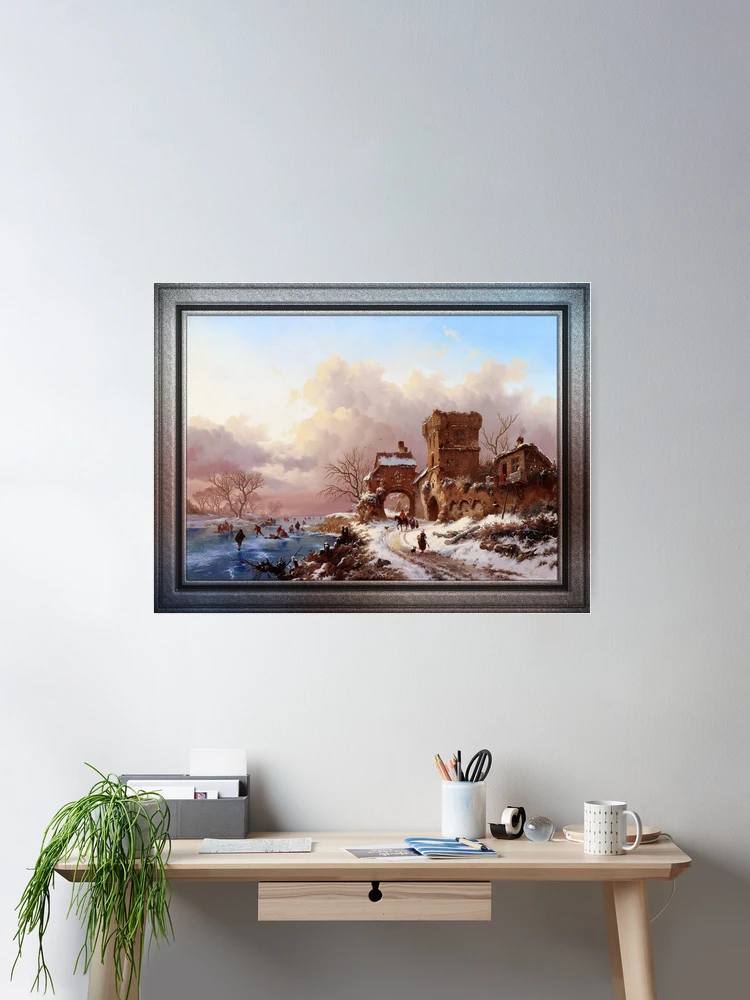
I Winter Landscape With Travelers Near The Town Gate, painted by Frederik Marinus Kruseman (1816 – 1882), the viewer is transported to a serene winter’s day in the 19th century, where the tranquility of the frozen landscape is punctuated by the movements of travelers. This stunning piece, dating from around 1857, exemplifies the Dutch Romanticism style, characterized by its detailed naturalistic approach, its emphasis on the landscape as both a subject of beauty and contemplation, and its carefully composed atmosphere. The artist presents a rich narrative of rural life in the cold months, capturing both the splendor and harshness of winter in a northern European town.
Innehållsförteckning
Huvudämne och komposition
At the heart of the painting is a town gate, acting as the focal point of the composition. This structure, grand and imposing, stands against the backdrop of a serene but somewhat desolate winter scene. The gate leads into a quaint village or town, which is implied but not directly shown in the artwork. On either side of the entrance, towering bare trees stretch their limbs into the cold air, their gnarled branches reaching out toward the sky, their starkness enhanced by the absence of leaves. These trees, mostly without foliage, evoke a sense of dormancy, signifying the depth of winter’s grip.
Just outside the town gate, the ground is blanketed in a layer of snow, its purity highlighted by the faint tinge of sunset light that reflects off its surface. The snow is soft and undisturbed near the gate, but as it stretches farther into the scene, the untouched white is interrupted by travelers on foot, creating dynamic movement within the otherwise still landscape.
Dessa siffror, bundled in winter coats and cloaks, traverse the icy terrain, their heads lowered against the cold wind, adding a sense of realism and humanity to the scene. The scene thus tells a story of daily life during winter, where travel and movement persist despite the frozen conditions.
Föremål och material
The painting’s attention to detail is evident in its depiction of materials. The stone structure of the town gate is textured and weathered, with intricate architectural features that reflect the period’s craftsmanship. The gate itself serves as a symbolic barrier between the bustling life of the town and the expansive, icy wilderness outside. The faint glow from the window of the building atop the gate hints at warmth within, contrasting the harsh cold of the outside world.
The snow is not just a passive element in the scene; Kruseman skillfully uses it to highlight the light effects of the setting sun. The snow, with its delicate, powdery texture, reflects the amber and pale colors of the sky, which gently fade into a soft pinkish hue near the horizon.
Vattnet, visible in the foreground, has a frozen sheen to it, allowing travelers and skaters to glide across its surface. There are figures visible on the ice, engaged in the sport of skating—a pastime synonymous with cold winters in the Low Countries during the 19th century. Figurerna’ motion contrasts with the stillness of the trees and the looming town gate.
Terrain and Surroundings
The surrounding terrain consists of a variety of textures and layers, from the soft snow that covers the ground to the frozen river in the foreground, which adds depth and intrigue to the scene. Floden, partially frozen, reflects the cloudy sky above, while thin cracks in the ice hint at the fragile nature of the winter landscape. I fjärran, the horizon is dominated by the fading light of the sunset, casting a warm glow across the scene that contrasts with the cool tones of the snow and ice.
The snow-covered path that leads to the town gate is marked by the footprints of the travelers, whose dark forms stand out against the pale ground. This path draws the viewer’s eye toward the gate, enhancing the sense of movement within the otherwise quiet scene. Kruseman captures the meticulous nature of winter in the Dutch countryside, using natural elements such as the icy river and leafless trees to convey the quiet solitude of the moment.
Stil och teknik
Kruseman’s mastery of light and shadow is evident in this painting, as he effectively contrasts the warm tones of the sunset against the cooler shades of the winter landscape. Penseln är känslig, with Kruseman’s attention to detail in the depiction of trees, snow, and architecture creating a harmonious balance between realism and artistic expression.
The artist’s use of light plays a significant role in setting the mood of the painting. Den mjuka, diffused light suggests the end of a day, evoking a peaceful and contemplative atmosphere. The viewer is invited to imagine the quiet of the countryside as the sun sets, with the only sounds being the crunch of snow underfoot and the distant voices of the travelers.
The figures in the painting are rendered with a great deal of realism, with Kruseman capturing the naturalistic details of their clothing and movements. The traveler’s cloaks and hats evoke the practical fashion of the time, as they were meant to shield the wearer from the biting cold of winter. The posture of the travelers also adds a sense of realism—heads lowered against the wind, bodies slightly bent as they move through the snow.
Tema och humör
The predominant mood in Winter Landscape With Travelers Near The Town Gate is one of quiet solitude, tempered by the presence of life and motion. The scene captures the interplay between nature and humanity, showing how the people in the painting are subject to the forces of nature, yet continue to move forward despite the harsh winter conditions. There is a sense of resilience in the travelers’ purposeful strides, contrasting with the stillness of the frozen landscape.
This is a portrayal of a community enduring the winter season, yet finding a certain peacefulness within it. The town gate acts as both a literal and symbolic threshold, representing the boundary between the warmth and security of the town and the harshness of the world outside. The traveler’s presence suggests a world beyond the gate, one of movement and passage, yet still part of the larger natural landscape.
I huvudsak, Kruseman’s work reflects a deep reverence for the natural world, capturing the stark beauty of winter while also suggesting the enduring spirit of those who live within it. The painting invokes themes of endurance, tidens gång, and the quiet beauty found in the often-overlooked details of daily life.
Vinterlandskap med resenärer är en retuscherad digital konst gammal mästare reproduktion av en offentlig egendom.
Detta digitala konstskapande, som med alla konstverk som kan hittas på Xzendor7-webbplatsen finns att köpa online i en mängd olika materialformat inklusive canvastavlor, akryltryck, metalltryck, trätryck, inramade tryck, affischer, och som rullade canvastryck i en mängd olika storlekar från 12 tum till 72 tum beroende på storleken på det faktiska konstverket och den print on demand-butik du väljer att köpa konsten från.
Konstverket är också tillgängligt på ett brett utbud av herr- och damkläder, muggar, väskor, halsdukar, anteckningsböcker och tidskrifter och många heminredningsprodukter.
Om konstnären
Info nedan härledd från Wikipedia.org
Frederik fick sina första teckningstimmar av stillebensmålaren Jan Reekers (1790 – 1858), som då var direktör för Royal Acadamy of Fine Arts i Amsterdam; och som också hade lärt sin kusin Jan Adam[ medan han gick på en yrkesskola i Haarlem från 1832 till 1833.
I 1833 han började sedan studera måleri med den holländska målaren, Gravör, Litograf, Akvarellist och illustratör Nicolaas Johannes Roosenboom (1805 – 1880).
Sedan i 1835 han flyttade till Het Gooi i centrala Nertherlands, där han tog avancerade studier med holländska landskapsmålaren Jan van Ravenswaay (1789 – 1869); samt studerade en kort tid med holländska landskapsmålare och litograf Barend Cornelis Koekkoek (1803 – 1862).
Han återvände senare till Haarlem och därifrån till Kleve i nordvästra Tyskland där han målade landskap, innan du återvänder hem 1839.
I 1841 han flyttade till Bryssel och stannade där tills 1852, förutom en kort period på några månader när han åkte till Paris. I 1852 han åkte hem till Haarlem och stannade där i fyra år, varefter han åkte till Belgien, där han stannade till sin död i 1882.