

Chat Time
“Chat Time” do pintor americano Gil Elvgren (1914 – 1980)
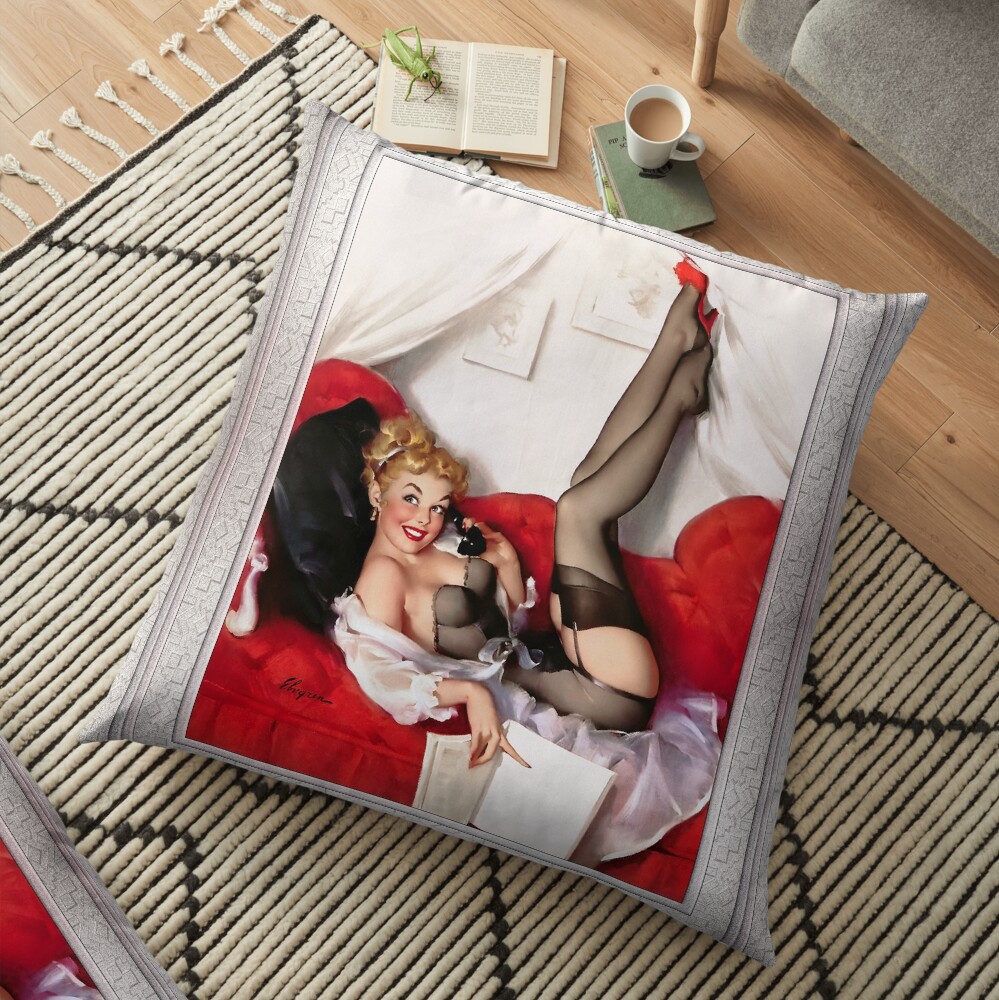
“Chat Time,” created by American artist Gil Elvgren, exemplifies the timeless allure of mid-century pin-up art, capturing the essence of playful flirtation, elegância, and carefree sensuality. Gil Elvgren, known for his masterful portrayals of women in soft, inviting poses, crafted works that showcased idealized beauty and the feminine form. Nasceu em 1914 e passando 1980, Elvgren’s artistic style is steeped in realism and rich with narrative, often focusing on women in domestic, leisure, or comical situations. “Chat Time” não é exceção, illustrating a quintessential moment of feminine allure and charm.
Índice
Main Subject and Mood
The central subject of the painting is a smiling woman in the midst of a telephone conversation. She is reclining comfortably on a plush red couch, her legs elegantly propped up in the air, drawing attention to her gartered stockings and high heels. The model’s playful posture, with one hand holding a vintage telephone receiver and the other draped over a white book, creates a sense of ease and casual confidence. The woman’s expression, a beaming smile and a glint in her eyes, conveys a feeling of joyful anticipation and engagement in her conversation, adding an intimate, personal touch to the scene.
The mood of the painting exudes lightheartedness, charme, and flirtation. The relaxed position of the woman, her easy smile, and the inviting quality of the painting reflect a moment of indulgent leisure, an escape from the pressures of the day. It’s an intimate glimpse into a personal moment, with the viewer invited to observe without interruption. O macio, glowing lighting further enhances this mood, highlighting the subject’s beauty and the relaxed environment surrounding her.
Composition and Materials
Elvgren’s composition in “Chat Time” is carefully designed to guide the viewer’s eye through the scene, balancing the subject with the surrounding elements. The deep red of the couch provides a striking contrast against the soft, neutral tones of the background, which is composed of light cream walls and minimal decorative elements. This serves to center attention on the woman while keeping the focus intimate and personal. The use of a minimalist setting emphasizes the subject’s beauty and the moment she is captured in.
The rich textures of the materials, from the velvet-like softness of the red couch to the delicate sheen of the woman’s sheer lingerie, add a tactile dimension to the artwork. The folds of fabric in her attire suggest a luxurious comfort, while the delicate details of the stockings and high heels reinforce the feminine, elegant mood of the painting. These carefully chosen textures bring a realism to the scene that makes it seem alive, almost as though the woman could step out of the frame at any moment.
Estilo e técnica
“Chat Time” is rendered in the traditional pin-up style, with Elvgren’s characteristic attention to detail in both the human form and the surrounding environment. The artist’s technique employs soft brushwork, creating a smooth finish that enhances the realistic appearance of the subject, while also imparting a dreamlike quality to the scene. Elvgren’s use of light and shadow is masterful, casting gentle highlights on the woman’s face and form to emphasize her youthful, radiant beauty, while soft shadows lend depth and dimension to her figure.
The painter’s skill in capturing the female form is evident in the precise rendering of the woman’s curves and the naturalistic portrayal of her pose. Her limbs are subtly accentuated through gentle highlights and shading, emphasizing the sensuality of her body without overt sexualization. This balance of form and function is a signature trait of Elvgren’s work, where the appeal lies in the suggestion of femininity rather than explicit exposure.
Objects and Setting
The surrounding objects in “Chat Time” are integral to the overall composition and mood of the piece. The plush red couch serves as the focal point of the scene, its rich color creating a striking contrast to the light tones of the woman’s attire and the room’s background. The telephone, an essential prop in the painting, symbolizes communication and connection, adding an element of intimacy and interaction to the scene. The presence of a white book resting in the woman’s hand suggests a casual, comfortable moment, where she might have been reading before being interrupted by the phone call.
The setting itself is sparse, with only the bare essentials of a private room, yet it creates a sense of belonging and warmth. The soft white curtains, flowing gently behind the woman, provide a light, airy backdrop that complements her delicate features. The minimalism of the room draws the viewer’s attention entirely to the subject, enhancing the intimate nature of the painting.
Thematic Significance
Em sua essência, “Chat Time” plays with themes of femininity, domesticity, and casual allure. O assunto, seemingly caught in a moment of playful leisure, is portrayed as both elegant and approachable. She occupies a space between social propriety and flirtation, with her posture suggesting a balance between modesty and openness. This is characteristic of many of Elvgren’s works, where the depiction of women often focuses on their charm, confiança, and beauty in everyday situations.
The telephone, a symbol of communication and connection, subtly implies the notion of private conversation and closeness, hinting at the idea that the woman is involved in a personal or intimate exchange. This adds a layer of narrative to the scene, where the viewer is invited to imagine the nature of the conversation, adding depth to the otherwise simple moment.
Conclusão
Dentro “Chat Time,” Gil Elvgren delivers a moment frozen in time, capturing the beauty, elegância, and charm of a woman enjoying a lighthearted conversation. The painting reflects the sensibilities of the mid-20th century, blending innocence with flirtation in a way that resonates even today. Through his detailed portrayal of the subject, the setting, and the interplay of light and shadow, Elvgren invites viewers to experience a world of beauty and charm, where each curve, cor, and gesture tells a story of youthful allure and timeless elegance.
Esta é uma reprodução remasterizada dos antigos mestres de arte digital de uma imagem de domínio público que está disponível como um impressão em tela.
BIO do artista derivado de Wikipedia.org
e um roupão de babados violeta e azul com corte floral em camadas que ela está segurando perto do peito. e um roupão de babados violeta e azul com corte floral em camadas que ela está segurando perto do peito. e um roupão de babados violeta e azul com corte floral em camadas que ela está segurando perto do peito, e um roupão de babados violeta e azul com corte floral em camadas que ela está segurando perto do peito, e frequentou o colégio universitário. Depois da formatura, ele começou a estudar arte no Minneapolis Institute of Arts.
Mais tarde, ele se mudou para Chicago para estudar na Academia Americana de Arte, e se formou na Academia durante a grande depressão, na idade de vinte e dois.
Após a formatura, Elvgren juntou-se ao grupo de artistas da Stevens and Gross, A agência de publicidade mais prestigiada de Chicago, e tornou-se protegido do artista Haddon Sundblom.
Dentro 1937, Gil começou a pintar pin-ups de calendário para Louis F. Dow, uma das principais editoras da América, durante o qual ele criou sobre 60 pin-up girl trabalha em tela 22 ″ × 28 ″ e distingue-as por uma assinatura impressa.
Muitas de suas pin-ups foram reproduzidas como arte de nariz em aeronaves militares durante a Segunda Guerra Mundial; e foi por volta dessa época em 1944, que Elvgren foi abordado pela Brown and Bigelow Publishing Company; uma empresa que ainda domina o campo na produção de calendários, especialidades de publicidade e mercadoria promocional.
No próximo ano de 1945 até 1972, Elvgren foi associado ao Brown & Editora bigelow, e começou a trabalhar com 24 polegada por 30 telas de polegadas, um formato que ele usaria para o próximo 30 anos, e assinou seu trabalho em letra cursiva.
Elvgren foi um sucesso comercial. Ele morou em vários locais, e esteve ativo de 1930 a 1970. Dentro 1951 ele começou a pintar em um estúdio em sua casa, então em Winnetka, Illinois, usando um assistente para configurar a iluminação, construir adereços e cenas, conjuntos de fotos, e preparar suas tintas.
Seus clientes incluíam empresas conhecidas como Brown e Bigelow, Coca, General Electric e a Sealy Colchões Company, para nomear alguns. Além disso, durante as décadas de 1940 e 1950, ele ilustrou histórias para uma série de revistas, como The Saturday Evening Post e Good Housekeeping.
Entre as modelos e lendas de Hollywood que Elvgren pintou durante sua carreira estava Myrna Hansen, Donna Reed, Barbara Hale, Arlene Dahl, Lola Albright e Kim Novak.