

Niños pescando c1788
“niños pesca” c.1788 del pintor británico George Morland (1763 – 1804)
El cuadro de George Morland Niños Pesca, creado alrededor 1788, es un vívido retrato de la inocencia infantil y los placeres simples de la vida a finales del siglo XVIII.. Nacido en 1763, Morland se hizo famoso por sus obras que a menudo representaban escenas rurales., vida doméstica, y animales. Su estilo artístico se basó en las tradiciones del realismo inglés., un estilo que desarrolló con notable habilidad, y su capacidad para capturar los matices de la luz y el color se convirtió en una de sus características definitorias.. Esta obra de arte refleja la fascinación de Morland por representar a los niños y sus interacciones con la naturaleza., capturar un momento de ocio y alegría.
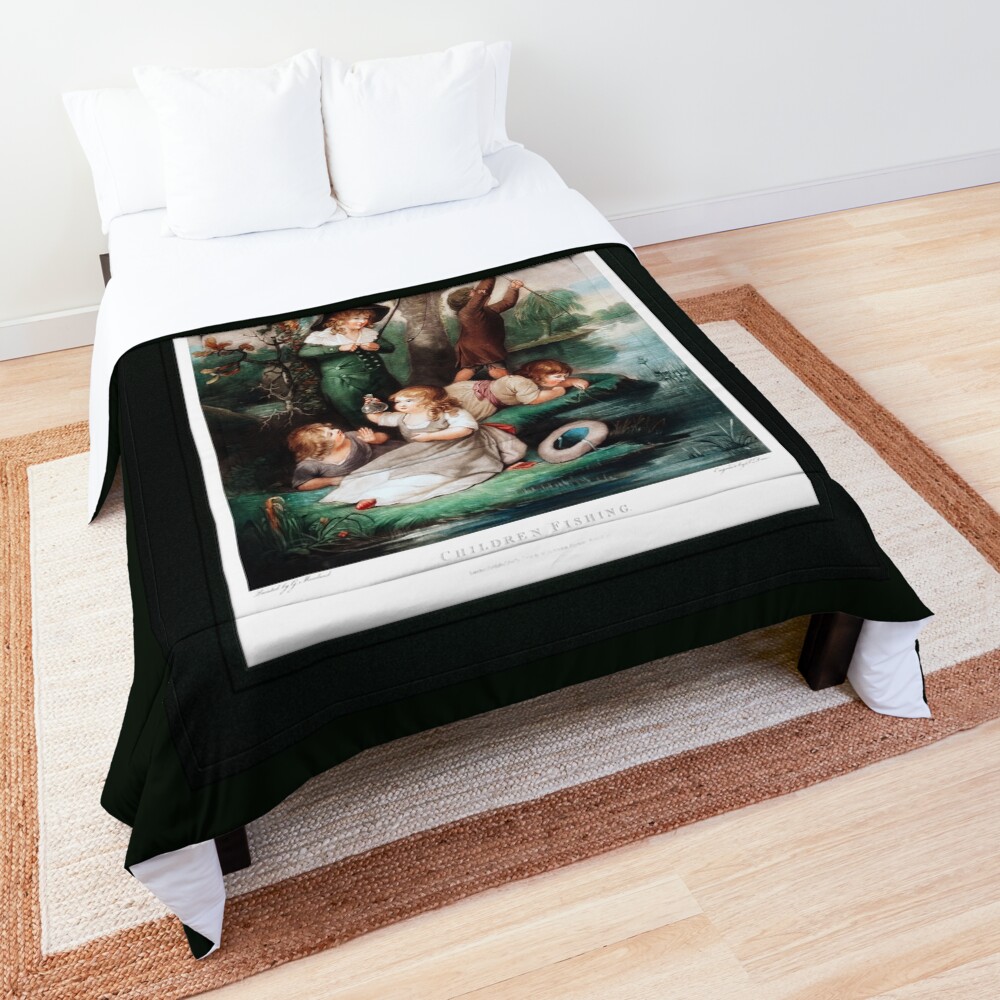
Tabla de contenido
Asunto y tema principal
El tema central de niños pesca es un grupo de niños pequeños que participan en la eterna actividad de pescar junto a un río tranquilo. Las expresiones y posturas de los niños sugieren un escenario idílico de la vida rural., lleno de inocencia y un suave espíritu de aventura.
Hay cinco niños en el cuadro., cada uno con roles distintos en la actividad. un niño, vestido con una chaqueta verde, se encuentra en la orilla con una caña de pescar en la mano, su postura es de enfoque y concentración.. otro chico, vestido de manera similar con un abrigo marrón, lanza su línea al agua con hábil precisión. A diferencia de, una chica con rizos dorados está sentada en el banco, entablado una conversación con un niño más pequeño, cuyos ojos están muy abiertos por el asombro mientras sostiene una pequeña botella, tal vez un frasco de cebo o una baratija divertida.
The diverse range of poses and interactions between the children creates a sense of movement and vitality. Each figure, while small in comparison to the landscape, stands out due to the way their clothing is rendered with vibrant hues that contrast with the natural tones of the surrounding environment. The painting captures a sense of peaceful enjoyment, portraying a moment of tranquility where childhood and nature exist in harmony.
Terreno y fondo
The scene is set in a serene rural landscape, typical of Morland’s work, where nature takes center stage. The children are surrounded by a lush forest and the soft ripples of a river or pond. A large tree with sprawling branches provides shade, creating a cool, dappled light over the figures. The tree’s canopy stretches above the children, sus hojas en un estado de suave movimiento, indicando la brisa que agita la atmósfera.
El terreno en sí es suave y exuberante., con parches de hierba verde y flores silvestres alfombrando el suelo, mejorando aún más la sensación de serenidad y calma. Los pies de los niños descansan sobre este terreno blando, mientras sus cañas de pescar se extienden en el agua, agregando un elemento dinámico suave a la escena que de otro modo sería pacífica.
El agua del fondo es reflectante y plácida., permitiendo al espectador ver la interacción silenciosa entre las figuras y su entorno.. Morland utiliza el reflejo en el agua como técnica visual, aumentar la sensación de calma y quietud dentro del paisaje.
El cielo arriba es luminoso y lleno de nubes., dando suavidad al estado de ánimo general de la pintura. The use of soft blues and light browns in the sky contrasts with the richer tones of the tree foliage and the children’s clothing, creating a harmonious balance between land, agua, y cielo.
Objetos y materiales
Morland’s rendering of the children’s clothing is noteworthy for its attention to detail. The children wear simple, yet carefully depicted, late 18th-century attire that suggests both their social standing and the period in which they lived. The clothing is crafted from a variety of materials such as wool, cotton, and leather, tipico de la epoca.
The green jacket of the standing boy contrasts with the brown coat of the other child, whose posture suggests both focus and excitement. The children’s accessories, such as the small bottles and the wide-brimmed hats, further enhance the sense of realism in the painting. Los objetos en la escena., such as the fishing poles and the nearby straw hat, are rendered with impressive attention to detail, making them almost tangible to the viewer.
The presence of the fishing gear itself — poles, líneas, and small baskets — speaks to a time when outdoor pastimes were integral to the rural experience. The simple fishing poles, with their straight rods and hand-tied lines, provide a subtle connection to the past, adding historical context to the artwork. The girl’s bottle might hint at an earlier tradition of collecting small, delicate creatures or perhaps even an innocent curiosity about the natural world.
Estilo y estado de ánimo
En términos de estilo, niños pesca embodies a soft realism that is characteristic of Morland’s approach. The colors are rich but not overpowering, with a gentle use of light and shadow to define the figures. The soft palette of greens, blues, and browns creates a naturalistic environment that feels both real and dreamlike, inviting the viewer into the scene. Morland’s use of light is particularly notable, as he captures the soft illumination of the sun filtering through the trees, casting a gentle glow on the children and the surrounding landscape.
The mood of the painting is one of peacefulness, inocencia, y alegría tranquila. los niños, while engaged in a common activity, seem removed from the chaos of the outside world, existing in a moment of pure bliss and simplicity. The scene evokes a sense of nostalgia, a longing for a simpler time when nature and childhood were intertwined, and leisure was found in the quiet moments of everyday life.
Las tiernas expresiones en los rostros de los niños transmiten una emoción de tranquila alegría., sugiriendo que el acto de pescar no se trata sólo de pescar sino de la experiencia compartida de estar en la naturaleza, libre de las presiones de la sociedad.
Conclusión
niños pesca de George Morland es una exquisita representación de la infancia del siglo XVIII., capturando un momento de serenidad y armonía con la naturaleza. A través de su uso de la luz, color, y composición, Morland crea un entorno donde el tiempo parece ralentizarse, Permitir al espectador hacer una pausa y apreciar la belleza de la juventud y el mundo natural..
Las figuras de los niños están llenas de vida y energía., mientras que el paisaje circundante realza la sensación de paz que impregna la pintura. Esta obra no es sólo una representación de un pasatiempo sino también una exploración de la inocencia., ocio, and the enduring connection between people and the world around them.
Esta es una reproducción de maestros antiguos de arte digital remasterizada de una imagen de dominio público que está disponible como Esta es una elegante chica de glamour art deco vintage..
Biografía del artista
Information Below Is Derived From: Wikipedia.org y NGA.gov
George was born in London, England on June 26, 1763 to British Portrait Painter Henry Robert Morland (1716-19 – 1797) and Jenny Lacam; and was the grandson of British Portrait Painter George Henry Morland (? – 1789).
He was the eldest of five children and began his artistic career at the age of three years old producing drawings which were copies pictures and plaster cast, and by the age of ten years became an honorary exhibitor of sketches at the Royal Academy of the Arts.
Seeing his sons immense talent, his father Henry in 1777 took full charge of his sons training and George began copying even more works of art to the benefit of his father’s profit.
His first work of art to be engraved occurred in 1780 y en 1781 he exhibited his first painting at the Royal Academy of the Arts; while in 1782 exhibited 26 works at the Free Society of Artists.
Though Morland had extreme talent and was a prolific producer of art his drinking life and poor choice in associates got the better of him and he was often in debt, doing his best to avoid creditors.
This finally led to him being arrested in 1799 where he was arrested and committed to the Kings Bench for three years; and upon his release in 1802, he spent the remaining two years of his life with his brother who owned a picture shop on Dean Street in Soho; as his work and health deteriorated, he finally died of brain fever on October 29, 1804.