

Choosing Her Man
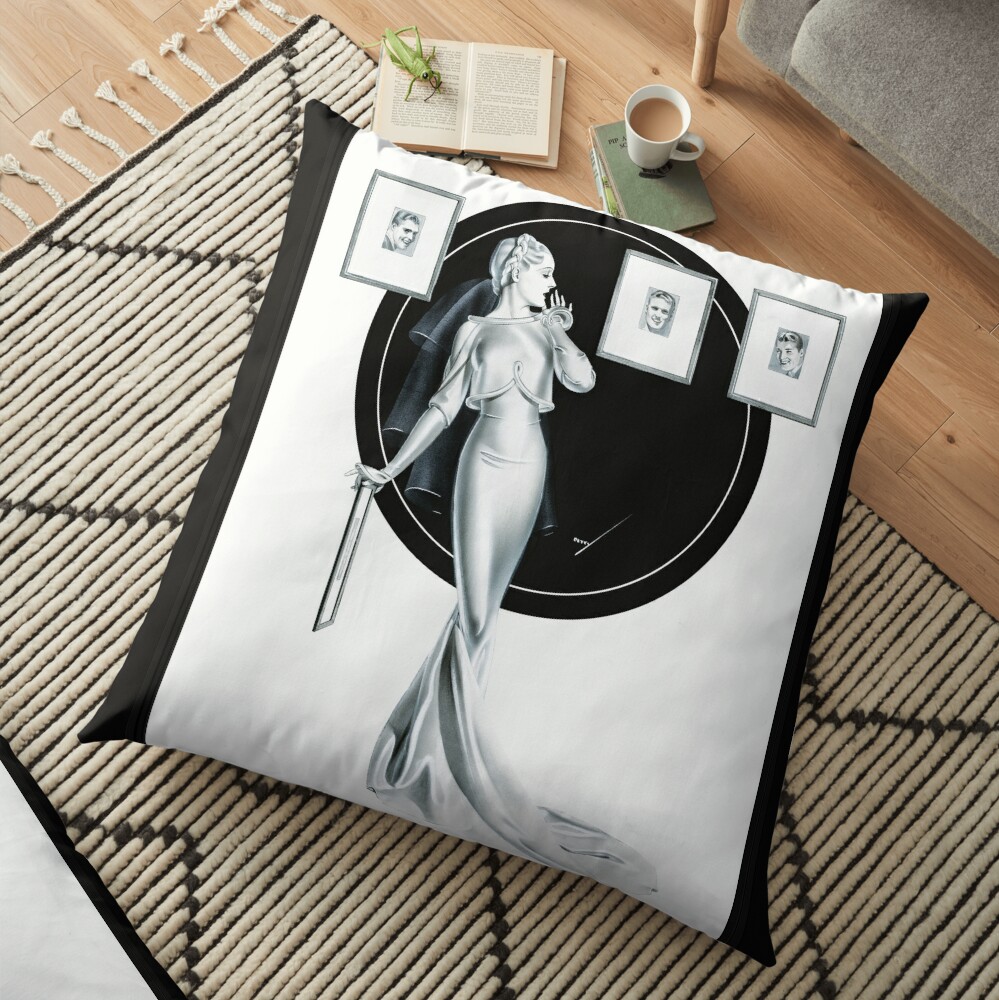
Choosing Her Man, c.1936-37, del pintor nord-americà George Brown Petty IV (1894 – 1975)
“Choosing Her Man,” created by American artist George Brown Petita IV in the years 1936-37, presents an intriguing exploration of femininity and romantic selection in a stylized, almost surreal manner. Known for his pin-up illustrations and commercial art, Petty’s work often emphasizes beauty and idealized forms, focusing on the human figure and its portrayal within carefully constructed scenes. Aquesta peça concreta, steeped in the glamour and visual aesthetics of its era, offers a compelling glimpse into the refined and sensual atmosphere of the late Art Deco period.
Taula de continguts
Assumpte i composició principal
The focal point of this artwork is an elegant, poised woman, her figure rendered with stunning precision and an almost ethereal quality. She stands tall, elegantly composed, in a long, flowing silver gown that contours to her body with impeccable grace. El vestit, designed in a sleek and smooth manner, highlights her poised, confident stature. The model’s hands are delicately placed in a subtle gesture, with one hand gently touching her lips as if in deep contemplation. This pose suggests a moment of hesitation, possibly symbolizing the process of making an important decision — in this case, the act of “choosing her man.”
She is framed by a strong geometric design, with the circular black backdrop drawing the viewer’s attention inward, accentuating the woman’s figure and emphasizing her position as the center of the narrative. Per sobre d'ella, three smaller framed photographs hang on the wall, depicting male portraits. The faces in these frames are subtly evocative, their expressions faintly drawn and almost mysterious. These men serve as the potential suitors, subtly placed within the composition to give a narrative to the woman’s decision-making process. The portraits stand as symbolic representations of the choices that await her, their subtle yet distinct presence adding a layer of psychological depth to the image.
Thematic and Symbolic Elements
The theme of the piece revolves around the idea of choice and romantic selection. The juxtaposition of the female figure with the framed portraits of men brings attention to the emotional and intellectual process of selecting a partner. The model’s contemplative expression suggests internal conflict or thoughtful consideration, presenting the choice as not merely superficial but a deeper, more thoughtful evaluation of each individual. The stark contrast between the bold circular form in the background and the fragile elegance of the woman’s figure speaks to the tension between the decisiveness of the choice and the gentleness of femininity. The work suggests that the decision is not made lightly, but with both elegance and purpose.
El llarg, flowing gown worn by the woman may be seen as a metaphor for the ideal of grace, bellesa, and sophistication — qualities often associated with the feminine ideal of the time. The silver hue of the gown, almost metallic in its shine, connects with the era’s Art Deco aesthetics, where modernity and luxury were often symbolized through such materials. L'ús de llisos, fluid lines in the gown also contrasts with the hard-edged geometric forms that surround the central figure, emphasizing a harmony between femininity and structure.
Estil i estat d'ànim
“Choosing Her Man” is undeniably rooted in the Art Deco style, which dominated the visual arts from the 1920s through the 1940s. The precision, simetria, and elegance of the design align with the aesthetic ideals of the movement, characterized by sleek lines, bold colors, and a fascination with modernity and glamour. Petty’s careful use of black and white, with the occasional silver detail, further reinforces the refined mood of the piece, while the absence of color gives the work a timeless quality. This minimalist approach places emphasis on form and contrast, where the woman’s figure remains the central element amidst the stark background and the framed images.
The mood of the artwork is both contemplative and alluring, with the woman’s expression evoking a sense of quiet introspection. The decision she is facing, represented by the three portraits of men, seems both important and personal. There is a sense of suspense and anticipation, as if the viewer is witnessing a moment of pivotal emotional weight. The stark contrast between the woman’s soft, flowing form and the sharp, geometric lines of the background creates a subtle tension, symbolizing the inner conflict between the emotional and the rational aspects of making a decision.
Objectes, Terreny, i Materials
The physical elements in the piece, such as the woman’s gown, the photograph frames, and the background circle, are all presented with careful precision. The photographs, although not overtly detailed, are intricately framed and placed in such a way as to reinforce the theme of choice and evaluation. They are small and unobtrusive, yet they play an essential role in creating the story within the artwork. The frames themselves are finely detailed, contributing to the luxurious and polished aesthetic of the composition.
The terrain or setting of the piece is minimalistic — an abstracted interior space that prioritizes the visual impact of the figures and forms over the realism of a traditional setting. The lack of other physical details suggests that the scene is more about the emotional and intellectual climate of the moment rather than a depiction of a specific, physical location.
Petty’s use of materials is also noteworthy. The monochromatic color scheme, punctuated only by the metallic sheen of the woman’s gown, adds a sense of high-class sophistication. The style and treatment of the image resemble the polished look of commercial art and fashion illustrations of the era, designed to appeal to the upper-class sensibilities of the time.
Conclusió
“Choosing Her Man” by George Brown Petty IV (c. 1936-37) is a striking piece that embodies the elegance and sophistication of the Art Deco era. Through the careful portrayal of a woman poised in the act of selecting a partner, Petty examines the intersection of femininity, choice, and allure. The artwork speaks to the emotional complexity of romantic decision-making while showcasing the artist’s mastery of form, composició, i profunditat temàtica. With its precise execution and thoughtful symbolism, “Choosing Her Man” remains a powerful reflection of its time and a timeless commentary on the delicate process of selection in matters of the heart.
Aquesta és una reproducció de mestres antics d'art digital remasteritzada d'una imatge de domini públic que està disponible com a impressió de llenç en línia..
Artista Bio
Informació a continuació derivada de Wikipedia.org
El primer de George Petty va arribar a l’atenció del públic durant els anys de secundària, on va ser l’artista del diari escolar.
Mentre anava a l'escola secundària, George es va inscriure a classes nocturnes a l'Acadèmia de Belles Arts de Chicago sota la tutela de Ruth VanSickle Ford..
Mentre estava a l'acadèmia, George va impartir el seu propi curs de dibuix, cobrant als seus companys de classe cinc dòlars per sessió; a més de treballar a la botiga de fotografia del seu pare, on va aprendre l’habilitat d’utilitzar un aerògraf.
Més tard George va anar a París i va estudiar a l'Académie Julian amb Jean-Paul Laurens i altres fins 1916, quan va esclatar la Primera Guerra Mundial, cosa que va provocar l'ambaixador Myron T.. Herrick, per ordenar a tots els nord-americans que marxin de París i tornin als Estats Units.
Després de tornar als Estats Units, George va treballar com a retocador d’aerògrafs en una impremta local de Chicago; més tard es va establir com a artista independent, pintant noies del calendari i portades de revistes per a The Household; i per 1926 havia obert el seu propi estudi.
George és especialment conegut per la sèrie de pintures de noies pin-up de Petty Girl que va fer per a Esquire Publications, de la tardor de 1933 a través 1956.
George representava amb freqüència les seves noies pin-up amb les cames relativament llargues, i caps relativament més petits que els seus models actuals.
La seva obra va aparèixer principalment a la publicació d’Esquire i Fawcett – True també conegut com a True, La revista de l’home; però també es trobava als calendaris comercialitzats per Esquire, True and the Ridgid Tool Company de North Ridgeville, Ohio, que es va fundar a 1923.