

Choosing Her Man
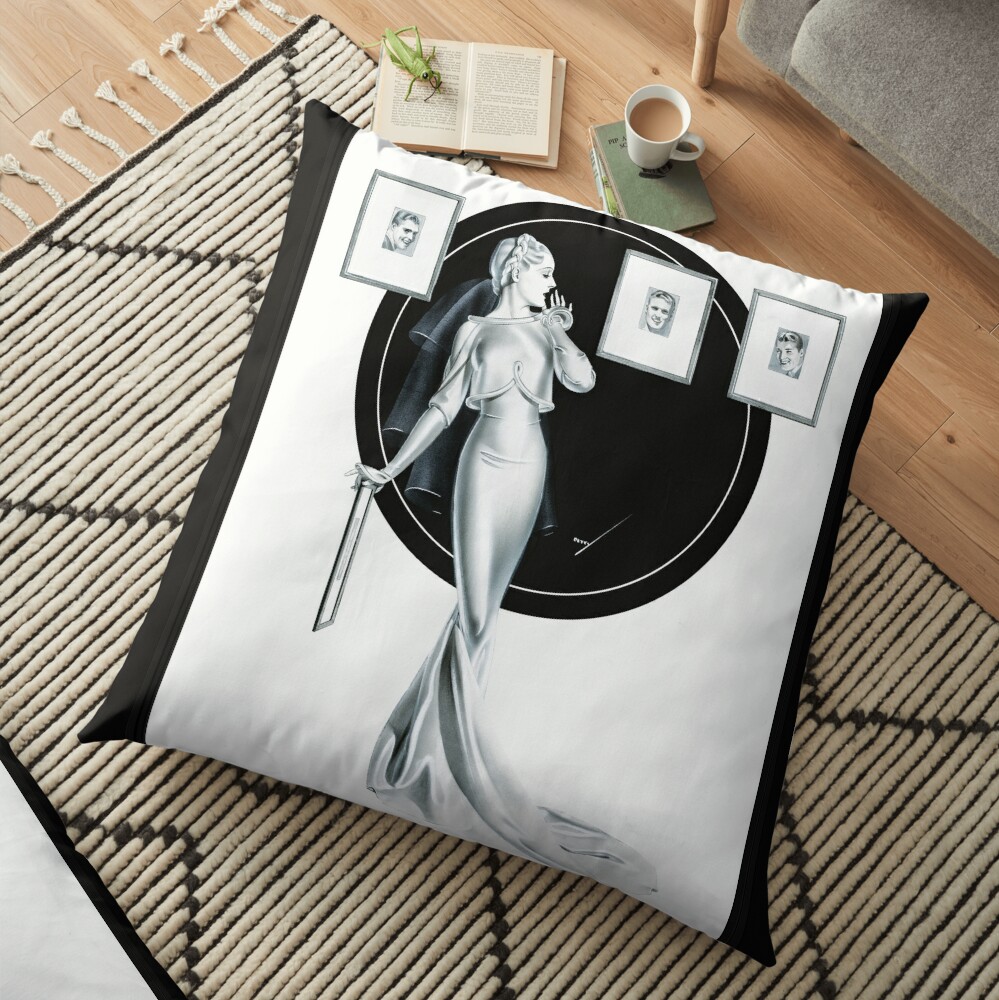
Choosing Her Man, c.1936-37, troch Amerikaanske skilder George Brown Petty IV (1894 – 1975)
“Choosing Her Man,” created by American artist George Brown Petty IV in the years 1936-37, presents an intriguing exploration of femininity and romantic selection in a stylized, almost surreal manner. Known for his pin-up illustrations and commercial art, Petty’s work often emphasizes beauty and idealized forms, focusing on the human figure and its portrayal within carefully constructed scenes. Dit bysûndere stik, steeped in the glamour and visual aesthetics of its era, offers a compelling glimpse into the refined and sensual atmosphere of the late Art Deco period.
Ynhâldsopjefte
Haadûnderwerp en komposysje
The focal point of this artwork is an elegant, poised woman, her figure rendered with stunning precision and an almost ethereal quality. Se stiet heech, elegantly composed, in a long, flowing silver gown that contours to her body with impeccable grace. De jurk, designed in a sleek and smooth manner, highlights her poised, confident stature. The model’s hands are delicately placed in a subtle gesture, with one hand gently touching her lips as if in deep contemplation. This pose suggests a moment of hesitation, possibly symbolizing the process of making an important decision — in this case, the act of “choosing her man.”
She is framed by a strong geometric design, with the circular black backdrop drawing the viewer’s attention inward, accentuating the woman’s figure and emphasizing her position as the center of the narrative. Boppe har, trije lytsere framed foto's hingje oan 'e muorre, manlike portretten ôfbyldzje. De gesichten yn dizze frames binne subtyl evokatyf, harren útdrukkings swak tekene en hast mysterieuze. Dizze manlju tsjinje as de potinsjele oanbidders, subtyl pleatst binnen de komposysje om in ferhaal te jaan oan it beslútfoarmingproses fan de frou. De portretten steane as symboalyske foarstellings fan de karren dy't op har wachtsje, harren subtile noch ûnderskate oanwêzigens tafoegjen fan in laach fan psychologyske djipte oan it byld.
Thematic and Symbolic Elements
It tema fan it stik draait om it idee fan kar en romantyske seleksje. De njonkenstelling fan 'e froulike figuer mei de framed portretten fan manlju bringt omtinken foar it emosjonele en yntellektuele proses fan it selektearjen fan in partner. The model’s contemplative expression suggests internal conflict or thoughtful consideration, presenting the choice as not merely superficial but a deeper, more thoughtful evaluation of each individual. The stark contrast between the bold circular form in the background and the fragile elegance of the woman’s figure speaks to the tension between the decisiveness of the choice and the gentleness of femininity. The work suggests that the decision is not made lightly, but with both elegance and purpose.
The long, flowing gown worn by the woman may be seen as a metaphor for the ideal of grace, skientme, and sophistication — qualities often associated with the feminine ideal of the time. The silver hue of the gown, almost metallic in its shine, connects with the era’s Art Deco aesthetics, where modernity and luxury were often symbolized through such materials. The use of smooth, fluid lines in the gown also contrasts with the hard-edged geometric forms that surround the central figure, emphasizing a harmony between femininity and structure.
Styl en stimming
“Choosing Her Man” is undeniably rooted in the Art Deco style, which dominated the visual arts from the 1920s through the 1940s. The precision, symmetry, and elegance of the design align with the aesthetic ideals of the movement, characterized by sleek lines, fet kleuren, and a fascination with modernity and glamour. Petty’s careful use of black and white, with the occasional silver detail, further reinforces the refined mood of the piece, while the absence of color gives the work a timeless quality. This minimalist approach places emphasis on form and contrast, where the woman’s figure remains the central element amidst the stark background and the framed images.
The mood of the artwork is both contemplative and alluring, with the woman’s expression evoking a sense of quiet introspection. The decision she is facing, represented by the three portraits of men, seems both important and personal. There is a sense of suspense and anticipation, as if the viewer is witnessing a moment of pivotal emotional weight. The stark contrast between the woman’s soft, flowing form and the sharp, geometric lines of the background creates a subtle tension, symbolizing the inner conflict between the emotional and the rational aspects of making a decision.
Foarwerpen, Terrein, en Materialen
The physical elements in the piece, such as the woman’s gown, the photograph frames, and the background circle, are all presented with careful precision. The photographs, although not overtly detailed, are intricately framed and placed in such a way as to reinforce the theme of choice and evaluation. They are small and unobtrusive, yet they play an essential role in creating the story within the artwork. The frames themselves are finely detailed, contributing to the luxurious and polished aesthetic of the composition.
The terrain or setting of the piece is minimalistic — an abstracted interior space that prioritizes the visual impact of the figures and forms over the realism of a traditional setting. The lack of other physical details suggests that the scene is more about the emotional and intellectual climate of the moment rather than a depiction of a specific, physical location.
Petty’s use of materials is also noteworthy. The monochromatic color scheme, punctuated only by the metallic sheen of the woman’s gown, adds a sense of high-class sophistication. The style and treatment of the image resemble the polished look of commercial art and fashion illustrations of the era, designed to appeal to the upper-class sensibilities of the time.
Konklúzje
“Choosing Her Man” by George Brown Petty IV (c. 1936-37) is a striking piece that embodies the elegance and sophistication of the Art Deco era. Through the careful portrayal of a woman poised in the act of selecting a partner, Petty examines the intersection of femininity, choice, en allure. The artwork speaks to the emotional complexity of romantic decision-making while showcasing the artist’s mastery of form, komposysje, and thematic depth. Mei syn krekte útfiering en trochtochte symbolyk, “Choosing Her Man” bliuwt in krêftige ôfspegeling fan syn tiid en in tiidleas kommentaar op it delikate proses fan seleksje yn saken fan it hert.
Dit is in remastered digitale keunst âlde masters reproduksje fan in ôfbylding yn it iepenbier domein dy't te krijen is as doekprint online.
Artist Bio
Info hjirûnder ôflaat fan Wikipedia.org
George Petty's kaam foar it earst yn 'e publike oandacht tidens syn middelbere skoaljierren, dêr't er personielskeunstner wie foar de skoalkrante.
Wylst hy nei middelbere skoalle gie, skreau George him yn foar nachtlessen oan 'e Chicago Academy of Fine Arts ûnder lieding fan Ruth VanSickle Ford.
Wylst op 'e akademy George learde syn eigen tekenkursus, it opladen fan syn klasgenoaten fiif dollar per sesje; en ek wurke yn 'e fotografywinkel fan syn heit wêr't hy de feardigens learde om in airbrush te brûken.
Letter gie George nei Parys en studearre oan 'e Académie Julian mei Jean-Paul Laurens en oaren oant 1916, doe't de Earste Wrâldoarloch útbruts, wat feroarsake ambassadeur Myron T. Herrick, om alle Amerikanen te bestellen om Parys te ferlitten en werom te gean nei de Feriene Steaten.
Nei werom nei de Feriene Steaten, George wurke as airbrush retoucher by in pleatslik drukkerij yn Chicago; letter fêstige him as freelance keunstner, skildere kalinder famkes en tydskrift covers foar The Household; en by 1926 hy hie syn eigen atelier iepene.
George is benammen bekend fan 'e Petty Girl-searje fan pin-up girl-skilderijen dy't hy die foar Esquire Publications, fan 'e hjerst fan 1933 troch 1956.
George skildere faaks syn pin-up famkes mei relatyf lange skonken, en relatyf lytsere hollen as dy fan syn eigentlike modellen.
Syn wurk ferskynde primêr yn Esquire en Fawcett Publication's – True ek bekend as True, The Man's Magazine; mar wie ek yn kalinders ferkocht troch Esquire, True en de Ridgid Tool Company fan Noard Ridgeville Ohio, dat waard oprjochte yn 1923.