

Christus in de storm op de Zee van Galilea
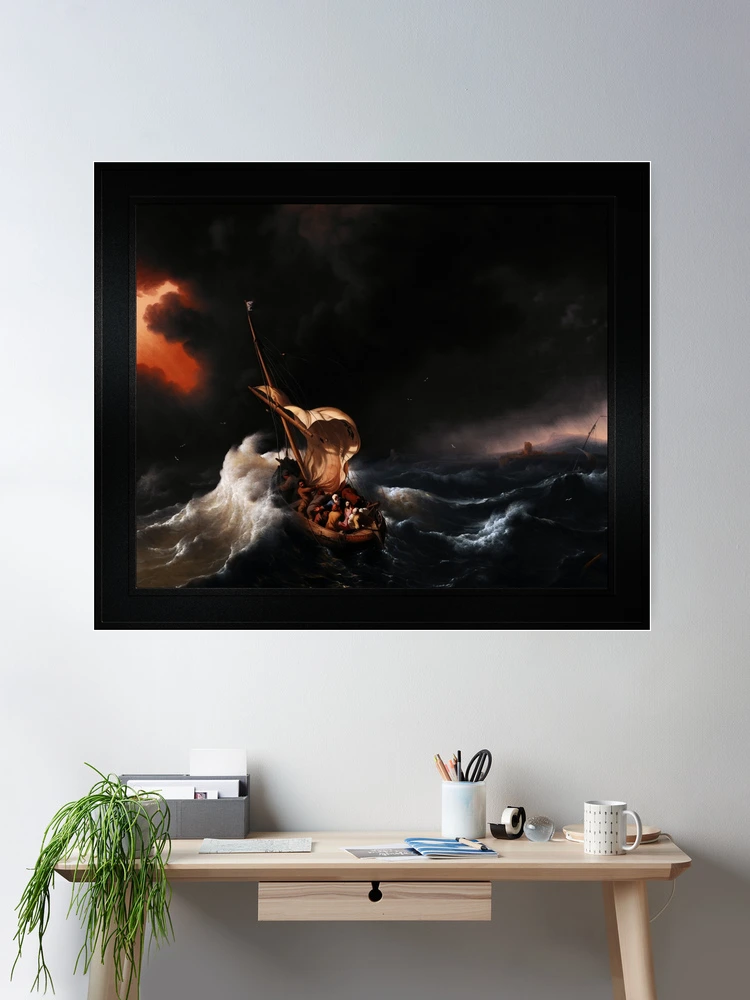
Het kunstwerk getiteld “Christus in de storm op de Zee van Galilea”, gemaakt in 1695 by the German-Dutch painter Ludolf Backhuysen (1630 – 1708), powerfully conveys a dramatic moment of biblical history. Backhuysen, known for his skillful mastery of maritime landscapes, utilizes his expertise to depict both the ferocity of nature and the calm authority of Christ amidst a violent storm. This painting is part of a broader tradition of maritime paintings during the Dutch Golden Age, with a specific focus on the themes of human struggle against nature, goddelijke tussenkomst, and the Christian narrative.
Inhoudsopgave
Main Subject and Narrative
The primary subject of the painting is the biblical story from the Gospel of Matthew, where Jesus Christ calms the storm on the Sea of Galilee. Backhuysen chooses to focus on the intense moment of chaos aboard the boat, capturing the panic of the disciples and the calm demeanor of Christ. Op de voorgrond, the viewer sees a group of men, likely disciples, struggling against the wind and waves. Their expressions reveal fear and desperation as the storm rages around them. The turbulent sea, dark clouds, and relentless waves all serve to heighten the sense of danger that envelops the boat.
Amidst the turmoil, Christ remains serene and composed, the central figure of the composition. His presence is both reassuring and commanding, symbolizing divine authority over nature and the human condition. The artist uses the contrast between the violent sea and the peaceful figure of Christ to underscore the miraculous nature of the event. Christ’s stillness contrasts with the frenetic energy of the storm, making His divine role clear.
Objecten en symboliek
The boat itself is a critical object in this piece, representing both the literal vessel in the biblical story and the symbolic “ship” of the Christian church navigating through the turbulent waters of the world. The ship is crafted with great detail, and the artist’s ability to render the movement of the water around it adds a sense of realism. The storm is not just a natural occurrence, but also a visual metaphor for the trials and tribulations of life, which are often beyond human control.
The figures in the boat are also symbolic. The disciples, depicted in various stages of panic and struggle, reflect the human response to overwhelming challenges. One figure leans over the edge of the boat, possibly to throw up, while another clutches the mast, his face twisted in fear. These expressions of human vulnerability are contrasted by Christ’s calmness, suggesting faith and the belief that divine intervention will provide salvation.
aanvullend, the elements of the storm—raging waves, dark clouds, and flashes of lightning—add to the intensity of the scene. The dark sky, with its dramatic lighting, represents the chaotic forces of nature and, metaphorically, the trials of life. Yet the light breaking through the clouds hints at hope and the divine presence that promises peace and guidance.
Terrein en materialen
The scene unfolds on the turbulent waters of the Sea of Galilee, welke, in Backhuysen’s portrayal, are dark, foamy, and churning. The waves are masterfully painted, showing a range of textures from the frothy white caps to the deep, threatening blue and green depths. The artist’s command of light is particularly notable in the way it reflects off the surface of the water and highlights the contours of the figures, lending a sense of realism to the otherwise supernatural scene.
De lucht, a striking backdrop to the action, is filled with ominous dark clouds, their heavy masses suggesting the sheer power and chaos of the storm. The dramatic interplay of light and dark contributes to the overall mood of the painting, amplifying the tension in the narrative. A small area of light appears through a break in the clouds, potentially indicating the divine presence, adding an aura of hope amidst the turmoil.
Stijl, Thema, en stemming
Ludolf Backhuysen’s style is one of the defining characteristics of the Dutch Golden Age. Known for his ability to capture the mood and texture of the sea, Backhuysen demonstrates an extraordinary talent for conveying motion and emotion. The turbulence of the water, the billowing sails, and the energy of the storm all exhibit a mastery of the seascape genre.
The theme of the painting merges the natural with the divine, showing human struggle against the overpowering forces of nature, only to be saved through divine intervention. The mood is one of awe and reverence, evoking a sense of the sublime in the viewer. The dynamic clash between the forces of the storm and the calm figure of Christ is a powerful visual metaphor for faith, trust, and divine power.
Het kleurenpalet, while dominated by darker hues of stormy skies and deep ocean blues, also contains areas of lighter tones that reflect the divine light shining through the chaos. The contrast between light and dark creates a dramatic tension in the composition, emphasizing the miracle at the heart of the scene.
In terms of technique, Backhuysen uses fine brushwork to create a vivid depiction of the storm, with each wave and cloud rendered in intricate detail. The fluidity of the water and the dramatic effects of the sky demonstrate Backhuysen’s technical prowess and his ability to transport the viewer into the heart of the storm.
Conclusie
“Christus in de storm op de Zee van Galilea” by Ludolf Backhuysen stands as a testament to both the artistic skill of the artist and the theological depth of the subject matter. The painting is a dramatic visualization of the biblical narrative, combining natural and divine elements in a way that speaks to the viewer on both an emotional and spiritual level. The intensity of the storm, the vulnerability of the disciples, and the calm authority of Christ all combine to create a powerful visual experience, offering a meditation on faith, divine protection, and human endurance.
A Back Story Of The Artwork
Dit blijkt een werk te zijn dat gekopieerd is van Rembrandt van Rijn (1606 – 1669) deel, “De Storm op het Meer van Galilea c1633″.
Terwijl de originele versie gemaakt door Rembrandt is van dichtbij met de hele focus op de boot met Jezus en zijn 12 discipelen in de boot met hem; deze versie heeft een veel bredere kijk.
Deze versie toont Jezus in de zeilboot met een extra 8 Heren, omdat het op zijn kant wordt geslagen door een grote golf; en rechts van het tafereel zien we een deel van een mast uit het water steken en verder naar achteren nog een zeilboot gevangen in de zeestorm.
In de verte zien we twee bouwwerken op enkele kilometers van elkaar aan de kust, enkele bergen achter een van de structuren en grote donkere onweerswolken met een kleine open plek in de wolken die oranje van kleur is vanwege de zon; terwijl de boot wordt verlicht door een helder wit licht.
Christus in de Storm op de Zee van Galilea is een geremasterde reproductie van digitale kunst oude meesters van een afbeelding uit het publieke domein die beschikbaar is als een canvas print online.
Deze digitale kunstcreatie, zoals bij alle kunstwerken die op de Xzendor7-website te vinden zijn, is deze online te koop in verschillende materiaalformaten, waaronder canvasafdrukken, acryl afdrukken, metalen prints, hout prints, ingelijste afdrukken, affiches, en zoals opgerolde canvasafdrukken in verschillende maten uit 12 inch tot 72 inch, afhankelijk van de grootte van het daadwerkelijke kunstwerk en de print on demand-winkel waar je de kunst wilt kopen.
Het artwork is ook beschikbaar op een breed scala aan heren- en dameskleding, mokken, bakken, sjaals, notitieboekjes en tijdschriften en veel woondecoratieproducten.
Bio -kunstenaar
Onderstaande informatie afgeleid van: Wikipedia.org
Ludolf werd geboren in Emden, Oost-Friesland, een lagere regio in Nedersaksen Duitsland in 1630 en op ongeveer de leeftijd van 20 ging naar Amsterdam, Nederland en kreeg een baan als kalligraaf en koopmansklerk.
Het was in deze tijd dat hij ontdekte dat hij een groot talent voor schilderen had, en wijdde daarom zijn tijd aan dit streven, zijn huidige baan verlaten; aanvankelijk pentekeningen en ook studerend bij de eminente Nederlandse Gouden Eeuw-schilders Allaert van Everdingen (1621 – 1675), een schilder, graficus en etser evenals Hendrick Dubbels (1621 – 1707), een zee- en winterlandschapsschilder.
Als natuurstudent ging Ludolf vaak de zee op in een open boot om de aard van de golven te bestuderen tijdens stormgebeurtenissen; aangezien zijn belangrijkste focus op zeekunst lag, met de nadruk op scènes met stormachtige oceaangolven.