

Consuelo Vanderbilt c1906
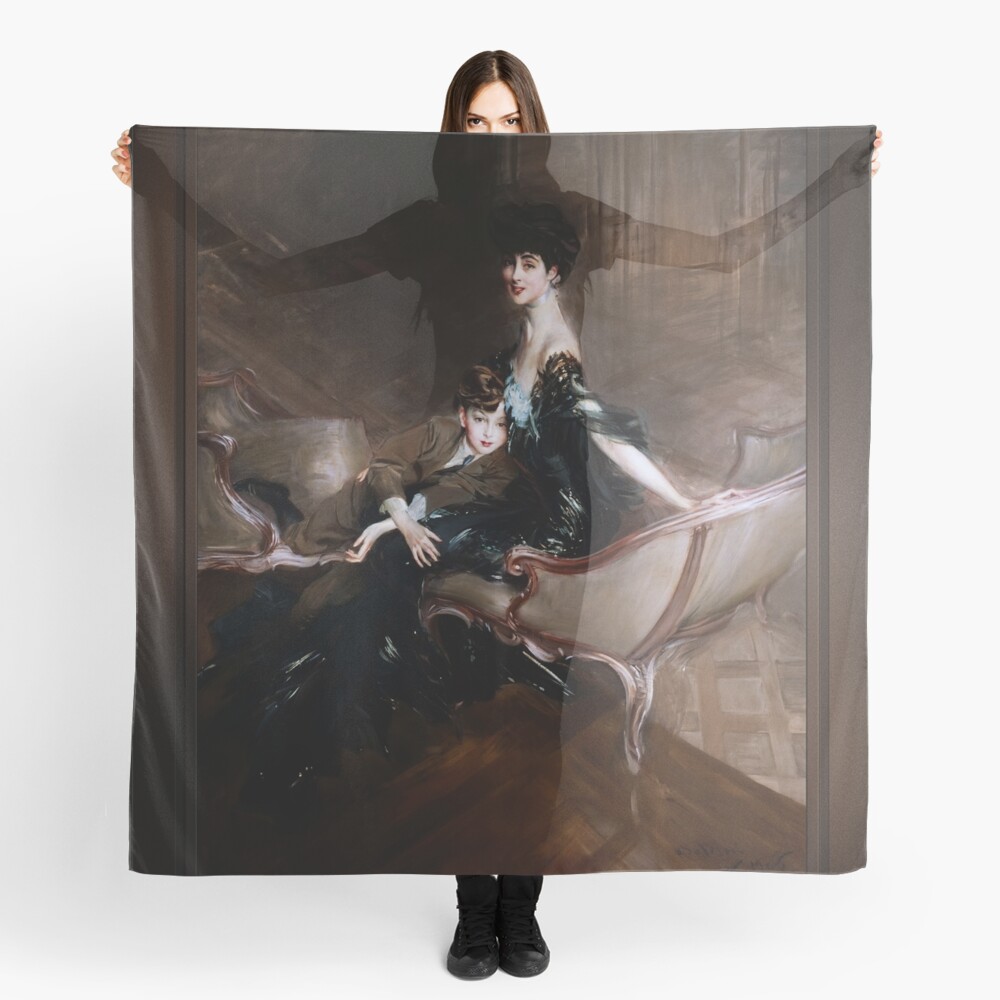
그림 “Consuelo Vanderbilt c1906” 이탈리아의 유명한 화가의 작품 조반니 볼디니 (1842 – 1931) offers a striking glimpse into the world of opulence, 우아함, and aristocratic culture at the turn of the 20th century. 이 초상화에서, Boldini captures the elegance and poise of Consuelo Vanderbilt (1876 -1964), Duchess of Marlborough, and Her Son, Lord Ivor Spencer-Churchill (1898 – 1956), an American heiress who was one of the most admired figures of her time.
이 걸작, 주위에 만들어졌습니다 1906, exemplifies the sophisticated charm and dynamism of the Belle Époque period, an era that was characterized by prosperity, 아름다움, and refined social circles. The portrait exudes a sense of timeless glamour, blending traditional portraiture with the modern techniques of the time, establishing Boldini as a master of his craft.
목차
주요 주제 및 구성
The focal point of the painting is Consuelo Vanderbilt herself, portrayed seated gracefully on a chaise longue. She is elegantly dressed in a black gown that shimmers with opulence, its billowing fabric almost flowing out of the canvas. The texture of the fabric is expertly rendered, capturing the luxurious quality of the material. Boldini’s use of broad, fluid brushstrokes lends the gown a sense of movement, as if the dress is caught in a moment of motion. 부드러움 사이의 대비, flowing black fabric and the sharp details of Consuelo’s serene yet poised expression creates a striking balance between formality and vivacity.
Vanderbilt’s posture is one of relaxed confidence, exuding an aristocratic composure. 그녀의 자세, with one arm placed delicately over the back of the chaise longue, contributes to the overall elegant demeanor. In the painting, she is seen looking slightly to the side, a gentle smile gracing her lips, suggesting an air of mystery and quiet introspection. 그녀의 검은 머리, swept into an intricate updo, frames her face delicately, while the diamond earrings that dangle from her ears shimmer with understated elegance.
Beside Consuelo, sitting somewhat closer to her, is her son. The child is dressed in a brown suit, contrasting sharply with the grandeur of Vanderbilt’s attire. The child’s expression appears somewhat pensive, with a relaxed posture that mirrors the woman’s grace. This inclusion of the child adds a layer of narrative depth, symbolizing the continuation of the Vanderbilt legacy and perhaps hinting at the familial relationships that were often central to the societal dynamics of that time.
The Surrounding Environment and Objects
The background of the portrait is a softly blurred, almost abstract depiction of a lavish interior. The rich brown tones and the hazy light suggest a warm, luxurious atmosphere. The lack of specific detailing in the background, where the figure of the chaise longue blends into the undefined surroundings, directs the viewer’s focus entirely on the figures of Consuelo and her child. This technique exemplifies Boldini’s skill in emphasizing the human subjects while creating a sense of depth and sophistication in the overall composition.
The chaise longue itself is an elegant piece of furniture, upholstered in soft, muted tones, which complements the color palette of the entire painting. Its curved, sweeping lines are emblematic of the furniture styles that were popular during the late 19th and early 20th centuries, emphasizing a luxurious lifestyle. The gently reflective surface of the polished wood of the chair adds a slight gleam, catching the viewer’s eye. 하지만, the furniture does not detract from the figures at the center of the portrait; 꽤, it serves to frame them within the setting of a grand, aristocratic home.
스타일, 기술, 그리고 기분
Boldini’s style is immediately recognizable for its fluidity, 활력, 그리고 운동. He was known for his masterful brushwork and ability to convey motion and life through the manipulation of light and shadow. 이 초상화에서, the brushstrokes are dynamic and expressive, creating a sense of immediacy and energy. While the detailed areas, such as the face and hands of Consuelo, show the artist’s attention to realism, the flowing gown and background elements are treated with a freer, almost impressionistic technique.
The mood of the portrait is one of serene sophistication. Consuelo’s relaxed yet poised demeanor, 소프트함과 결합된, inviting tones of the painting, conveys a sense of calm confidence and timeless beauty. The portrait does not try to overemphasize any particular emotion, but rather captures the subject at a moment of tranquility, possibly reflecting her position in society as a woman of great wealth and influence. The inclusion of the child suggests that the figure of the mother is one of both personal and familial importance, further enhancing the aristocratic atmosphere of the scene.
Boldini’s work is also marked by his ability to integrate the subject into the environment, making the background and surroundings essential to the narrative of the portrait. The slightly abstract treatment of the background allows the viewer to focus more on the subject while still giving the impression of a luxurious setting. The interplay between the formal portrait style and the more dynamic brushwork is characteristic of Boldini’s approach, making this work a powerful example of the Italian painter’s legacy.
The Legacy of Giovanni Boldini
Giovanni Boldini was an Italian painter who spent much of his career in Paris, where he became known for his portraits of the high society. His subjects were often wealthy and influential individuals, much like Consuelo Vanderbilt, who was a prominent figure in both American and European aristocracy. Boldini’s portraits are known for their graceful fluidity, exquisite technique, and emphasis on elegance and refinement. He captured the spirit of his time with a sense of movement and drama, making him one of the most celebrated portrait painters of the late 19th and early 20th centuries.
“Consuelo Vanderbilt c1906” is a prime example of Boldini’s ability to merge realism with an almost painterly abstraction. Through his vibrant brushwork and subtle tonal contrasts, he immortalized his subject not only as an individual but also as a reflection of the social and cultural environment in which she lived. The portrait remains a testament to the grandeur of the Belle Époque era, showcasing both the artist’s technical skill and his ability to capture the essence of his subjects.
이것은 공개 도메인 이미지의 리마스터링된 디지털 아트 올드 마스터 복제입니다. 캔버스 프린트 온라인.
유래 된 아티스트 바이오 Wikipedia.org
볼디니는 페라라에서 태어났습니다., 12월의 이탈리아 31, 1842, 종교적 주제의 화가의 아들에게. 에 1862 세의 나이에 20, 그는 그림을 공부하고 공부하기 위해 6년 동안 피렌체에 갔다..
그는 Academy of Fine Arts의 수업에 드물게 참석했습니다., 하지만 피렌체에서, Macchiaioli로 알려진 다른 사실주의 화가를 만났습니다., 인상주의의 이탈리아 선구자.
그들의 영향은 자연에 대한 그의 자발적인 반응을 보여주는 Boldini의 풍경에서 볼 수 있습니다., 그가 가장 잘 알려진 것은 그의 초상화 때문이지만
런던으로 이사, Boldini는 초상화가로서 성공을 거두었습니다.. 홀랜드 부인과 웨스트민스터 공작부인을 비롯한 사회 주요 인사들의 초상화를 완성했다..
에 1872 그는 파리로 이사했다, 에드가 드가를 만나 친구가 된 곳. 19세기 후반에 그는 파리에서 가장 세련된 초상화가가 되었습니다., Macchiaioli 영향의 일부를 강조하는 멋진 스타일의 그림과 젊은 예술가의 작품을 연상시키는 브리오, John Singer Sargent 및 Paul Helleu와 같은.
에 1889, 그는 파리 박람회 이탈리아 섹션의 커미셔너로 지명되었습니다., 이 임명으로 Légion d' honneur를 받았습니다.. 에 1897 뉴욕에서 개인전을 가졌다.; 그리고 베니스 비엔날레에도 참가했다. 1895, 1903, 1905, 과 1912.