

cresida
Introduction and Overview La retrato artwork “cresida” by British painter Edward John Poynter (1836 – 1919), painted in the 19th century, showcases the artist’s expertise in capturing figures from classical mythology and Shakespearean drama with the refined techniques of the Academic tradition. This piece depicts the tragic figure of Cressida from Shakespeare’s Troilus and Cressida, a character whose beauty and emotional complexity have fascinated many artists. Poynter’s rendering of her, bathed in soft light and delicate hues, invites the viewer to step into a moment of quiet reflection, capturing her vulnerability and emotional depth. La pintura, executed with precision and an almost photographic level of detail, draws upon classical themes, blending realism with allegory.
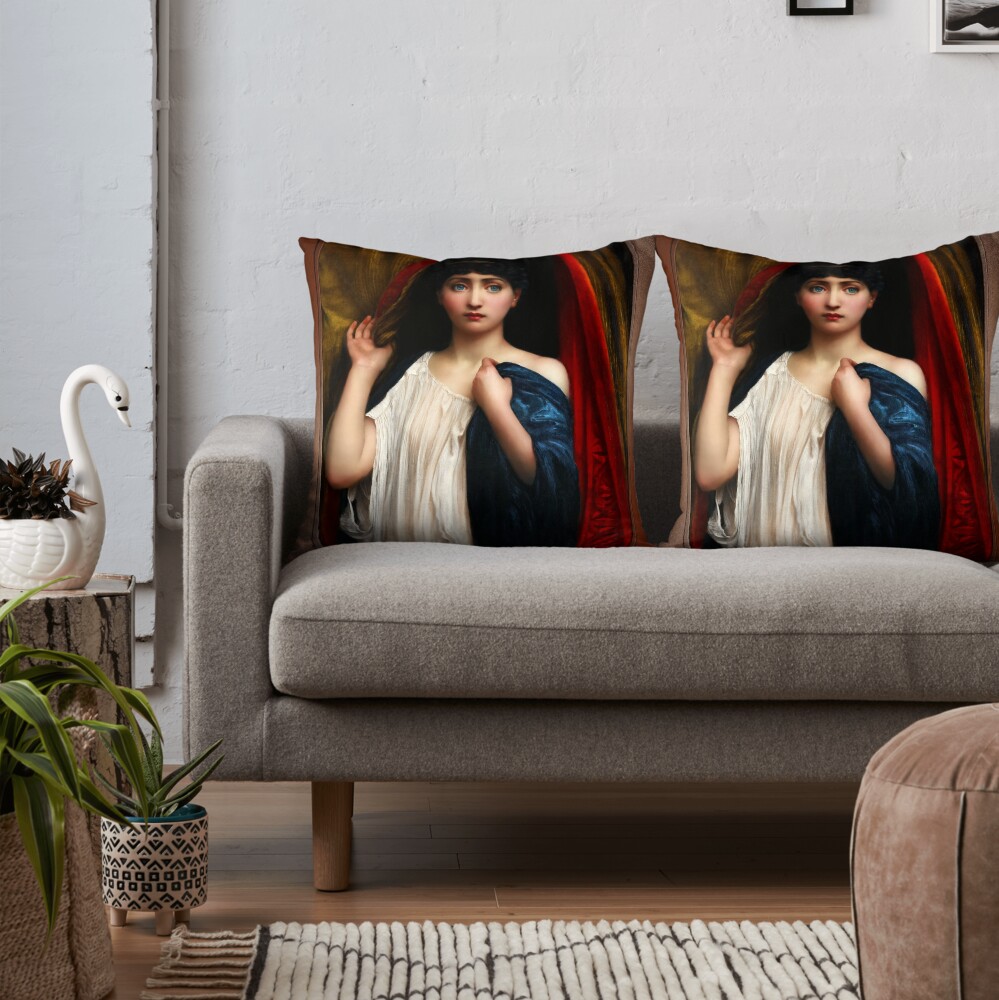
Tabla de contenido
El tema principal: cresida
At the heart of the composition is Cressida herself, a young woman with deep blue eyes that seem to gaze directly into the viewer’s soul, evoking a sense of melancholy. Her expression is pensive, casi melancólico, hinting at her inner turmoil and the conflicted emotions she endures in the play. Cressida stands in a poised, graceful position, her figure draped in a delicate, white garment that clings to her form, suggesting both her vulnerability and her beauty. The fabric is meticulously painted, capturing every fold and texture with remarkable realism. Over her shoulder, un rico, deep blue cloak cascades down, adding a striking contrast to the pale tones of her attire.
Her right hand gently touches the fabric of the cloak near her shoulder, while her left hand rests lightly against a curtain of deep red and golden hues. This placement of her hands creates a sense of composure, as if she is both at ease and yet emotionally caught in a moment of private contemplation. The luxurious materials, silk and velvet, play a significant role in enhancing the visual richness of the painting, adding depth and a sense of opulence to the scene. The artist’s attention to fabric and the way it interacts with the human form reveals his mastery over texture and material.
El fondo y la configuración
The background of the painting is composed of dark, draped curtains in deep reds and golds, which frame the subject. These rich, warm colors not only enhance the figure of Cressida but also convey a sense of intimacy and drama, creating a stage-like setting that echoes the themes of the play. The drapery is rendered in a way that emphasizes both its weight and softness, almost suggesting the presence of a theatrical space. The choice of such vivid tones behind Cressida acts as a visual metaphor for the passionate and often tragic emotions that she experiences throughout the play.
La configuración, although somewhat undefined beyond the drapery, contributes to the overall mood of the painting. el pesado, sumptuous fabrics suggest that Cressida exists within a world of aristocracy and courtly intrigue, a realm of opulence and moral complexity. Este telón de fondo, though simple, enhances the psychological depth of the scene, suggesting a private moment of introspection in an otherwise tumultuous world.
Técnica, Materiales, y estilo
Poynter’s approach to painting in “cresida” reflects the precision and detail typical of the Academic style. His technique, often characterized by highly polished surfaces and an almost photographic attention to detail, is evident in every aspect of the piece. La representación meticulosa de las texturas., from the delicate sheen of Cressida’s garment to the soft, voluminous folds of her cloak, speaks to the artist’s deep understanding of materials and his ability to translate these onto canvas with remarkable fidelity.
The light in the painting is soft and diffused, highlighting the subject’s features in a naturalistic way. Poynter employs a careful balance between light and shadow, creating a sense of three-dimensionality and depth that draws the viewer’s eye to the subject’s face and posture. The use of light to accentuate Cressida’s facial features, particularly her eyes, further intensifies the emotional resonance of the piece, allowing the viewer to feel her vulnerability and the weight of her emotional state.
In terms of color palette, Poynter’s choices are both sophisticated and evocative. The cool tones of Cressida’s dress and the contrasting warm hues of the backdrop create a visual harmony that enhances the emotional impact of the painting. The artist’s use of vivid, saturated colors adds a dramatic effect, while the subtle transitions between light and dark convey the complex interplay of emotions that define Cressida’s character in Shakespeare’s play.
Tema y estado de ánimo
The overarching theme of the painting is one of emotional complexity and vulnerability. Poynter’s “cresida” is not merely a portrait of a woman in an opulent setting; it is a study of a character caught between love, lealtad, and betrayal. Cressida’s eyes, wide and filled with an almost innocent sadness, reflect her inner conflict and emotional turmoil. Su postura, composed yet delicate, suggests a woman who is in the midst of a private struggle, uncertain of her place in the world around her.
The mood of the painting is somber and reflective, underscored by the warm, dark tones of the background and the soft, diffused light that envelops Cressida. The emotional weight of her expression, coupled with the luxurious materials of her attire, suggests a tension between her outer beauty and the inner turmoil she faces. This duality is at the heart of the painting, as Poynter captures not only the physical beauty of his subject but also the emotional depth that lies beneath the surface.
Conclusión
“cresida” by Edward John Poynter is a masterful depiction of one of Shakespeare’s most complex and tragic female characters. El hábil uso del color por parte del artista., luz, and texture creates a rich visual experience that mirrors the emotional depth of the subject. The painting serves not only as a technical achievement but also as an exploration of the human condition, capturing a moment of introspection and emotional vulnerability. A través de este trabajo, Poynter invites the viewer to engage with Cressida’s inner world, offering a poignant meditation on love, betrayal, and the complexities of the human heart.
Esta es una reproducción de maestros antiguos de arte digital remasterizada de una imagen de dominio público que está disponible como Esta es una elegante chica de glamour art deco vintage..
Biografía del artista derivada de Wikipedia.org
Eduardo nació en París, Francia al arquitecto británico y fundador del Instituto de Arquitectos Británicos (c1834) Ambrosio Poynter (1796 – 1886) y emma forster (? – 1848); y poco después de su nacimiento sus padres regresaron a Gran Bretaña.
Edward fue a Brighton College y a la escuela de Ipswich., pero se vio obligado a irse temprano debido a problemas de salud; que le llevó a pasar los inviernos en Madeira, Portugal y en Roma, Italia.
Cuando él era 17 años, estando en Roma conoció al pintor británico Frederick Leighton, y esa reunión causó una impresión significativa en; tal que cuando regresó a Londres se matriculó en la Leigh's Academy, que fue fundada por James Mathews Leigh (1808 – 1860) y eventualmente se convertiría en la Escuela de Bellas Artes Heatherley hoy; y también estudiaría en las Royal Academy Schools.
De allí se fue a París para estudiar en el estudio del pintor clasicista suizo Marc Gabriel Charles Gleyre. (1806 – 1874).
Durante su carrera, Edward ocupó varios cargos oficiales, entre los que se incluían ser profesor Slade en el University College London. (1871 – 1875), director de la Escuela Nacional de Formación Artística (1875 – 1881) y director de la Galería Nacional (1894 – 1904); supervisando la inauguración de la Tate Gallery.
Edward se destacó como pintor de grandes cuadros históricos a lo largo de su carrera., con obras como Israel en Egipto c1867, seguido de St George para Inglaterra c1869, representando a San Jorge y el Dragón y quizás culminando con La visita de la Reina de Saba al Rey Salomón c1884-90.