

Sladké daleko nic
“Sladké daleko nic,” created by the British painter John William Godward v 1904, embodies the essence of leisurely tranquility in classical art. John William Godward (1861 – 1922) is renowned for his dedication to depicting serene and opulent scenes inspired by ancient Rome and Greece, often focusing on beautiful women in idealized settings.
V tomto obraze, Godward captures a moment of pure relaxation, where the subject reclines in a luxurious setting, offering the viewer a window into a world of unhurried elegance. Název, which translates from Italian as “The Sweetness of Doing Nothing,” is a fitting description of the painting’s mood. This theme of languor and contentment is a hallmark of Godward’s work and reflects a classical ideal of living in harmony with nature and luxury.
Obsah
Hlavní předmět: A Reclining Woman
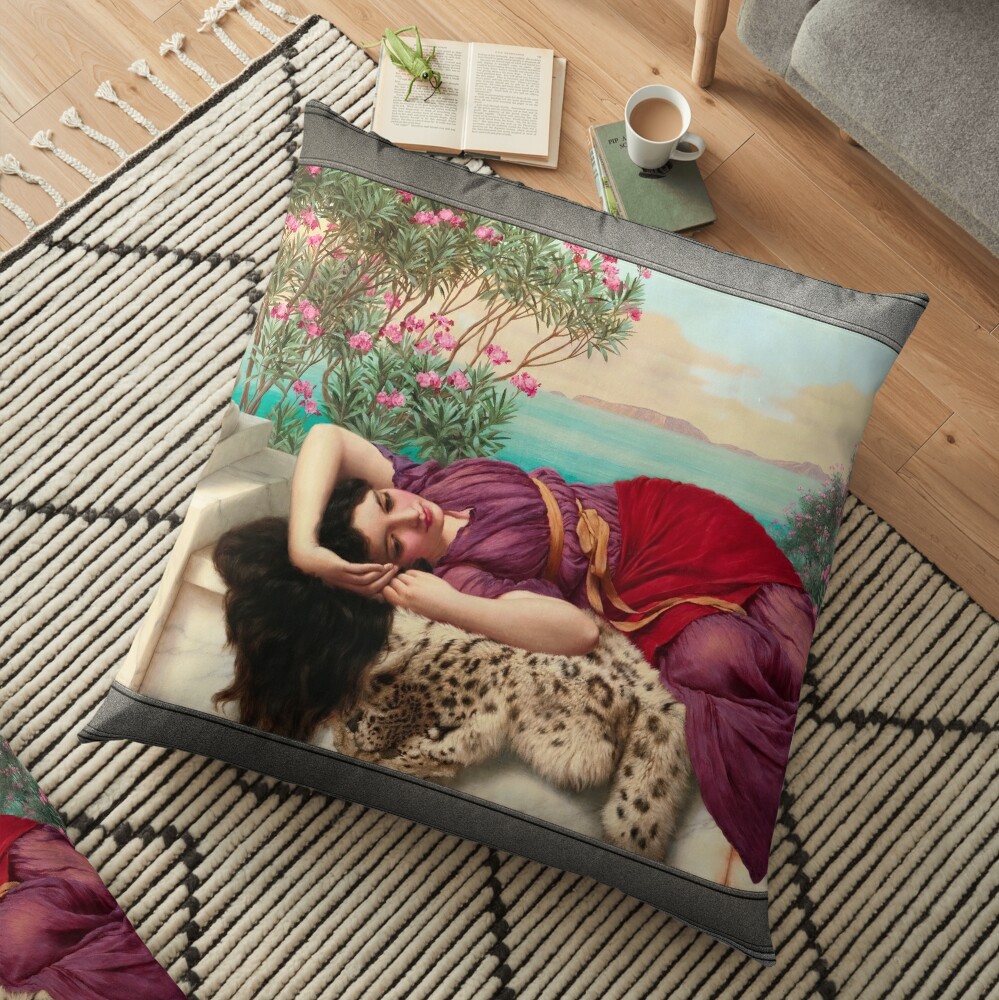
At the heart of the composition lies a young woman, the focal point of the painting. Draped in flowing, rich fabrics, she reclines languidly on a marble terrace. Her pose suggests both comfort and contemplation, her head resting gently on her right arm, while her other hand lies relaxed by her side. The woman’s attire is a blend of classical Greek and Roman influences, with a deep red robe cinched at the waist by a golden sash, flowing loosely around her body.
The fabric of her clothing flows with remarkable realism, draping gracefully over her form and pooling around her on the marble. The woman’s expressive face is calm and serene, exuding a sense of peace and satisfaction. Její dlouhé, dark hair tumbles softly over her shoulder and down her back, enhancing her delicate beauty.
The figure is sculpted in a manner that emphasizes classical ideals of beauty, graceful, štíhlý, and harmonious. The figure’s serene expression is a key aspect of Godward’s work, reinforcing the theme of repose and quiet indulgence. Her classical beauty is not only visual but also imbued with the quiet strength of timeless femininity. Her natural poise suggests an air of nobility or refinement, which Godward often associated with the ancient world.
The Surrounding Environment
The setting is a classical terrace that overlooks a tranquil, Mediterranean-style landscape. The woman is positioned in front of a marble railing, part of a larger architectural structure, perhaps an ancient villa or temple. The terrace’s polished marble surface reflects light beautifully, its smooth, lustrous quality enhancing the overall luxurious atmosphere. The colors of the marble subtly contrast with the rich hues of the woman’s attire, bringing attention to her figure.
Beyond the terrace, the landscape stretches into a serene view of the sea. The coastline is bathed in soft, golden sunlight, with distant hills rolling gently toward the horizon. This idyllic landscape evokes a sense of peace and isolation, where nature and human beauty coexist harmoniously. Several clusters of lush foliage, including pink and purple flowers, border the scene, enhancing the natural beauty of the environment. The plants are rendered with incredible attention to detail, their vibrant colors and intricate shapes adding depth and dimension to the scene.
Krajina, with its gentle slopes and clear skies, reinforces the theme of relaxation and the gentle passage of time. moře, calm and expansive, suggests infinity and timelessness, while the distant hills provide a sense of tranquility and permanence. These natural elements frame the scene in a way that invites the viewer to contemplate the idyllic stillness of the moment.
Materiály a techniky
Godward’s expertise in depicting texture and light is evident in his meticulous rendering of the materials in the painting. The marble terrace is finely detailed, its polished surface capturing the play of light and shadow in a way that heightens the realism of the scene. The luxurious fabrics of the woman’s attire are painted with such precision that one can almost feel the softness and weight of the cloth. The vivid reds and purples of her robe contrast beautifully with the more subdued tones of the landscape, drawing the viewer’s attention to her figure.
Godward’s brushwork is delicate and refined, with a focus on smooth surfaces and clarity of form. The light in the painting is soft and even, contributing to the overall sense of calm and timelessness. There are no harsh contrasts or sharp shadows, which emphasizes the restful mood of the piece. The artist’s use of color is also notable, as he employs a rich yet harmonious palette to evoke warmth and serenity. The overall composition is balanced, with each element of the scene working together to create a cohesive and pleasing visual experience.
The Style and Mood of the Artwork
“Sladké daleko nic” embodies the style of academic realism, a movement that prioritized the accurate depiction of human figures, classical themes, and idealized settings. Godward was a part of the late Victorian tradition, and his works often aligned with the aesthetic tastes of the time, which favored classical themes and polished finishes. Námět malby, a beautiful woman at rest in an idyllic classical setting, is typical of Godward’s oeuvre, where he often sought to create timeless moments of beauty and serenity.
The mood of the painting is one of complete relaxation and peace. There is no urgency or turmoil; místo toho, the viewer is invited to share in the quiet pleasure of the woman’s repose. This sense of timeless, unhurried contentment is central to the painting’s appeal. The serene landscape, the softness of the light, and the tranquility of the scene combine to evoke feelings of nostalgia for a more harmonious and slower-paced world. Téma “Sladké daleko nic” reminds the viewer of the simple joys of leisure, free from the pressures of modern life.
Závěr
“Sladké daleko nic” is a masterful example of John William Godward’s ability to evoke the beauty of the classical world through the lens of academic realism. The painting captures a moment of pure relaxation, where the lines between the natural world and human beauty blur, creating a sense of timeless serenity. The luxurious setting, coupled with the delicate portrayal of the reclining woman, invites the viewer to step into a world where tranquility reigns and time seems to stand still.
Dolce Far Niente je remasterovaná reprodukce starých mistrů digitálního umění obrázku ve veřejné doméně, který je dostupný jako a tisk na plátno online.
Tato digitální umělecká tvorba, stejně jako všechna umělecká díla, která lze nalézt na webu Xzendor7, je k dispozici ke koupi online v různých materiálových formátech včetně tisků na plátno, akrylové tisky, kovové potisky, otisky dřeva, zarámované tisky, plakáty, a jako rolované obrazy na plátně v různých velikostech od 12 palce až 72 palce v závislosti na velikosti skutečného uměleckého díla a obchodu s tiskem na vyžádání, ve kterém se rozhodnete umění koupit.
Umělecká díla jsou k dispozici také na široké škále pánského a dámského oblečení, hrnky, totes, šátky, sešity a deníky a mnoho produktů pro domácí dekoraci.
Životopis umělce
Info níže z Wikipedia.org
John William Godward byl nejstarší z pěti dětí, a byl pojmenován po svém otci Johnovi a dědečkovi Williamovi.
Od r vystavoval na Královské akademii 1887. Když se s jedním ze svých modelů přestěhoval do Itálie 1912, jeho rodina s ním přerušila veškerý kontakt a dokonce vystřihla jeho obraz z rodinných snímků. Godward se vrátil do Anglie v 1921, zemřel v 1922, a je pohřben na hřbitově Brompton Cemetery, Západní Londýn.
Jedním z jeho nejznámějších obrazů je Dolce far Niente (1904), který byl zakoupen do sbírky Andrewa Lloyda Webbera v 1995. Stejně jako v případě několika dalších obrazů, Godward namaloval více než jednu verzi; v tomto případě, dříve (a méně známé) 1897 verze s dalším 1906 verze.
Ve věku let spáchal sebevraždu 61 a říká se, že to napsal ve své poznámce o sebevraždě “svět není dost velký [oba] já a Picasso”.
Jeho odcizená rodina, který nesouhlasil s tím, že se stal umělcem, styděli se za jeho sebevraždu a spálili jeho papíry. Je známo, že přežila pouze jedna fotografie Godwarda.
Godward byl viktoriánský neoklasicista, a proto, teoreticky, stoupenec Frederica Leightona. nicméně, on je více blízko spřízněný stylisticky k siru Lawrence Alma-Tadema, s nímž sdílel zálibu v ztvárnění klasické architektury – zejména, statické krajinné prvky postavené z mramoru.
Naprostá většina Godwardových dochovaných snímků zachycuje ženy v klasických šatech pózující proti krajinným prvkům; i když v jeho díle jsou některé polonahé a zcela nahé postavy, pozoruhodným příkladem je “V Tepidáriu z roku 1913”.
Název sdílený s kontroverzním obrazem Alma-Tadema se stejným námětem, který sídlí v “Galerie umění Lady Lever”. Názvy odrážejí Godwardův zdroj inspirace; což byla klasická civilizace, především starověkého Říma; předmět, který umělecky těsně spojuje Godwarda s Alma-Tademou.
Vzhledem k tomu, že klasické stipendium bylo mezi potenciálním publikem jeho obrazů za jeho života rozšířeno více než v současnosti, pečlivý výzkum detailů byl důležitý pro dosažení postavení umělce v tomto žánru.
Alma-Tadema byl archeolog a také malíř, který navštěvoval historická místa a sbíral artefakty, které později použil ve svých obrazech: k Bohu, také, studoval takové detaily, jako je architektura a oblékání, aby jeho díla nesla punc autenticity.
Navíc, Godward ve svých obrazech pečlivě a pečlivě vykresloval další důležité rysy, zvířecí kůže, z nichž obrazy “Polední odpočinek c1910” a “Cool Retreat c1910” obsahuje příklady takového ztvárnění i divoké květiny “Nerissa c1906” a “Letní květiny c1903”.
Vzhled krásných žen ve studovaných pózách na tolika Godwardových plátnech způsobuje, že mnoho nováčků v jeho dílech ho mylně zařadí do kategorie Prerafaelita., zejména proto, že jeho paleta je často zářivě barevná. Volba předmětu (starověká civilizace versus, například, Arthurianská legenda) je správnější než viktoriánský neoklasicistní.
Společný s mnoha malíři, kteří jsou s ním současní, Godward byl ‚vysoký viktoriánský snílek‘, vytváří obrazy idealizovaného a romantizovaného světa, který, v případě Godwarda i Alma-Tademy, přišel být kritizován jako světonázor viktoriánů v tógách.
k Bohu “rychle si vybudoval reputaci svými malbami mladých žen v klasickém prostředí a svou schopností zprostředkovat citlivostí a technickým mistrovstvím pocit kontrastních textur masa, mramor, kožešiny a tkaniny.
Godwardova záliba v tvorbě uměleckých děl zasazených do klasického období pravděpodobně pocházela z doby, ve které se narodil; protože to bylo poslední úplné klasické oživení v západním malířství, která v Anglii vzkvétala od 60. let 19. století až do 90. let 19. století.