

Idleness c1900
John William Godward, a prominent British painter known for his stunning depictions of the Classical world, vytvořil umělecké dílo “Idleness” v 1900. k Bohu (1861 – 1922), celebrated for his mastery in portraying women in serene, timeless poses within classical and mythological settings, paints a poignant image of stillness and leisure in this particular work. Scéna, though filled with vibrant color and serene composition, evokes a timeless mood that blends the antique with an almost dreamlike quality. Godward’s style, often associated with the Academic tradition, is on full display in this painting, where the skillful use of light, textura, and classical elements invites the viewer into a moment frozen in time.
Obsah
Předmět
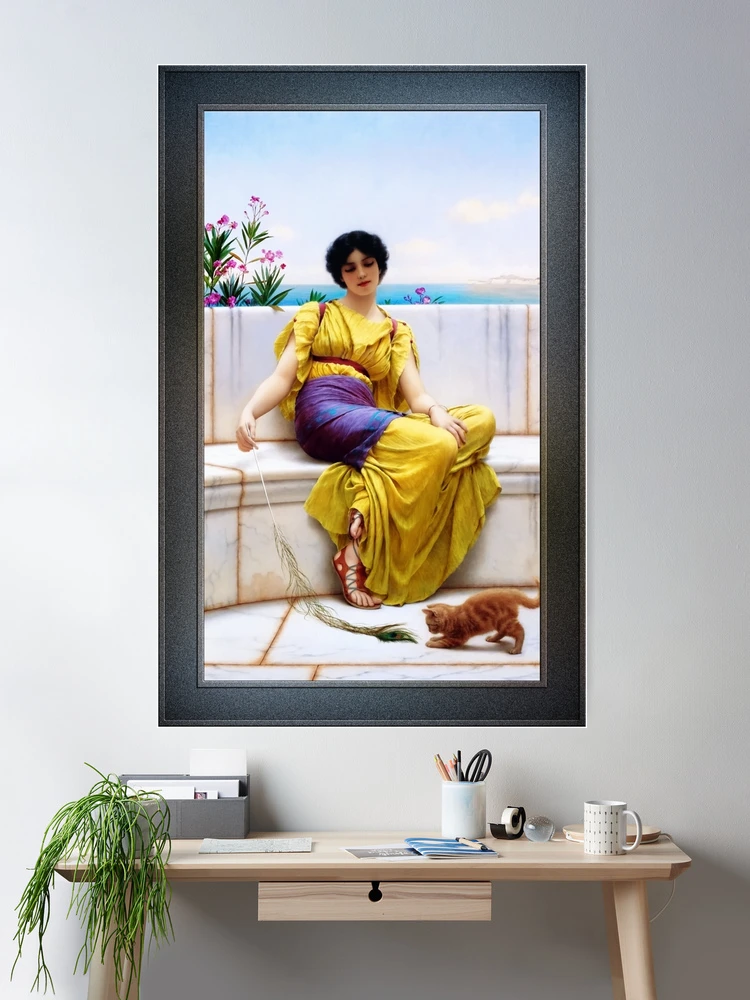
V srdci “Idleness” is the depiction of a young woman, sitting gracefully on a marble bench with a contemplative expression. Her delicate posture and the way she holds a long peacock feather, gently draped from her fingers, imply a quiet moment of repose, as she uses it to play with a kitten. Her body, draped in flowing garments of rich yellow and purple, suggests a figure both in the midst of relaxation and deep thought. The colors of her attire, set against the cool tones of the surrounding environment, add an ethereal quality to her figure, elevating her presence to that of an idealized beauty.
The woman’s dark, short hair contrasts with the golden hues of her clothing, creating a visual balance that complements the soft and inviting mood of the piece. Her facial expression is peaceful, with her gaze lowered as if lost in thought or perhaps in idle contemplation. It is an image of tranquility, drawing the viewer’s attention to the subject’s serene beauty. The slowness and grace of her movements are accentuated by the absence of any evident action or hurry in her pose, fitting the title “Idleness” perfectly. Her limbs, languidly arranged, exude a sense of stillness that enhances the theme of leisure.
Předměty a materiály
The bench on which the young woman rests is made of polished marble, its surface smooth and lustrous, contributing to the luxurious and timeless atmosphere of the artwork. The marble’s cool, pale tones contrast beautifully with the warmer hues of her attire. The surrounding scene includes delicate touches of floral elements, with vibrant pink flowers and green foliage sprouting from pots or planters that frame the scene. These natural elements serve to soften the otherwise pristine environment, adding a touch of liveliness to the otherwise tranquil setting.
The woman’s bare feet are visible, suggesting a connection to the earth beneath her, while her sandals are softly laced, further emphasizing her relaxed state. The twine she holds seems to gently cascade from her hand, a quiet object that contrasts with the elegance of her posture. The composition overall uses these subtle details, její oblečení, the marble bench, the plants, and the twine, to evoke a sense of harmony between the subject and her environment, suggesting an idyllic escape from the demands of everyday life.
Terén a pozadí
Pozadí “Idleness” features a coastal vista, with a soft blue sky and distant views of the sea. The horizon appears calm, with gentle ripples on the water’s surface that mirror the peaceful stillness of the scene. This landscape, while not highly detailed, is nonetheless a crucial element in conveying the sense of serenity and escape. The background serves as a visual reminder of the natural world and its role in providing the perfect setting for the woman’s contemplative repose.
The architecture surrounding the subject, though minimal, suggests an outdoor space—perhaps a garden or courtyard of some ancient villa. The use of white and light tones in the stonework is in harmony with the soft pastel colors of the sky, further enhancing the atmosphere of classical elegance and beauty. The gentle curves of the stonework lead the viewer’s eye towards the figure, focusing attention on the stillness of the subject amidst a tranquil, almost dreamlike, setting.
Styl a technika
Godward’s style is one rooted in the academic traditions of the 19th century, influenced by his early training under classical painters and his deep admiration for the ancient Roman and Greek worlds. v “Idleness,” his attention to detail is evident in the texture of the woman’s gown, the softness of her skin, and the lustrous quality of the marble. Each fold of the woman’s clothing is carefully modeled to convey the weight and flow of the fabric, while the skin is rendered with a soft glow that highlights the artist’s ability to capture the nuances of light.
The use of color is one of the defining features of Godward’s style. The warm yellow of the woman’s dress contrasts beautifully with the cooler blues of the sea and sky, creating a harmonious palette that exudes calm and contentment. The juxtaposition of purple and yellow further enhances the vibrant yet restrained mood of the painting. The choice of colors is not just aesthetically pleasing but serves to emphasize the classical theme of timeless beauty and the idea of idleness as an ideal state of mind.
Godward’s meticulous brushwork and mastery of light and shadow create a sense of depth and dimension within the composition. The sunlight that softly illuminates the woman’s face and the folds of her clothing enhances the sense of warmth in the scene. This soft rendering of light and shadow contrasts with the clarity of the background, making the figure appear almost ethereal in comparison. The careful application of paint, combined with Godward’s ability to capture the texture of different surfaces, such as the smooth marble, the softness of the woman’s skin, and the delicate fabric of her dress, demonstrates his exceptional skill as an artist.
Nálada a téma
Nálada “Idleness” is one of peacefulness, relaxation, and an almost reverent stillness. The figure of the young woman, with her contemplative pose and serene expression, captures the essence of the theme of idleness: a moment in time where nothing is required, and all that exists is the peaceful state of being. This sense of timeless leisure is further reinforced by the classical setting and the absence of any hurried motion in the scene. There is no sense of urgency or distraction in this moment, only the quiet, almost sacred, experience of simply being.
The theme of idleness, a concept often revered in classical art, suggests a harmonious balance between human beings and nature. It invites the viewer to reflect on the value of stillness and the simple pleasures of life. In this work, Godward celebrates the beauty of leisure, not as a fleeting or wasteful moment, but as an ideal state of existence that connects the human figure with nature and the timeless, classical world.
Idleness is a remastered digital art old masters reproduction of a public domain image that is available as a tisk na plátno online.
Tato digitální umělecká tvorba, stejně jako všechna umělecká díla, která lze nalézt na webu Xzendor7, je k dispozici ke koupi online v různých materiálových formátech včetně tisků na plátno, akrylové tisky, kovové potisky, otisky dřeva, zarámované tisky, plakáty, a jako rolované obrazy na plátně v různých velikostech od 12 palce až 72 palce v závislosti na velikosti skutečného uměleckého díla a obchodu s tiskem na vyžádání, ve kterém se rozhodnete umění koupit.
Umělecká díla jsou k dispozici také na široké škále pánského a dámského oblečení, hrnky, totes, šátky, sešity a deníky a mnoho produktů pro domácí dekoraci.
O umělci
Info níže z Wikipedia.org
John William Godward byl nejstarší z pěti dětí, a byl pojmenován po svém otci Johnovi a dědečkovi Williamovi.
Od r vystavoval na Královské akademii 1887. Když se s jedním ze svých modelů přestěhoval do Itálie 1912, jeho rodina s ním přerušila veškerý kontakt a dokonce vystřihla jeho obraz z rodinných snímků. Godward se vrátil do Anglie v 1921, zemřel v 1922, a je pohřben na hřbitově Brompton Cemetery, Západní Londýn.
Jedním z jeho nejznámějších obrazů je Dolce far Niente (1904), který byl zakoupen do sbírky Andrewa Lloyda Webbera v 1995. Stejně jako v případě několika dalších obrazů, Godward namaloval více než jednu verzi; v tomto případě, dříve (a méně známé) 1897 verze s dalším 1906 verze.
Ve věku let spáchal sebevraždu 61 a říká se, že to napsal ve své poznámce o sebevraždě “svět není dost velký [oba] já a Picasso”.
Jeho odcizená rodina, který nesouhlasil s tím, že se stal umělcem, styděli se za jeho sebevraždu a spálili jeho papíry. Je známo, že přežila pouze jedna fotografie Godwarda.
Godward byl viktoriánský neoklasicista, a proto, teoreticky, stoupenec Frederica Leightona. nicméně, on je více blízko spřízněný stylisticky k siru Lawrence Alma-Tadema, s nímž sdílel zálibu v ztvárnění klasické architektury – zejména, statické krajinné prvky postavené z mramoru.
Naprostá většina Godwardových dochovaných snímků zachycuje ženy v klasických šatech pózující proti krajinným prvkům; i když v jeho díle jsou některé polonahé a zcela nahé postavy, pozoruhodným příkladem je “V Tepidáriu z roku 1913”.
Název sdílený s kontroverzním obrazem Alma-Tadema se stejným námětem, který sídlí v “Galerie umění Lady Lever”. Názvy odrážejí Godwardův zdroj inspirace; což byla klasická civilizace, především starověkého Říma; předmět, který umělecky těsně spojuje Godwarda s Alma-Tademou.
Vzhledem k tomu, že klasické stipendium bylo mezi potenciálním publikem jeho obrazů za jeho života rozšířeno více než v současnosti, pečlivý výzkum detailů byl důležitý pro dosažení postavení umělce v tomto žánru.
Alma-Tadema byl archeolog a také malíř, který navštěvoval historická místa a sbíral artefakty, které později použil ve svých obrazech: k Bohu, také, studoval takové detaily, jako je architektura a oblékání, aby jeho díla nesla punc autenticity.
Navíc, Godward ve svých obrazech pečlivě a pečlivě vykresloval další důležité rysy, zvířecí kůže, z nichž obrazy “Polední odpočinek c1910” a “Cool Retreat c1910” obsahuje příklady takového ztvárnění i divoké květiny “Nerissa c1906” a “Letní květiny c1903”.
Vzhled krásných žen ve studovaných pózách na tolika Godwardových plátnech způsobuje, že mnoho nováčků v jeho dílech ho mylně zařadí do kategorie Prerafaelita., zejména proto, že jeho paleta je často zářivě barevná. Volba předmětu (starověká civilizace versus, například, Arthurianská legenda) je správnější než viktoriánský neoklasicistní.
Společný s mnoha malíři, kteří jsou s ním současní, Godward byl ‚vysoký viktoriánský snílek‘, vytváří obrazy idealizovaného a romantizovaného světa, který, v případě Godwarda i Alma-Tademy, přišel být kritizován jako světonázor viktoriánů v tógách.
k Bohu “rychle si vybudoval reputaci svými malbami mladých žen v klasickém prostředí a svou schopností zprostředkovat citlivostí a technickým mistrovstvím pocit kontrastních textur masa, mramor, kožešiny a tkaniny.
Godwardova záliba v tvorbě uměleckých děl zasazených do klasického období pravděpodobně pocházela z doby, ve které se narodil; protože to bylo poslední úplné klasické oživení v západním malířství, která v Anglii vzkvétala od 60. let 19. století až do 90. let 19. století.