

Dolce Far Niente
“Dolce Far Niente,” created by the British painter John William Godward en 1904, embodies the essence of leisurely tranquility in classical art. John William Godward (1861 – 1922) is renowned for his dedication to depicting serene and opulent scenes inspired by ancient Rome and Greece, often focusing on beautiful women in idealized settings.
En ĉi tiu pentraĵo, Godward captures a moment of pure relaxation, where the subject reclines in a luxurious setting, offering the viewer a window into a world of unhurried elegance. The title, which translates from Italian as “The Sweetness of Doing Nothing,” is a fitting description of the painting’s mood. This theme of languor and contentment is a hallmark of Godward’s work and reflects a classical ideal of living in harmony with nature and luxury.
Enhavtabelo
La Ĉefa Temo: A Reclining Woman
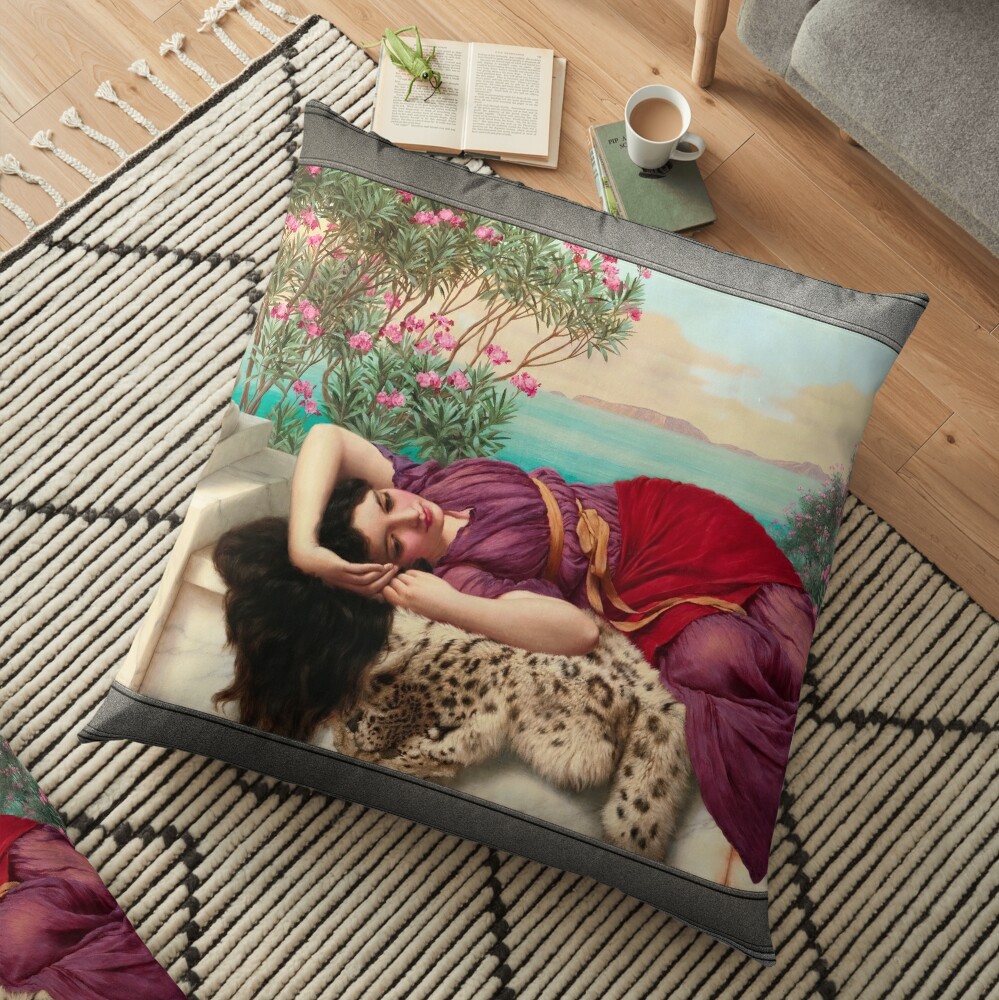
At the heart of the composition lies a young woman, the focal point of the painting. Draped in flowing, rich fabrics, she reclines languidly on a marble terrace. Her pose suggests both comfort and contemplation, her head resting gently on her right arm, while her other hand lies relaxed by her side. The woman’s attire is a blend of classical Greek and Roman influences, with a deep red robe cinched at the waist by a golden sash, flowing loosely around her body.
The fabric of her clothing flows with remarkable realism, draping gracefully over her form and pooling around her on the marble. The woman’s expressive face is calm and serene, exuding a sense of peace and satisfaction. Ŝi longe, dark hair tumbles softly over her shoulder and down her back, enhancing her delicate beauty.
The figure is sculpted in a manner that emphasizes classical ideals of beauty, graceful, slender, and harmonious. The figure’s serene expression is a key aspect of Godward’s work, reinforcing the theme of repose and quiet indulgence. Her classical beauty is not only visual but also imbued with the quiet strength of timeless femininity. Her natural poise suggests an air of nobility or refinement, which Godward often associated with the ancient world.
The Surrounding Environment
The setting is a classical terrace that overlooks a tranquil, Mediterranean-style landscape. The woman is positioned in front of a marble railing, part of a larger architectural structure, perhaps an ancient villa or temple. The terrace’s polished marble surface reflects light beautifully, its smooth, lustrous quality enhancing the overall luxurious atmosphere. The colors of the marble subtly contrast with the rich hues of the woman’s attire, bringing attention to her figure.
Beyond the terrace, the landscape stretches into a serene view of the sea. The coastline is bathed in soft, golden sunlight, with distant hills rolling gently toward the horizon. This idyllic landscape evokes a sense of peace and isolation, where nature and human beauty coexist harmoniously. Several clusters of lush foliage, including pink and purple flowers, border the scene, enhancing the natural beauty of the environment. The plants are rendered with incredible attention to detail, their vibrant colors and intricate shapes adding depth and dimension to the scene.
The landscape, with its gentle slopes and clear skies, reinforces the theme of relaxation and the gentle passage of time. The sea, calm and expansive, suggests infinity and timelessness, while the distant hills provide a sense of tranquility and permanence. These natural elements frame the scene in a way that invites the viewer to contemplate the idyllic stillness of the moment.
Materialoj kaj teknikoj
Godward’s expertise in depicting texture and light is evident in his meticulous rendering of the materials in the painting. The marble terrace is finely detailed, its polished surface capturing the play of light and shadow in a way that heightens the realism of the scene. The luxurious fabrics of the woman’s attire are painted with such precision that one can almost feel the softness and weight of the cloth. The vivid reds and purples of her robe contrast beautifully with the more subdued tones of the landscape, drawing the viewer’s attention to her figure.
Godward’s brushwork is delicate and refined, with a focus on smooth surfaces and clarity of form. The light in the painting is soft and even, contributing to the overall sense of calm and timelessness. There are no harsh contrasts or sharp shadows, which emphasizes the restful mood of the piece. The artist’s use of color is also notable, as he employs a rich yet harmonious palette to evoke warmth and serenity. The overall composition is balanced, with each element of the scene working together to create a cohesive and pleasing visual experience.
The Style and Mood of the Artwork
“Dolce Far Niente” embodies the style of academic realism, a movement that prioritized the accurate depiction of human figures, classical themes, and idealized settings. Godward was a part of the late Victorian tradition, and his works often aligned with the aesthetic tastes of the time, which favored classical themes and polished finishes. The painting’s subject matter, a beautiful woman at rest in an idyllic classical setting, is typical of Godward’s oeuvre, where he often sought to create timeless moments of beauty and serenity.
The mood of the painting is one of complete relaxation and peace. There is no urgency or turmoil; Anstataŭe, the viewer is invited to share in the quiet pleasure of the woman’s repose. This sense of timeless, unhurried contentment is central to the painting’s appeal. The serene landscape, the softness of the light, and the tranquility of the scene combine to evoke feelings of nostalgia for a more harmonious and slower-paced world. La temo de “Dolce Far Niente” reminds the viewer of the simple joys of leisure, free from the pressures of modern life.
Konkludo
“Dolce Far Niente” is a masterful example of John William Godward’s ability to evoke the beauty of the classical world through the lens of academic realism. The painting captures a moment of pure relaxation, where the lines between the natural world and human beauty blur, creating a sense of timeless serenity. The luxurious setting, coupled with the delicate portrayal of the reclining woman, invites the viewer to step into a world where tranquility reigns and time seems to stand still.
Dolce Far Niente is a remastered digital art old masters reproduction of a public domain image that is available as a tolo presaĵo rete.
Ĉi tiu cifereca arta kreaĵo, kiel kun ĉiuj artaĵoj, kiuj troveblas en la retejo de Xzendor7, estas aĉetebla interrete en diversaj materialaj formatoj inkluzive de kanvasaj presaĵoj., akrilaj presaĵoj, metalaj presaĵoj, lignaj presaĵoj, enkadrigitaj presaĵoj, afiŝoj, kaj kiel rulitaj kanvasaj presaĵoj en diversaj grandecoj de 12 colojn al 72 coloj depende de la grandeco de la reala artaĵo kaj la presaĵo laŭpeta butiko, de kiu vi elektas aĉeti la arton.
La artaĵo ankaŭ haveblas sur larĝa gamo de vestaĵoj de viroj kaj virinoj, tasoj, totoj, koltukoj, kajeroj kaj ĵurnaloj kaj multaj hejmornamaj produktoj.
Artisto Bio
Informoj Malsupre De Vikipedio.org
John William Godward estis la plej aĝa de kvin infanoj, kaj estis nomita laŭ lia patro Johano kaj avo Vilhelmo.
Li ekspoziciis ĉe la Reĝa Akademio de 1887. Kiam li moviĝis al Italio kun unu el siaj modeloj en 1912, lia familio rompis ĉian kontakton kun li kaj eĉ tranĉis lian bildon de familiaj bildoj. Godward revenis al Anglio en 1921, mortis en 1922, and is buried in Brompton Cemetery, Okcidenta Londono.
Unu el liaj plej konataj pentraĵoj estas Dolce far Niente (1904), kiu estis aĉetita por la kolekto de Andrew Lloyd Webber en 1995. Kiel en la kazo de pluraj aliaj pentraĵoj, Godward pentris pli ol unu version; en ĉi tiu kazo, pli frue (kaj malpli konata) 1897 versio kun plua 1906 versio.
Li faris memmortigon en la aĝo de 61 kaj laŭdire skribis en sia suicidletero tion “la mondo ne estas sufiĉe granda por [ambaŭ] mi mem kaj Picasso”.
Lia fremdigita familio, kiu malaprobis ke li fariĝu artisto, hontis pri sia memmortigo kaj bruligis liajn paperojn. Nur unu foto de Godward povas pluvivi.
Godward estis viktoria novklasikisto, kaj tial, en teorio, ano de Frederic Leighton. Tamen, li estas pli proksime aliancita stile al Sir Lawrence Alma-Tadema, kun kiu li partumis inklinon al la interpreto de Klasika arkitekturo - aparte, senmovaj pejzaĝaj trajtoj konstruitaj el marmoro.
La vasta plimulto de la pluekzistantaj bildoj de Godward prezentas virinojn en klasika robo pozis kontraŭ pejzaĝaj trajtoj; kvankam ekzistas kelkaj duonnudaj kaj tute nudaj figuroj inkluditaj en lia verko, rimarkinda ekzemplo estanta “En La Tepidarium c1913”.
Titolo kunhavita kun polemika Alma-Tadema pentraĵo de la sama temo kiu loĝas en la “Sinjorino Lever Artgalerio”. La titoloj reflektas la fonton de inspiro de Godward; kiu estis klasika civilizacio, plej precipe tiu de Antikva Romo; temo liganta Godward proksime al Alma-Tadema arte.
Konsiderante ke Klasika stipendio estis pli ĝeneraligita inter la ebla spektantaro por liaj pentraĵoj dum lia vivdaŭro ol en la nuntempo., zorgema esplorado de detaloj estis grava por ekhavi reputacion kiel artisto en tiu ĝenro.
Alma-Tadema estis arkeologo same kiel farbisto, kiu ekzamenis historiajn lokojn kaj kolektis artefaktojn kiujn li poste uzis en siaj pentraĵoj: Godward, ankaŭ, studis tiajn detalojn kiel arkitekturon kaj veston, por certigi, ke liaj verkoj portis la stampon de aŭtentikeco.
Krome, Godward pene kaj zorge igis aliajn gravajn ecojn en siaj pentraĵoj, bestaj feloj el kiuj la pentraĵoj “Tagmeza Ripozo c1910” kaj “Cool Retreat c1910” enhavas ekzemplojn de tia interpretado same kiel sovaĝaj floroj “Nerissa c1906” kaj “Someraj Floroj c1903”.
La aspekto de belaj virinoj en studitaj pozoj en tiel multaj el la kanvasoj de Godward igas multajn novulojn al liaj verkoj kategoriigi lin erare kiel esti antaŭrafaelita., precipe ĉar lia paletro ofte estas vigle bunta. La elekto de temo (antikva civilizo kontraŭ, ekzemple, Artura legendo) estas pli ĝuste tiu de la Viktoria Novklasikisto.
En ofta kun multaj farbistoj nuntempaj kun li, Godward estis "Alta Viktoria Revulo", produktante bildojn de idealigita kaj romantikigita mondo tio, en la kazo de kaj Godward kaj Alma-Tadema, estis kritikita kiel mondkoncepto de viktorianoj en togoj.
Godward “rapide establis reputacion por liaj pentraĵoj de junaj virinoj en klasika medio kaj lian kapablon peri kun sentemo kaj teknika majstrado la senton de kontrastaj teksturoj de karno., marmoro, felo kaj ŝtofoj.
La inklino de Godward por krei artaĵojn metita en la klasika periodo verŝajne venis de la tempoperiodo en kiu li estis naskita.; ĉar ĝi estis la lasta plenskala klasika reviviĝo en okcidentaj pentraĵoj, tio prosperis en Anglio de la 1860-aj jaroj ĝis la 1890-aj jaroj.