

Dolce Far Niente
“Dolce Far Niente,” vum britesche Moler geschaf John William Godward an 1904, embodies the essence of leisurely tranquility in classical art. John William Godward (1861 – 1922) is renowned for his dedication to depicting serene and opulent scenes inspired by ancient Rome and Greece, often focusing on beautiful women in idealized settings.
An dëser Molerei, Godward captures a moment of pure relaxation, where the subject reclines in a luxurious setting, offering the viewer a window into a world of unhurried elegance. Den Titel un, which translates from Italian as “The Sweetness of Doing Nothing,” is a fitting description of the painting’s mood. This theme of languor and contentment is a hallmark of Godward’s work and reflects a classical ideal of living in harmony with nature and luxury.
Inhaltsverzeechnes
D'Haaptthema: Eng lieweg Fra
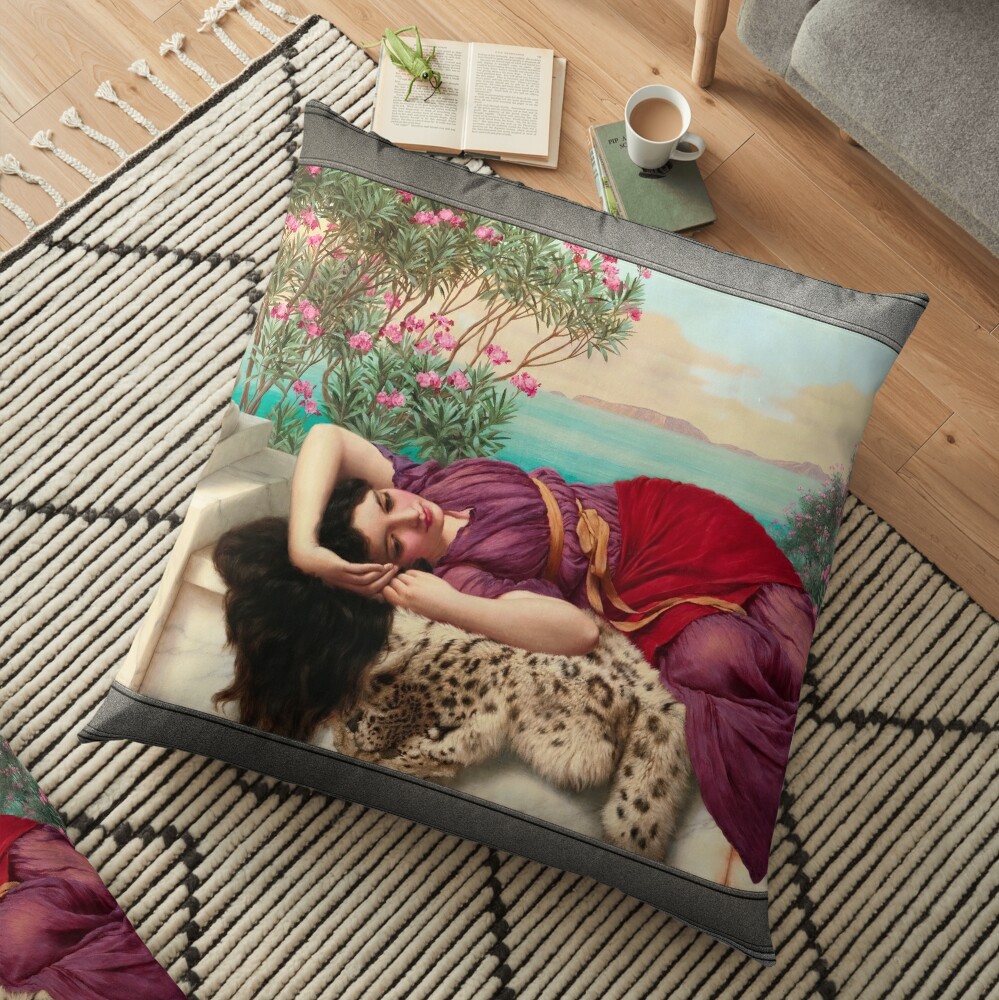
At the heart of the composition lies a young woman, the focal point of the painting. Draped in flowing, rich fabrics, she reclines languidly on a marble terrace. Her pose suggests both comfort and contemplation, her head resting gently on her right arm, while her other hand lies relaxed by her side. The woman’s attire is a blend of classical Greek and Roman influences, with a deep red robe cinched at the waist by a golden sash, flowing loosely around her body.
The fabric of her clothing flows with remarkable realism, draping gracefully over her form and pooling around her on the marble. The woman’s expressive face is calm and serene, exuding a sense of peace and satisfaction. Hir laang, dark hair tumbles softly over her shoulder and down her back, enhancing her delicate beauty.
The figure is sculpted in a manner that emphasizes classical ideals of beauty, graziéis, slender, and harmonious. The figure’s serene expression is a key aspect of Godward’s work, reinforcing the theme of repose and quiet indulgence. Her classical beauty is not only visual but also imbued with the quiet strength of timeless femininity. Her natural poise suggests an air of nobility or refinement, which Godward often associated with the ancient world.
D'Ëmgéigend Ëmfeld
The setting is a classical terrace that overlooks a tranquil, Mediterranean-style landscape. The woman is positioned in front of a marble railing, part of a larger architectural structure, perhaps an ancient villa or temple. The terrace’s polished marble surface reflects light beautifully, its smooth, lustrous quality enhancing the overall luxurious atmosphere. The colors of the marble subtly contrast with the rich hues of the woman’s attire, bringing attention to her figure.
Beyond the terrace, the landscape stretches into a serene view of the sea. The coastline is bathed in soft, golden sunlight, with distant hills rolling gently toward the horizon. This idyllic landscape evokes a sense of peace and isolation, where nature and human beauty coexist harmoniously. Several clusters of lush foliage, including pink and purple flowers, border the scene, enhancing the natural beauty of the environment. The plants are rendered with incredible attention to detail, their vibrant colors and intricate shapes adding depth and dimension to the scene.
D'Landschaft, with its gentle slopes and clear skies, reinforces the theme of relaxation and the gentle passage of time. D'Mier, calm and expansive, suggests infinity and timelessness, while the distant hills provide a sense of tranquility and permanence. These natural elements frame the scene in a way that invites the viewer to contemplate the idyllic stillness of the moment.
Materialien an Techniken
Godward’s expertise in depicting texture and light is evident in his meticulous rendering of the materials in the painting. The marble terrace is finely detailed, its polished surface capturing the play of light and shadow in a way that heightens the realism of the scene. The luxurious fabrics of the woman’s attire are painted with such precision that one can almost feel the softness and weight of the cloth. The vivid reds and purples of her robe contrast beautifully with the more subdued tones of the landscape, drawing the viewer’s attention to her figure.
Godward’s brushwork is delicate and refined, with a focus on smooth surfaces and clarity of form. The light in the painting is soft and even, contributing to the overall sense of calm and timelessness. There are no harsh contrasts or sharp shadows, which emphasizes the restful mood of the piece. The artist’s use of color is also notable, as he employs a rich yet harmonious palette to evoke warmth and serenity. The overall composition is balanced, with each element of the scene working together to create a cohesive and pleasing visual experience.
The Style and Mood of the Artwork
“Dolce Far Niente” embodies the style of academic realism, a movement that prioritized the accurate depiction of human figures, classical themes, and idealized settings. Godward was a part of the late Victorian tradition, and his works often aligned with the aesthetic tastes of the time, which favored classical themes and polished finishes. The painting’s subject matter, a beautiful woman at rest in an idyllic classical setting, is typical of Godward’s oeuvre, where he often sought to create timeless moments of beauty and serenity.
The mood of the painting is one of complete relaxation and peace. There is no urgency or turmoil; amplaz, the viewer is invited to share in the quiet pleasure of the woman’s repose. This sense of timeless, unhurried contentment is central to the painting’s appeal. The serene landscape, the softness of the light, and the tranquility of the scene combine to evoke feelings of nostalgia for a more harmonious and slower-paced world. D'Thema vun “Dolce Far Niente” reminds the viewer of the simple joys of leisure, free from the pressures of modern life.
Conclusioun
“Dolce Far Niente” is a masterful example of John William Godward’s ability to evoke the beauty of the classical world through the lens of academic realism. The painting captures a moment of pure relaxation, where the lines between the natural world and human beauty blur, creating a sense of timeless serenity. The luxurious setting, coupled with the delicate portrayal of the reclining woman, invites the viewer to step into a world where tranquility reigns and time seems to stand still.
Dolce Far Niente is a remastered digital art old masters reproduction of a public domain image that is available as a Canvas Print online.
Dës digital Konscht Kreatioun, wéi mat all de Konschtwierker, déi op der Xzendor7 Websäit fonnt kënne ginn, ass online a verschiddene Materialformater ze kafen, dorënner Canvas Prints, acryl Prints, Metallofdréck, Holzdrécker, cadréiert Printen, Plakater, a wéi gewalzt Canvas Printen a ville Gréissten vun 12 Zoll zu 72 Zoll ofhängeg vun der Gréisst vum aktuellen Konschtwierk an dem Print-on-Demande Buttek vun deem Dir gewielt hutt d'Konscht ze kafen.
D'Konschtwierk ass och op eng breet Palette vu Männer- a Fraekleedung verfügbar, Becher, totes, Schal, Notizbicher an Zäitschrëften a vill Heemdekoratiounsprodukter.
Kënschtler Bio
Info Ënnen Vun Wikipedia.org
Den John William Godward war den eelste vu fënnef Kanner, a gouf no sengem Papp John a Grousspapp William benannt.
Hien huet op der Royal Academy ausgestallt 1887. Wéi hien an Italien geplënnert ass mat engem vu senge Modeller an 1912, seng Famill huet all Kontakt mat him ofgebrach a souguer säi Bild vu Familljebiller geschnidden. Godward zréck an England an 1921, gestuerwen am 1922, a gëtt um Brompton Kierfecht begruewen, West London.
Eng vu senge bekanntste Biller ass d'Dolce far Niente (1904), déi fir d'Sammlung vum Andrew Lloyd Webber kaaft gouf an 1995. Wéi am Fall vun e puer anere Biller, Godward huet méi wéi eng Versioun gemoolt; an dësem Fall, eng fréier (a manner bekannt) 1897 Versioun mat enger weider 1906 Versioun.
Hien huet Suizid am Alter vun 61 a soll a senger Suizidnotiz dat geschriwwen hunn “d'Welt ass net grouss genuch fir [souwuel] ech selwer an e Picasso”.
Seng auslännesch Famill, deen ofgeleent hat vu sengem Kënschtler ginn, hu sech fir säi Suizid geschummt a seng Pabeiere verbrannt. Nëmmen eng Foto vu Godward ass bekannt fir z'iwwerliewen.
Godward war e Victorian Neo-Classicist, an dofir, an der Theorie, en Unhänger vum Frederic Leighton. Allerdéngs, hien ass méi no verbonnen stilistesch dem Sir Lawrence Alma-Tadema, mat wiem hien e Virdeel fir d'Rendering vun der klassescher Architektur gedeelt huet - besonnesch, statesch Landschaftsfeatures aus Marmor gebaut.
Déi grouss Majoritéit vun de existente Biller vum Godward weisen Fraen a klassesche Kleed géint Landschaftsfeatures; och wann et e puer semi-plakeg a voll plakeg Figuren a sengem Wierk abegraff sinn, e bemierkenswäert Beispill ze sinn “Am Tepidarium c1913”.
En Titel gedeelt mat enger kontroverser Alma-Tadema Molerei vum selwechte Sujet deen an der wunnt “Lady Lever Art Gallery”. D'Titele reflektéieren dem Godward seng Inspiratiounsquell; déi klassesch Zivilisatioun war, besonnesch dee vum antike Roum; e Sujet bindend dem Godward no un Alma-Tadema artistesch.
Gitt datt klassescht Stipendium méi verbreet war ënner dem potenzielle Publikum fir seng Biller wärend sengem Liewen wéi am haitegen Dag, suergfälteg Fuerschung vum Detail war wichteg fir e Stand als Kënschtler an dësem Genre z'erreechen.
Alma-Tadema war en Archäolog wéi och e Moler, deen op historesche Site gaang ass an Artefakte gesammelt huet, déi hie spéider a senge Biller benotzt huet: Godward, ze, studéiert sou Detailer wéi Architektur a Kleed, fir sécherzestellen datt seng Wierker de Stempel vun der Authentizitéit droen.
Zousätzlech, De Godward huet mëttelméisseg a virsiichteg aner wichteg Features a senge Biller gemaach, Déierefell vun deenen d'Biller “Mëtteg Dag Rescht c1910” an “E Cool Réckzuch c1910” enthält Beispiller vu sou enger Ausféierung wéi och Wëldblummen “Nerissa c1906” an “Summer Blummen c1903”.
D'Erscheinung vu schéine Fraen a studéierte Posen a sou vill vu Godward Canvasen verursaacht vill Newcomer zu senge Wierker fir hie falsch als Pre-Raphaelit ze kategoriséieren, besonnesch well seng Palette dacks eng vibrant faarweg ass. D'Wiel vum Thema (antike Zivilisatioun versus, zum Beispill, Arthurian Legend) ass méi richteg dee vum Victorian Neo-Klassiker.
Gemeinsam mat ville Moler zäitgenëssesch mat him, Godward war en "High Victorian Dreamer", produzéiert Biller vun enger idealiséierter a romantiséierter Welt déi, am Fall vu Godward an Alma-Tadema, koum als Weltvisioun vu Victorianer an Togas kritiséiert.
Godward “séier e Ruff etabléiert fir seng Biller vu jonke Fraen an engem klassesche Kader a seng Fäegkeet fir mat Sensibilitéit an technescher Meeschterschaft d'Gefill vu contrastesche Texturen vu Fleesch ze vermëttelen, Marmer, Pelz a Stoffer.
Dem Godward seng Virléift fir Konschtwierker an der klassescher Period ze kreéieren ass méiglecherweis aus der Zäit an där hie gebuer gouf; well et war déi lescht voll-Skala klassesch Erhuelung a westleche Biller, déi an England vun den 1860er bis zu den 1890er bléie gelooss hunn.