

Dream Girl
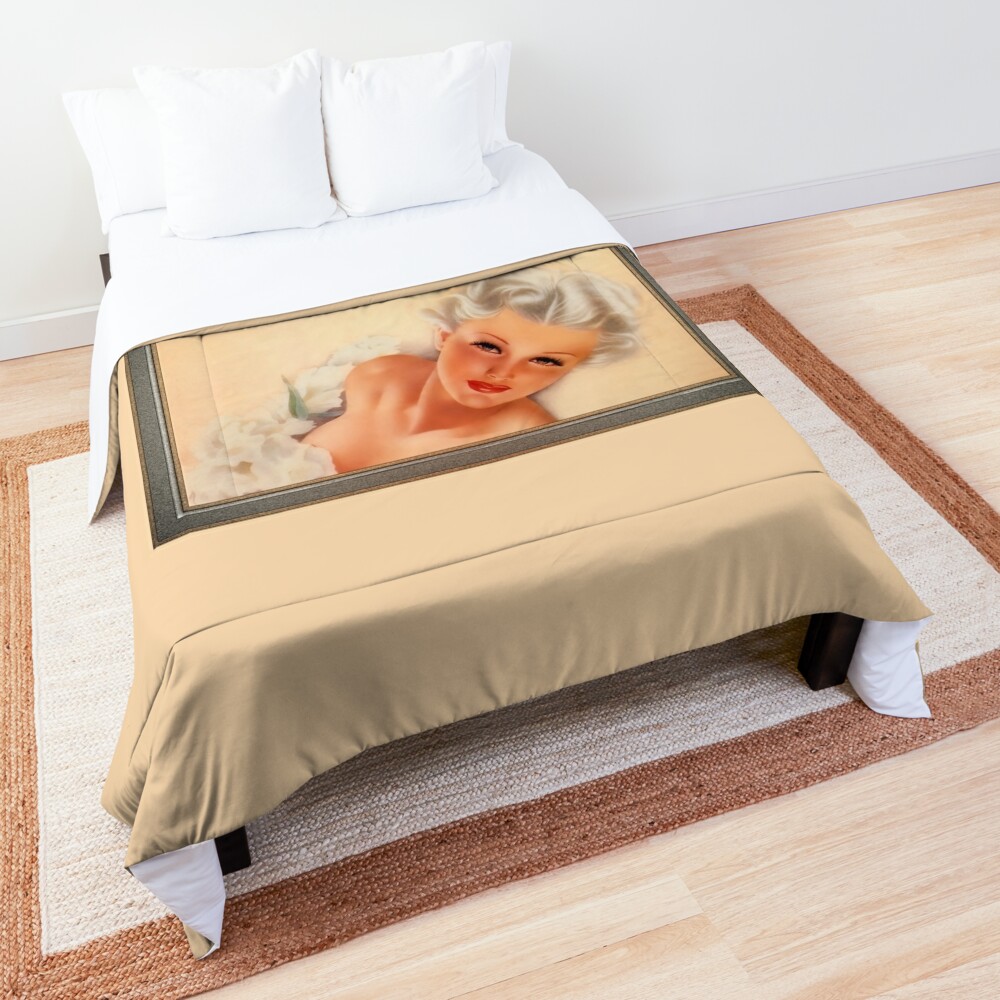
“Dream Girl,” erstallt duerch Peruvian Kënschtler Alberto Vargas placeholder image (1896 – 1982) in the 1940s, captures the seductive allure of feminine beauty and elegance with a style that epitomizes the glamour of mid-century pin-up art. Known for his meticulous attention to detail, Vargas expertly combines delicate elements of portraiture with soft, dreamlike qualities that evoke an air of both innocence and sensuality.
Dëst Konschtwierk, which draws viewers into a serene and nostalgic world, remains one of his most iconic pieces. Vargas’s unmistakable flair for capturing the human form in a manner that is both realistic and idealized is fully on display in “Dream Girl.”
Inhaltsverzeechnes
Sujet a Kompositioun
Um Häerz vun “Dream Girl” lies a beautiful, youthful woman. She gazes up softly, her expression one of serenity and quiet allure. The subject’s features are gracefully rendered, showcasing a high level of refinement in the artist’s technique. Her glowing skin, with its porcelain-like smoothness, seems almost ethereal against the muted background.
The delicate play of light on her face highlights the softness of her expression, emphasizing her large, dark eyes, voll Lippen, and smooth, gently arched eyebrows. The faint curve of her neck leads down to her soft shoulders, enhancing her graceful and feminine figure.
The woman’s platinum blonde hair is styled in soft waves that cascade gently across her head, framing her face like a halo of silk. The tousled effect of her hair gives a sense of motion, as though it were caught in a gentle breeze, further adding to the dreamlike quality of the image. This characteristic of movement is contrasted with her calm, passive demeanor, inviting the viewer into a world of poised elegance.
Objects and Elements
Surrounding the subject are subtle hints of nature, including soft white flowers that rest delicately around her, almost as if they have grown from the same delicate dreamlike state in which she exists. These floral elements are painted with soft strokes that blend seamlessly into the rest of the image, emphasizing the ethereal quality of the portrait. The flowers themselves appear almost weightless, with their petals depicted in a way that mimics the softness and fragility of the woman’s figure.
The background of the piece is a gentle wash of warm beige and peach tones, which enhances the overall softness of the scene. The delicate lightness of the background contrasts with the vividness of the subject’s face, which is the focal point of the painting. Vargas’s use of soft gradients in the background creates a hazy, dreamlike atmosphere, further inviting the viewer into a moment of quiet reverie.
Material a Medium
Alberto Vargas was a master of his medium, and his work with oil paints in “Dream Girl” is a testament to his exceptional technique. The use of oils allowed him to achieve a smooth, flawless surface that enhances the lifelike quality of the subject’s skin and features.
D'Faarwen vermëschen harmonesch, with an emphasis on soft pastels and subtle gradients that evoke a feeling of warmth and intimacy. Vargas’s brushwork is meticulous, showing his skill in capturing the delicate nuances of light, Schied, an Textur.
The soft transition between tones is key to the image’s mood, and the fluidity of Vargas’s strokes gives the subject a sense of being caught in a fleeting moment of time, as though the image could melt away or shift with a simple breath of wind. The final effect is one of polished elegance and timeless beauty, which was characteristic of Vargas’s signature pin-up art.
Styl an Technik
“Dream Girl” embodies the signature style of Alberto Vargas, a renowned artist known for his pin-up illustrations that graced the covers of magazines and advertisements in the mid-20th century. His work is deeply rooted in the tradition of American pin-up art but goes beyond the typical representations of the time. While Vargas’s women were often depicted in playful, seductive poses, he infused each of his subjects with a sense of grace and sophistication that set him apart from other pin-up artists.
His style is a blend of realism and idealization, where the human form is rendered with a high degree of detail while maintaining an almost fantastical allure. The women in Vargas’s portraits, such as the one in “Dream Girl,” are idealized depictions of beauty, captured in moments of tranquility that evoke a sense of fantasy. Dëst Stéck, besonnesch, reflects his mastery of creating an intimate connection with the viewer through the subject’s gaze and the tenderness of the scene.
Thema a Stëmmung
Den zentrale Thema vun “Dream Girl” revolves around the celebration of femininity, Schéinheet, a Gnod. The mood is one of serenity, roueg, and fantasy. The subject is neither overtly sexualized nor overly stylized in a way that detracts from her natural beauty. Amplaz, the piece invites contemplation of the soft allure that exists in quiet moments. The colors and gentle composition exude warmth, calmness, an zäitlos Eleganz, echoing the fantasy worlds of the golden era of Hollywood glamour.
The overall mood is also one of nostalgia, as the viewer is transported back to an earlier time when such portraits of women were emblematic of both class and allure. Der mëller, ethereal qualities of the image serve as a reminder of a more innocent, yet enchanting, vision of feminine beauty, one that is untainted by the complexities of modern life.
Conclusioun
“Dream Girl” by Alberto Vargas stands as a magnificent example of mid-20th-century art that celebrates the beauty of the human form and captures the viewer’s imagination through delicate realism and idealized femininity. Through his use of soft tones, graceful composition, and mastery of oil painting, Vargas brings to life an image that is both a product of its time and timeless in its elegance.
The woman in this piece is an ethereal vision, whose quiet charm and beauty continue to captivate audiences even decades after its creation. This artwork is not just a portrait; it is a dream captured in paint, an embodiment of grace, Schéinheet, and the fantasy of perfect femininity.
Dëst ass eng remastered digital Konscht al Master Reproduktioun vun engem ëffentlechen Domain Bild dat verfügbar ass online als eng gewalzt Leinwanddruck.
Kënschtler Bio
Info Ënnen Vun Wikipedia.org
Gebuer zu Arequipa, Peru, hie war de Jong vum bemierkenen peruanesche Fotograf Max T. Vargas. Den Alberto Vargas ass an d'USA geplënnert 1916 nom Konscht an Europa studéiert hunn, Zürich, a Genf virum Éischte Weltkrich.
Wärend hien an Europa war koum hien op d'franséisch Magazin La Vie Parisienne, mat engem Cover vum Raphael Kirchner, déi hie gesot huet e groussen Afloss op seng Aarbecht.
Seng fréi Karriär zu New York enthält Aarbecht als Kënschtler fir den Ziegfeld Follies a fir vill Hollywood Studios. Den Ziegfeld hänkt säi Bild vum Olive Thomas am Theater, a si gouf als eng vun den eelste Vargas Girls ugesinn.
Vargas’ dat bekanntst Stéck Filmwierk war fir d'Plakat vum 1933 Film The Sin of Nora Moran, déi weist eng bal plakeg Zita Johann an enger Pose vun der Verzweiflung. D'Plakat gëtt dacks als ee vun de gréisste Filmplakater genannt, déi jeemools gemaach gi sinn.
Hie gouf wäit bemierkt an de 1940er Joren als Ersteller vun ikonesche Weltkrich-II Ära Pin-ups fir den Esquire Magazin bekannt als “Vargas Girls.” Tëscht 1940 an 1946 Vargas produzéiert 180 Biller fir de Magazin.
D'Nueskonscht vu ville amerikaneschen an alliéierten Zweete Weltkrich Fligeren gouf inspiréiert an adaptéiert vun dësen Esquire Pin-ups, wéi och déi vum George Petty, an aner Kënschtler.