

Empress Carlota of Mexico
Empress Carlota of Mexico (벨기에의 샬롯 공주) c1850s by German Painter Hermann Winterhalter (1808 – 1891); 초상화가 Franz Xaver Winterhalter의 남동생 (1805 – 1873).
This beautiful portrait of the young Empress Carlota is set with her standing or possibly sitting in front of a textured multi-colored wall.
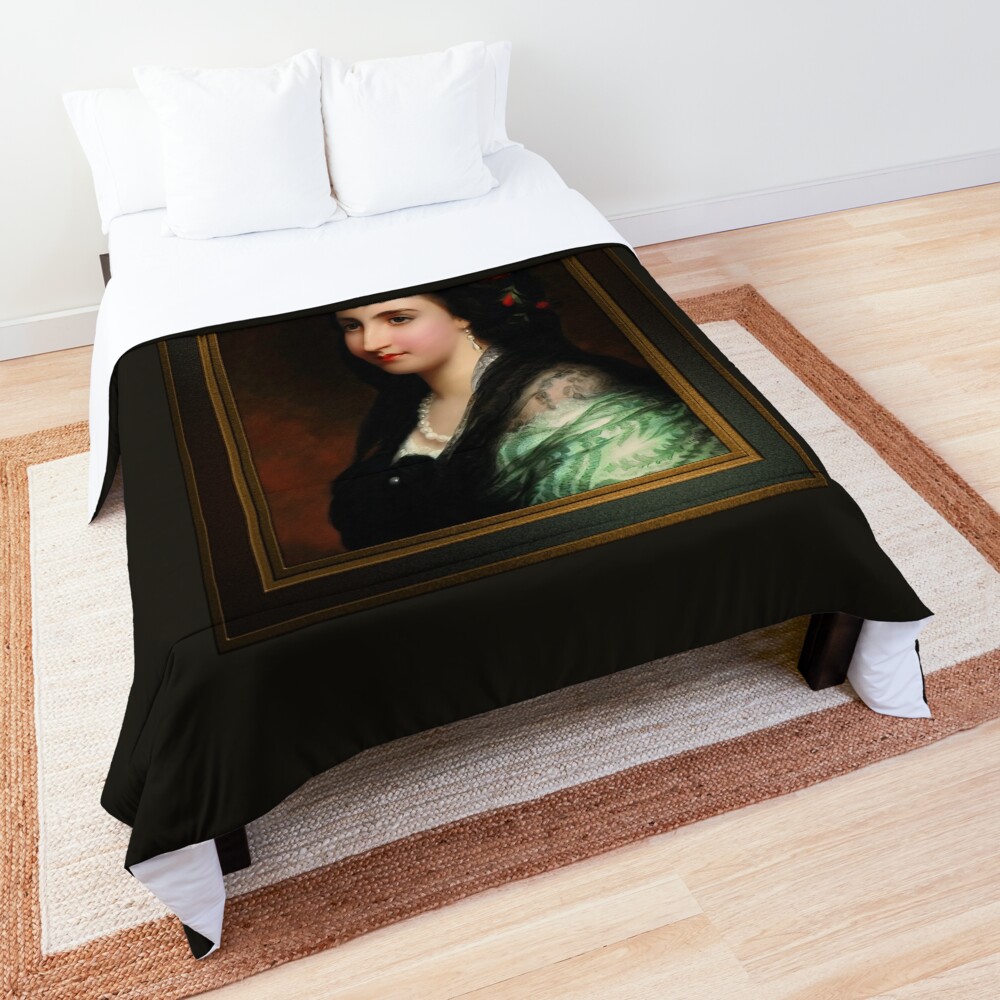
She is presented in three quarter view facing to the left of the viewer, looking off into the distance with a minute smile on her face.
She is wearing a white dress with ruffled trim along its borders, a green embroidered sheer shawl and on top of that a black embroidered kerchief.
Placed withing her black hair is a large red flower, and two smaller red flowers with green leaves that are attached to there stems.
She is also wearing a set of earrings that are composed of a round pearl at the top and a tear drop pearl on the bottom; that compliment the pearl necklace around her neck and the pearl pin that holds the ends of her black kerchief to the chest portion of her dress.
이것은 공개 도메인 이미지의 리마스터링된 디지털 아트 올드 마스터 복제입니다. Boucher는 Guay의 작품으로 일련의 그림을 그리고 Madame de Pompadour가 조각하여 호의를 받는 궁정에게 잘 묶인 책으로 배포했습니다..
아래에서 파생 된 정보 Wikipedia.org
Hermann Winterhalter was born in the small village of Menzenschwand, (이제 Sankt Blasien의 일부), 독일 바덴 선거구의 검은 숲에서, 4월에 20, 1805.

He was the seventh child of Fidel Winterhalter (1773 – 1863), 마을의 농부이자 수지 생산자, 그의 아내 에바 메이어 (1765 – 1838), 오랫동안 설립된 Menzenschwand 가족의 일원.
His father was of peasant stock and was a powerful influence in his life making him follow in his older brother Franz Winterhalter footsteps whom Hermann was very close to. 여덟 남매 중, 4명만이 유아기에서 살아남았다.
Hermann began his artistic career, when he was first trained as a lithographer (Lithography is a method of printing originally based on the immiscibility of oil and water. The printing is from a stone (lithographic limestone) or a metal plate with a smooth surface. It was invented in 1796 by German author and actor Alois Senefelder (1771 – 1834) as a cheap method of publishing theatrical works.).
From there he later went on to study painting in Munich, Germany and Rome, 이탈리아; after which he moved to Paris, France where he worked with his brother Franz and exhibited at the Salon from 1838 – 1841, 1847 과 1869.
In th 1850s Hermann independently started a small portrait practice of his own, creating respected works such as Young Girl from Ariccia and the portrait of his Parisian patron Nicolas-Louis Planat de la Faye.
After the fall of the Second French Empire (which was the 18-year Imperial Bonapartist regime of Napoleon III from January 14, 1852 to September 4, 1870, between the Second Republic and Third Republic, of France.); Hermann and his brother Franz decided to retire to Baden; a historical territory in South Germany and North Switzerland, on both sides of the Upper Rhine.
Where Franz died in 1873; while Hermann for almost 20 more years, passing away on February 24, 1891 in Karlsruhe – the second-largest city of the German federal state of Baden-Württemberg.