

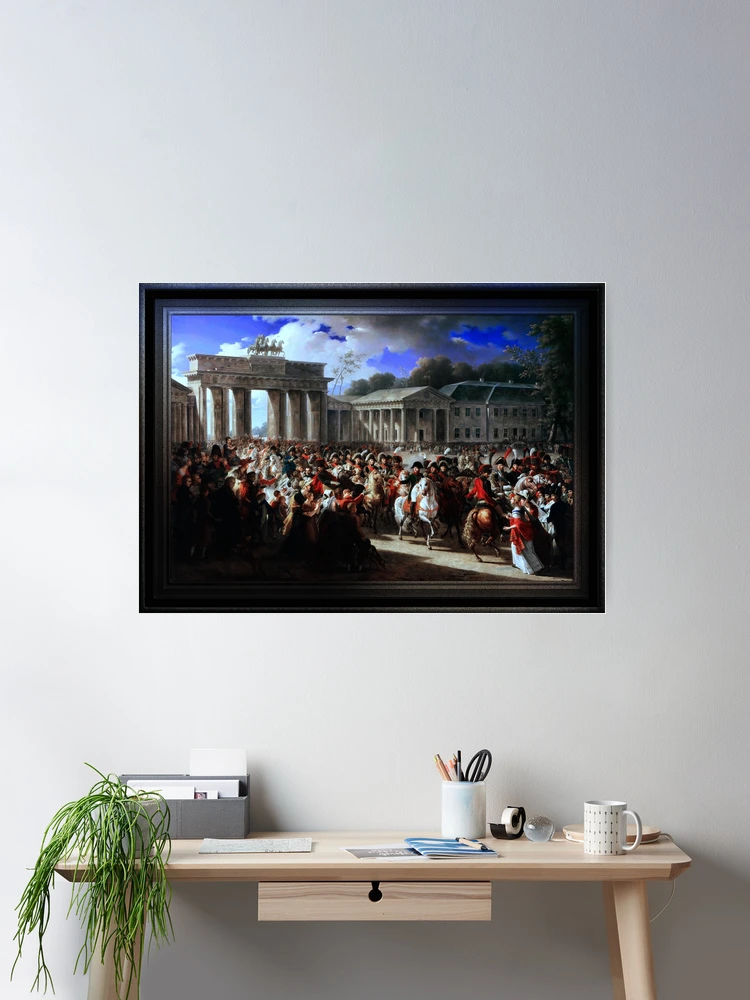
Einzug Napoleons I. in Berlin, Oktober, 27NS 1806 is a masterpiece by the French painter Charles Meynier (1763 oder 68 – 1832), umhergestellt 1810. This monumental work captures the historical moment of Napoleon Bonaparte’s entry into Berlin, following the victory at the Battle of Jena-Auerstedt during the Napoleonic Wars. Das Gemälde, executed in the neoclassical style, is a grand depiction of Napoleon’s triumph and the power he wielded at the height of his empire. The artwork is rich in both narrative and visual grandeur, combining elements of military spectacle with a portrayal of the dramatic atmosphere of the time.
Inhaltsverzeichnis
Hauptfach und Komposition
At the heart of the composition is the figure of Napoleon himself, mounted on a white horse and positioned at the forefront of the scene. He is flanked by his generals and soldiers, who all share the same air of triumph and discipline. The emperor is portrayed with a commanding presence, his gaze fixed and his posture upright, exuding authority and confidence. He is dressed in a grand military uniform, featuring the iconic red coat and golden epaulettes, symbolizing his imperial status. Sein Gesicht, while slightly softened, remains a testament to his power and resolve.
The crowd surrounding Napoleon is varied and dynamic, composed of soldiers, civilians, und Adel, all observing his entry into Berlin. The diverse array of figures, their facial expressions ranging from admiration to awe, provides a sense of the widespread reverence for the emperor. Among the crowd, many figures stand at attention, saluting their emperor, while others gather in groups, forming a living mass that surrounds the procession. The interaction between the figures is well-executed, showcasing Meynier’s talent for rendering human emotion in a collective context.
Architecture and Terrain
The backdrop of the painting features the architectural grandeur of Berlin, with notable buildings and structures representing the city’s 18th-century neoclassical architecture. The Brandenburg Gate – ein neoklassizistisches Denkmal aus dem 18. Jahrhundert, das im Auftrag des preußischen Königs errichtet wurde Friedrich Wilhelm II, nach der vorübergehenden Wiederherstellung der Ordnung während der Batavischen Revolution Januar 18, 1795, is iconic in its design. Is seen towering in the distance, symbolizing Berlin’s importance as a capital city and Napoleon’s military dominance over it. The columns of the gate rise with a sense of formality and monumental scale, echoing the strength and power of Napoleon’s army.
Im Vordergrund, the terrain is bustling with activity, with soldiers on horseback, infantrymen, and civilians filling the wide avenue that leads into the city. The sweeping motion of the crowd and the movement of the horses convey a sense of dynamism, as if the viewer is witnessing the event in real-time. The ground appears dusty and trampled underfoot, indicative of the many soldiers that had passed through this route before. The street’s wide expanse allows for a clear view of the emperor and his entourage, making them the undeniable focal point of the composition.
Materials and Style
Meynier’s choice of materials and technique demonstrates his mastery of neoclassical painting. Der Künstler verwendet Ölfarben, um ein sattes Ergebnis zu erzielen, vivid representation of the scene, employing both light and shadow to enhance the dramatic effect of the moment. The contrast between the dark sky and the illuminated figures in the foreground creates a stark division that emphasizes Napoleon’s central role in the composition. The lighting effect suggests both the grandeur of the event and the imminent shift in European power.
The use of light plays a central role in setting the mood of the painting. The figures of Napoleon and his generals are bathed in bright, fast ätherisches Licht, while the darker shadows cast on the crowd suggest a sense of distance and subjugation. The contrast highlights Napoleon’s central role in the scene, while the surrounding figures appear as mere onlookers in awe of his power.
The neoclassical style of the painting is characterized by its attention to detail, Realismus, and idealization of the figures. The precision in the depiction of clothing, Pferde, and architecture all point to Meynier’s rigorous training and adherence to classical ideals. His use of space and form, as well as his ability to convey movement, creates a harmonious balance within the composition. Das Gemälde, while rooted in historical realism, also embodies a sense of grandeur and heroism, characteristic of the Romantic period that would soon follow.
Stimmung und Atmosphäre
The mood of the painting is one of triumph, Ehrfurcht, und Ehrfurcht. The crowd’s overwhelming focus on Napoleon, coupled with the formal, almost ceremonial procession, suggests the emperor’s absolute control over the moment. The scene is imbued with a sense of monumental importance, as the viewer is invited to contemplate the historical significance of the event.
Gleichzeitig, there is a palpable tension in the air. While the soldiers and civilians show deference to Napoleon, the shadow of war and conquest lingers in the background. The stark contrast between the bright light surrounding Napoleon and the darkening skies hints at the fleeting nature of his empire, as well as the impending changes that would soon unfold across Europe. Das Gemälde, deshalb, captures both the glory of Napoleon’s reign and the weight of the forces that would eventually lead to his downfall.
Abschluss
Charles Meynier’s “Einzug Napoleons I. in Berlin” is a powerful historical narrative rendered in exquisite detail. Through his mastery of composition, Licht, und Form, Meynier encapsulates the moment of Napoleon’s triumph while also hinting at the complexities of his reign. The painting stands as a testament to the neoclassical ideals of the time, celebrating the heroism and grandeur of one of history’s most controversial figures.
Charles Meynier ist eine retuschierte Reproduktion der digitalen Kunst alter Meister eines gemeinfreien Bildes.
Diese digitale Kunstschöpfung, Wie alle Kunstwerke, die auf der Xzendor7-Website zu finden sind, können sie online in einer Vielzahl von Materialformaten einschließlich Leinwanddrucken erworben werden, Acryldrucke, Metalldrucke, Holzdrucke, gerahmte Drucke, Plakate, und wie gerollte Leinwanddrucke in verschiedenen Größen von 12 Zoll zu 72 Zoll, abhängig von der Größe des tatsächlichen Kunstwerks und dem Print-on-Demand-Shop, in dem Sie das Kunstwerk kaufen möchten.
Das Kunstwerk ist auch auf einer breiten Palette von Herren- und Damenbekleidung erhältlich, Tassen, Tragetaschen, Schals, Notizbücher und Tagebücher sowie viele Heimdekorationsprodukte.
Über den Künstler
Info unten abgeleitet von Wikipedia.org
Meynier war der Sohn eines Schneiders; und ein junges Alter zeigte ein Talent für die Kunst, und begann seine Ausbildung unter der Anleitung des französischen Zeichners und GraveursPierre-Philippe Choffard *1731 – 1809).
Als Schüler des französischen neoklassischen und historischen Malers François-André Vincent (1746 – 1816), Meynier gewann den zweiten Preis in der 1789 Prix de Rome Wettbewerb; während Anne-Louis Girodet de Roussy-Trioson den ersten Preis gewann. Vier Jahre später in 1793 Meynier kehrte nach Paris zurück.
Im 1815 Meynier wurde Mitglied der Académie de France à Rome; und in der Zeit zwischen 1819 zu 1822, er schuf die große Dekoration für die Decke des Louvre; sowie zahlreiche Werke geschaffen, die die napoleonische Legende verherrlichten, die zum größten Teil im Château de Versailles verbleibt.
Er entwarf auch Entwürfe für die Flachreliefs und Statuen auf dem Arc de Triomphe du Carrousel und der Pariser Börse. Von 1816 weiter, Meynier war Mitglied der Académie des Beaux-Arts; und in 1819 er wurde Lehrer an der École des Beaux-Arts.