

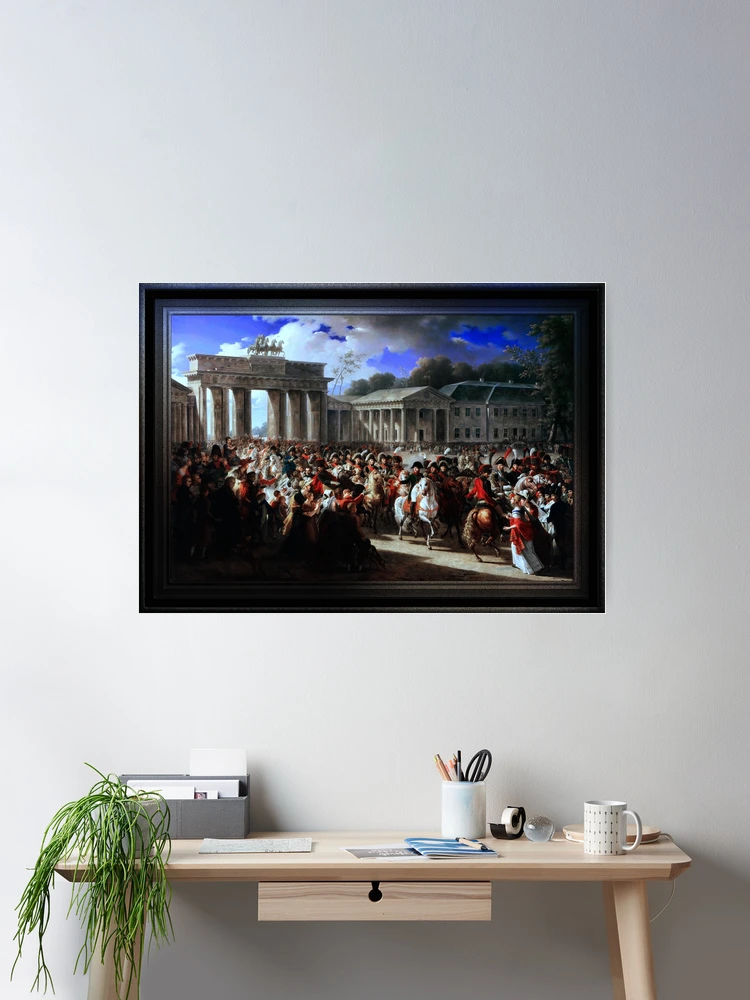
Entry of Napoleon I into Berlin, Deireadh Fómhair, 27ú 1806 is a masterpiece by the French painter Charles Meynier (1763 nó 68 – 1832), cruthaithe timpeall 1810. This monumental work captures the historical moment of Napoleon Bonaparte’s entry into Berlin, following the victory at the Battle of Jena-Auerstedt during the Napoleonic Wars. An phéintéireacht, executed in the neoclassical style, is a grand depiction of Napoleon’s triumph and the power he wielded at the height of his empire. The artwork is rich in both narrative and visual grandeur, combining elements of military spectacle with a portrayal of the dramatic atmosphere of the time.
Clár na nÁbhar
Príomh-Ábhar agus Comhdhéanamh
At the heart of the composition is the figure of Napoleon himself, mounted on a white horse and positioned at the forefront of the scene. He is flanked by his generals and soldiers, who all share the same air of triumph and discipline. The emperor is portrayed with a commanding presence, his gaze fixed and his posture upright, exuding authority and confidence. He is dressed in a grand military uniform, featuring the iconic red coat and golden epaulettes, symbolizing his imperial status. His face, while slightly softened, remains a testament to his power and resolve.
The crowd surrounding Napoleon is varied and dynamic, composed of soldiers, civilians, agus uaisle, all observing his entry into Berlin. The diverse array of figures, their facial expressions ranging from admiration to awe, provides a sense of the widespread reverence for the emperor. Among the crowd, many figures stand at attention, saluting their emperor, while others gather in groups, forming a living mass that surrounds the procession. The interaction between the figures is well-executed, showcasing Meynier’s talent for rendering human emotion in a collective context.
Architecture and Terrain
The backdrop of the painting features the architectural grandeur of Berlin, with notable buildings and structures representing the city’s 18th-century neoclassical architecture. The Brandenburg Gate – an 18th Century Neoclassical monument built on the orders of the Prussian King Frederick William II, after the temporary restoration of order during the Batavian Revolution January 18, 1795, is iconic in its design. Is seen towering in the distance, symbolizing Berlin’s importance as a capital city and Napoleon’s military dominance over it. The columns of the gate rise with a sense of formality and monumental scale, echoing the strength and power of Napoleon’s army.
Sa tulra, the terrain is bustling with activity, with soldiers on horseback, infantrymen, and civilians filling the wide avenue that leads into the city. The sweeping motion of the crowd and the movement of the horses convey a sense of dynamism, as if the viewer is witnessing the event in real-time. The ground appears dusty and trampled underfoot, indicative of the many soldiers that had passed through this route before. The street’s wide expanse allows for a clear view of the emperor and his entourage, making them the undeniable focal point of the composition.
Ábhair agus Stíl
Meynier’s choice of materials and technique demonstrates his mastery of neoclassical painting. The artist uses oil paints to achieve a rich, vivid representation of the scene, employing both light and shadow to enhance the dramatic effect of the moment. The contrast between the dark sky and the illuminated figures in the foreground creates a stark division that emphasizes Napoleon’s central role in the composition. The lighting effect suggests both the grandeur of the event and the imminent shift in European power.
The use of light plays a central role in setting the mood of the painting. The figures of Napoleon and his generals are bathed in bright, solas beagnach ethereal, while the darker shadows cast on the crowd suggest a sense of distance and subjugation. The contrast highlights Napoleon’s central role in the scene, while the surrounding figures appear as mere onlookers in awe of his power.
The neoclassical style of the painting is characterized by its attention to detail, réalachas, and idealization of the figures. The precision in the depiction of clothing, horses, and architecture all point to Meynier’s rigorous training and adherence to classical ideals. His use of space and form, as well as his ability to convey movement, creates a harmonious balance within the composition. An phéintéireacht, while rooted in historical realism, also embodies a sense of grandeur and heroism, characteristic of the Romantic period that would soon follow.
Giúmar agus Atmaisféar
The mood of the painting is one of triumph, reverence, agus uafás. The crowd’s overwhelming focus on Napoleon, coupled with the formal, almost ceremonial procession, suggests the emperor’s absolute control over the moment. The scene is imbued with a sense of monumental importance, as the viewer is invited to contemplate the historical significance of the event.
At the same time, there is a palpable tension in the air. While the soldiers and civilians show deference to Napoleon, the shadow of war and conquest lingers in the background. The stark contrast between the bright light surrounding Napoleon and the darkening skies hints at the fleeting nature of his empire, as well as the impending changes that would soon unfold across Europe. An phéintéireacht, mar sin, captures both the glory of Napoleon’s reign and the weight of the forces that would eventually lead to his downfall.
Conclúid
Charles Meynier’s “Entry of Napoleon I into Berlin” is a powerful historical narrative rendered in exquisite detail. Through his mastery of composition, éadrom, agus foirm, Meynier encapsulates the moment of Napoleon’s triumph while also hinting at the complexities of his reign. The painting stands as a testament to the neoclassical ideals of the time, celebrating the heroism and grandeur of one of history’s most controversial figures.
Charles Meynier is a retouched digital art old masters reproduction of a public domain image.
Cruthú ealaíne digiteach seo, mar atá an saothar ealaíne go léir atá le fáil ar shuíomh Gréasáin Xzendor7 ar fáil le ceannach ar líne i bhformáidí éagsúla ábhar lena n-áirítear priontaí canbháis, priontaí aicrileach, priontaí miotail, priontaí adhmaid, priontaí frámaithe, póstaeir, agus mar priontaí chanbhás rollta i méideanna éagsúla ó 12 orlach go 72 orlach ag brath ar mhéid an tsaothair ealaíne iarbhír agus ar an siopa priontála ar éileamh a roghnaíonn tú an ealaín a cheannach uaidh.
Tá an saothar ealaíne ar fáil freisin ar raon leathan éadaí fear agus ban, mugaí, totes, scaifeanna, leabhair nótaí agus irisleabhair agus go leor táirgí maisiúcháin tí.
Faoin Ealaíontóir
Faisnéis Thíos Díorthaithe ó Wikipedia.org
Mac táilliúra ab ea Meynier; agus léirigh aois óg tallann don ealaín, agus chuir sé tús lena oiliúint faoi mheantóireacht an Dréachtóir Francach agus an EngraverPierre-Philippe Choffard *1731 – 1809).
Mar mhac léinn leis an bPéintéir Neamhchlasaiceach agus Stairiúil Francach François-André Vincent (1746 – 1816), Bhuaigh Meynier an dara duais sa 1789 Comórtas Prix na Róimhe; agus bhain Anne-Louis Girodet de Roussy-Trioson an chéad duais. Ceithre bliana ina dhiaidh sin i 1793 D'fhill Meynier go Páras.
I 1815 Rinneadh ball den Académie de France sa Róimh Meynier; agus le linn na tréimhse idir 1819 chun 1822, chruthaigh sé an maisiú mór do uasteorainneacha an Louvre; chomh maith le saothair iomadúla a chruthú a thug glóir don finscéal Napoleon, atá fós sa Château de Versailles don chuid is mó.
Rinne sé dearaí freisin do na bunfhaoisimh agus na dealbha ar an Arc de Triomphe du Carrousel agus ar an bPáras Bourse. Ó 1816 ar aghaidh, Bhí Meynier ina bhall den Académie des Beaux-Arts; agus i 1819 ceapadh é ina mhúinteoir ag an École des Beaux-Arts.