

Arddangosfa
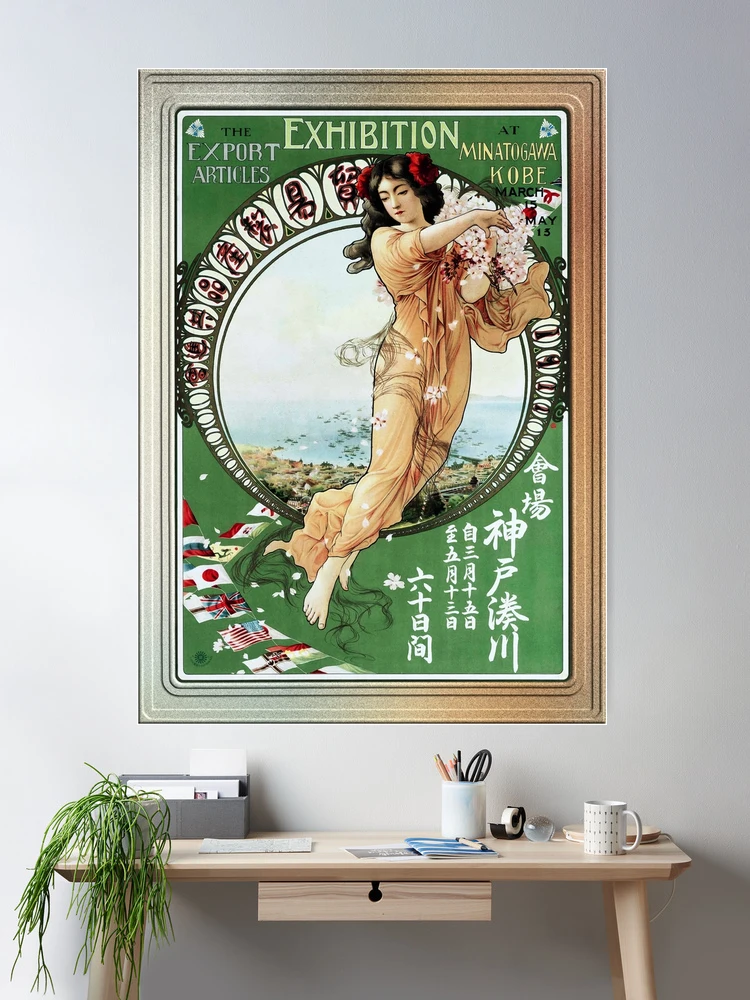
“Arddangosfa – Yr Erthyglau Allforio Yn Minatogawa Boeki Seisanhin Kyoshin-Kai” (1880 – 1947) erbyn Tsunetomi Kitano yn enghraifft gyfareddol o gelf poster Japaneaidd o ddechrau'r 20fed ganrif, gan gyfuno elfennau dylunio cywrain â symbolaeth ddiwylliannol i greu profiad gweledol parhaus. Tsunetomi Kitano, arlunydd Japaneaidd nodedig, trwytho'r gwaith hwn ag ymdeimlad o geinder, gan gyfuno estheteg draddodiadol Japan a dylanwadau Gorllewinol a oedd yn dod yn fwy amlwg yn ystod cyfnodau Meiji a Taisho. Crëwyd y gwaith celf fel rhan o ddarn hyrwyddo ar gyfer arddangosfa ym Minatogawa, Kobe, ac mae’n cynrychioli ymgysylltiad deinamig Japan â masnach ryngwladol a chyfnewid diwylliannol ar y pryd.
Mae'r olygfa a ddangosir ar y poster yn hynod symbolaidd, yn llawn lliwiau llachar a motiffau dylunio cywrain. Mae’r artist yn defnyddio’r elfennau hyn nid yn unig i hysbysebu’r arddangosfa ond hefyd i gyfleu naratif dyfnach am le Japan yn yr economi fyd-eang yn ystod cyfnod o foderneiddio cyflym.. Mae'r gwaith celf yn ymgorffori naws optimistiaeth a balchder cenedlaethol a nodweddodd oes Japan o ehangu diwydiannol ac adfywiad diwylliannol.
Tabl Cynnwys
Prif Bwnc: Y Ffigwr Canolog Benywaidd
Wrth wraidd y gwaith celf mae ffigwr benywaidd gosgeiddig, exuding ymdeimlad o dawelwch harddwch a cheinder. Mae hi wedi gwisgo mewn llifeiriant, gŵn arlliw meddal sy'n dal y golau ag ansawdd bron yn ethereal. Mae ffabrig y gŵn i'w weld yn llipa, fel pe bai yn symud, symbol o symudiad ysgafn ond cyson ymlaen Japan i'r llwyfan byd-eang. Ei hir, mae gwallt tywyll yn rhaeadru o gwmpas ei hysgwyddau ac yn llifo'n ddiymdrech i'r gofod o'i chwmpas, gan mwyhau y teimlad o hylifedd a gras.
Mae'r ffigwr yn dyner, braich estynedig yn dal clwstwr o flodau ceirios, sy'n ymddangos yn wasgaredig yn yr awel. Mae'r manylion cain hwn yn symbol o freuder a harddwch natur, yn ogystal â chynrychiolaeth o dreftadaeth ddiwylliannol Japan. Y blodau ceirios, symbol hanfodol o Japan, yn dwyn i gof themâu byrhoedledd ac adnewyddiad. Mae wyneb y fenyw yn feddal ac yn dawel, yn syllu i lawr mewn myfyrdod, yn atgyfnerthu'r llonyddwch, ond eto naws bwerus sy'n treiddio drwy'r darn.
Y Dyluniad a'r Dirwedd O Amgylch
The backdrop of the artwork includes a sweeping panoramic view of the port city of Kobe, with its bustling docks, ships, and the distant hills. The city is depicted with a level of detail that showcases the busy commerce of the time, reflecting Japan’s growing prominence in international trade. The ships in the harbor are clearly intended to represent Japan’s expanding reach in global markets, particularly the exportation of goods.
Around the central figure, a decorative floral border frames the scene. The circular design evokes both traditional Japanese patterns and Western Art Nouveau influences, with flowing lines and intricate geometric shapes. This fusion of Eastern and Western artistic elements is emblematic of the period’s cultural blend. The design also includes various national flags at the bottom, representing the international nature of the exhibition and highlighting the country’s connection to the global community.
Palet Lliw a Hwyliau
The color palette of the poster is rich and vibrant, dominated by shades of green, which are seen in the background and surrounding elements, suggesting fertility, twf, and prosperity. The light cream-colored tones of the woman’s gown contrast beautifully with the darker greens and blues of the backdrop, emphasizing her as the focal point of the artwork. The pink hues of the cherry blossoms add a touch of softness, their delicate petals drifting through the air, symbolizing beauty, peace, and the fleeting nature of life.
The overall mood of the artwork is one of serene confidence and national pride. There is a sense of forward-looking optimism, as the female figure not only represents Japan’s cultural and natural beauty but also the country’s readiness to engage in the global marketplace. Y meddal, llinellau llifo, combined with the strong, almost monumental presence of the woman, imbue the poster with a sense of grace and power, showcasing both Japan’s traditional values and its embrace of the future.
Teipograffeg ac Elfennau Testun
The text on the poster is arranged in a harmonious yet assertive manner, situated at the top and bottom of the artwork. The words “Exhibition at Minatogawa Kobe” are rendered in a bold, Western-style serif font that stands out against the more intricate background, further emphasizing the international nature of the event. The other text, written in Japanese characters, is neatly placed around the circular border, offering additional details about the exhibition dates and location. These textual elements are carefully integrated into the overall composition, adding to the poster’s function as both an advertisement and a piece of art.
Symbolaeth a Chyd-destun Diwylliannol
Kitano Tsunetomi’s poster is not just a visual promotion of the exhibition but also a celebration of Japan’s participation in the global community. The use of the cherry blossoms can be seen as a metaphor for the transient beauty of both nature and culture, a reflection of the nation’s deep connection to its natural environment and history. The woman’s graceful posture and serene expression further symbolize Japan’s poised and composed interaction with the rest of the world.
The inclusion of national flags, with their various designs, suggests a welcoming of foreign influences and recognition of Japan’s growing role in the global sphere. The exhibition itself, housed in the port city of Kobe, underscores the importance of international trade during the period, while the vibrant colors and strong design evoke a sense of national pride and optimism for the future.
Nghasgliad
I gloi, “Arddangosfa – Yr Erthyglau Allforio Yn Minatogawa Boeki Seisanhin Kyoshin-Kai” by Kitano Tsunetomi is a masterful work of art that blends both artistic beauty and cultural significance. The artist’s careful use of symbolism, intricate design elements, and a harmonious color palette brings forth a sense of cultural pride and optimism. Trwy'r gwaith celf hwn, Tsunetomi captures the essence of a transformative period in Japanese history, illustrating the nation’s blossoming role on the world stage and its deep connection to both tradition and progress.
Mae hwn yn atgynhyrchiad hen feistri celf ddigidol wedi'i atgynhyrchu o ddelwedd parth cyhoeddus.
Bio artist
Gwybodaeth Isod O Wikipedia.org
Kitano Tsunetomi initially made printing plates for illustrations in newspapers. At 17 he went to Osaka to become a painter.
He now designed illustrations for stories that appeared in newspapers. His large-format advertising posters with beautiful women also found recognition.
Yn 1910 his picture “Assembly of the Beetles” (す だ く 虫, Sudaku mushi) and the following year the picture “Sunshine in the Rain” (日照 雨, Sobae) were awarded a 3rd prize at the Bunter exhibition.
With that he had established himself as a painter in the Nihonga style.
Yn 1914 Kitano exhibited the picture “The Thread of Request” (願 い の 糸, Negai no ito) at the resurrected Inten exhibition .
From then on he remained connected to this series of exhibitions and belonged, together with the Tokyo Kaburagi Kiyokata and Uemura Shōen in Kyoto, to the prominent painters of beautiful women.
Since Kitano initially portrayed “magical” beautiful women, he was counted among the wing of painting that dealt with the unusual, the “Gadan no Akuma-ha” (画壇 の 悪 魔 派).
From the middle Taishō period, the picture of the Yodogimi should be emphasized, which has a new depth of representation.
With the Shōwa period, Kitano captured modern Japan in a fresh way.
Kitano was shown in 1931 at the “Exhibition of Japanese Painting” in Berlin. Yn 1989 the Japanese Post issued two postage stamps for 62 yen each with a dancer from the “Awa Odori”, the festive procession in Tokushima Prefecture (historically Awa Province).