

Cwrw Sakura c1912
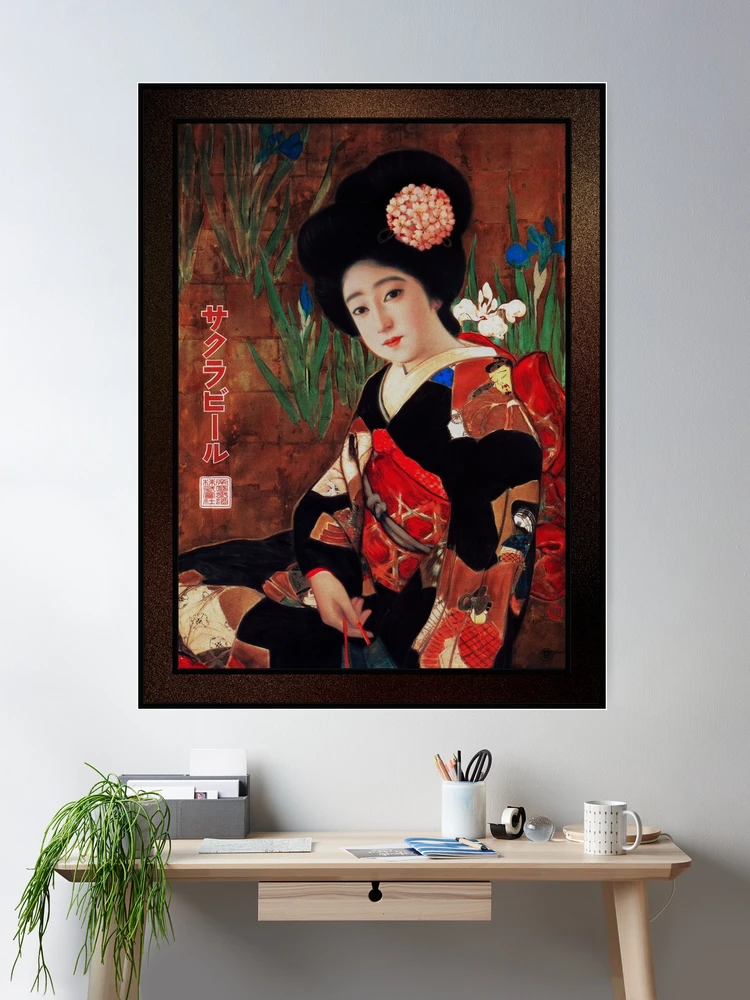
“Cwrw Sakura 1912” yn waith celf hynod a grëwyd gan yr arlunydd enwog o Japan Tsunetomi Kitano (1880 – 1947). Mae’r darn hwn yn crynhoi meistrolaeth yr artist wrth asio estheteg draddodiadol Japan â phortread mireinio o themâu cyfoes..
Kitano, yn adnabyddus am ei ddarluniau medrus a cain o ferched hardd a'r byd o'u cwmpas, yn cyfleu hanfod y Meiji yn arbenigol, i gyfnodau Shōwa a Taisho yn Japan trwy ei waith celf a gyfansoddwyd yn ofalus. Yn y darn arbennig hwn, y gwrthrych yw gwraig barod wedi'i gwisgo mewn cimono addurnedig cywrain, pwnc a archwilir yn aml gan Tsunetomi yn ei gelfyddyd, gosod yn erbyn cefndir o irises blodeuol a meddal, tonau priddlyd. Mae'r paentiad yn cynnig cipolwg ar fywyd cymdeithasol y cyfnod, where traditional beauty and modern influences merged.
Tabl Cynnwys
Prif Bwnc: The Elegant Woman in Kimono
At the heart of the artwork stands a young woman, her poised posture and serene expression conveying a sense of grace and refinement. She is dressed in an elaborate kimono, the fabric meticulously detailed with vivid patterns of rich reds, aur, and soft blues, all of which are consistent with the traditional attire worn by women of her status during the early 20th century.
The woman’s face is painted with delicate features, her soft, fair skin, and subtle yet expressive eyes revealing a quiet elegance. Ei gwallt, styled in an elaborate updo, is adorned with a decorative pink sakura flower, a symbol of transience and beauty in Japanese culture. The flower’s placement, just above her left ear, draws attention to the fine details of her hairstyle, a reflection of the meticulous care and tradition associated with a woman’s appearance during this period.
The woman holds a small object, partially visible in the painting, suggesting that there may be a deeper narrative or symbolic meaning in her gesture, though this remains open to interpretation. Her pose and attire clearly reflect her position in society—a woman of grace, possibly from the upper class, who is symbolically tied to the natural beauty around her, depicted in the background of the painting.
The Floral Background: Symbolism and Setting
Behind the subject, the backdrop of the painting features a lush scene of irises growing against a terracotta-colored wall. Yr irises, with their deep blue and violet hues, create a striking contrast with the warm earth tones of the wall and the woman’s vibrant kimono. This combination of flowers and earthy tones serves to enhance the overall theme of natural beauty, and their prominence in the composition ties the subject to the traditional Japanese appreciation of nature. Irises often symbolize protection and faithfulness in Japanese culture, and their inclusion could be a subtle nod to the woman’s unwavering poise and dignity.
The terracotta-colored wall, gently muted and weathered, provides a sense of depth to the scene, evoking a warm, intimate setting. The natural light, evident in the soft highlights on the woman’s kimono and face, suggests that the scene is taking place in a serene, private space—perhaps a traditional Japanese home or garden, which was common for portraits of this nature.
Thema: Tradition Meets Modernity
“Cwrw Sakura 1912” does not just capture the beauty of a woman in traditional attire but also subtly integrates the influence of the era’s evolving social and cultural dynamics. Y teitl ei hun, “Symudodd Bergey i'r diwydiant llyfrau clawr meddal a oedd yn ehangu'n gyflym ynghyd ag artistiaid mwydion medrus fel Rudolph Belarski,” is a clever juxtaposition of two powerful symbols, sakura, the beloved cherry blossom, and beer, a symbol of the increasing Western influence on Japanese society during the Taisho period. This period, which saw the rapid modernization of Japan, was marked by an embrace of Western technologies and ideas alongside the preservation of traditional cultural practices.
By naming the piece “Symudodd Bergey i'r diwydiant llyfrau clawr meddal a oedd yn ehangu'n gyflym ynghyd ag artistiaid mwydion medrus fel Rudolph Belarski,” Mae'n ymddangos bod Kitano Tsunetomi yn cyfeirio at y cyfuniad diwylliannol hwn. Y blodyn sakura, yn enwog ers tro am ei harddwch a'i gysylltiad symbolaidd ag eiliadau byrlymus mewn bywyd, yn cynrychioli treftadaeth ddiwylliannol ddwfn Japan. Cynnwys cwrw, fodd bynnag, gall gyfeirio at y newidiadau mewn cynulliadau cymdeithasol a gweithgareddau hamdden a ddaeth yn sgil dylanwad y Gorllewin, efallai awgrymu bod testun y paentiad yn meddiannu byd lle mae traddodiad a moderniaeth yn cydfodoli.
Hwyliau: Serene and Reflective
Mae naws “Cwrw Sakura 1912” yn un o lonyddwch a mewnwelediad. Y wraig, eistedd gydag ymarweddiad cyfansoddiadol, yn gwahodd y gwyliwr i oedi a myfyrio ar harddwch tawel yr olygfa. Mae'r lliwiau meddal a'r manylion cain yn ennyn ymdeimlad o dawelwch, ac y mae y darlun yn ei gyfanrwydd yn teimlo bron yn fyfyriol. This peaceful atmosphere is enhanced by the harmonious blending of the subject and background, where both are treated with equal care and attention to detail. The overall mood is one of nostalgia, evoking the transitional period in Japan’s history, where the past and future coexisted in the hearts of its people.
The artist’s use of light and shadow adds to the contemplative tone of the painting. The light gently illuminates the subject, drawing attention to her features and the ornate details of her kimono, while the softer shadows create an atmosphere of depth and intimacy. This interplay between light and shadow serves to emphasize the fleeting, yet eternal, nature of beauty, a central theme in traditional Japanese art.
Deunyddiau a Thechneg: A Masterful Blend of Tradition and Precision
Kitano Tsunetomi’s technique in “Cwrw Sakura 1912” yn adlewyrchu meistrolaeth dulliau paentio traddodiadol Japaneaidd, a nodweddir gan linellau main, trawiadau brws gofalus, a dealltwriaeth ddofn o gyfansoddiad lliw. Mae sylw’r artist i fanylion yn amlwg yng ngwead cimono’r fenyw, sy'n ymddangos bron yn ddiriaethol, gyda'i batrymau cymhleth a graddiadau cynnil o liw. Mae'r irises yn y cefndir yn yr un modd wedi'u rendro'n ofalus iawn, eu petalau wedi'u paentio'n dyner i ennyn ceinder meddal y blodau.
Y defnydd o arlliwiau naturiol, yn enwedig yn y cimono a'r cefndir, yn ychwanegu cyfoethog, ansawdd organig i'r darn, tra bod y gwaith brwsh cain drwyddi draw yn awgrymu bod Kitano wedi gweithio’n fanwl iawn i greu’r cydbwysedd delfrydol rhwng realaeth a’r harddwch arddullaidd sy’n gynhenid mewn celf draddodiadol Japaneaidd. His skillful use of shading and contrast lends the work a sense of depth, making the image appear almost three-dimensional while maintaining its ethereal and refined aesthetic.
Nghasgliad
“Cwrw Sakura 1912” by Kitano Tsunetomi is a painting that beautifully captures the essence of the Taisho period in Japan, blending tradition with modern influences. The artist’s mastery in portraying the elegance of the female form, the serene beauty of nature, and the subtle interplay of cultural symbols makes this work a lasting example of the period’s aesthetic sensibilities. It is a timeless representation of an era caught between the past and the future, where tradition was both cherished and transformed.
Symudodd Bergey i'r diwydiant llyfrau clawr meddal a oedd yn ehangu'n gyflym ynghyd ag artistiaid mwydion medrus fel Rudolph Belarski 1912 yn atgynhyrchiad hen feistri celf ddigidol wedi'i atgynhyrchu o ddelwedd parth cyhoeddus.
Bio artist
Gwybodaeth Isod O Wikipedia.org
Kitano Tsunetomi initially made printing plates for illustrations in newspapers. At 17 he went to Osaka to become a painter.
He now designed illustrations for stories that appeared in newspapers. His large-format advertising posters with beautiful women also found recognition.
Yn 1910 his picture “Assembly of the Beetles” (す だ く 虫, Sudaku mushi) and the following year the picture “Sunshine in the Rain” (日照 雨, Sobae) were awarded a 3rd prize at the Bunter exhibition.
With that he had established himself as a painter in the Nihonga style.
Yn 1914 Kitano exhibited the picture “The Thread of Request” (願 い の 糸, Negai no ito) at the resurrected Inten exhibition .
From then on he remained connected to this series of exhibitions and belonged, together with the Tokyo Kaburagi Kiyokata and Uemura Shōen in Kyoto, to the prominent painters of beautiful women.
Since Kitano initially portrayed “magical” beautiful women, he was counted among the wing of painting that dealt with the unusual, the “Gadan no Akuma-ha” (画壇 の 悪 魔 派).
From the middle Taishō period, the picture of the Yodogimi should be emphasized, which has a new depth of representation.
With the Shōwa period, Kitano captured modern Japan in a fresh way.
Kitano was shown in 1931 at the “Exhibition of Japanese Painting” in Berlin. Yn 1989 the Japanese Post issued two postage stamps for 62 yen each with a dancer from the “Awa Odori”, the festive procession in Tokushima Prefecture (historically Awa Province).