

Feeding Time
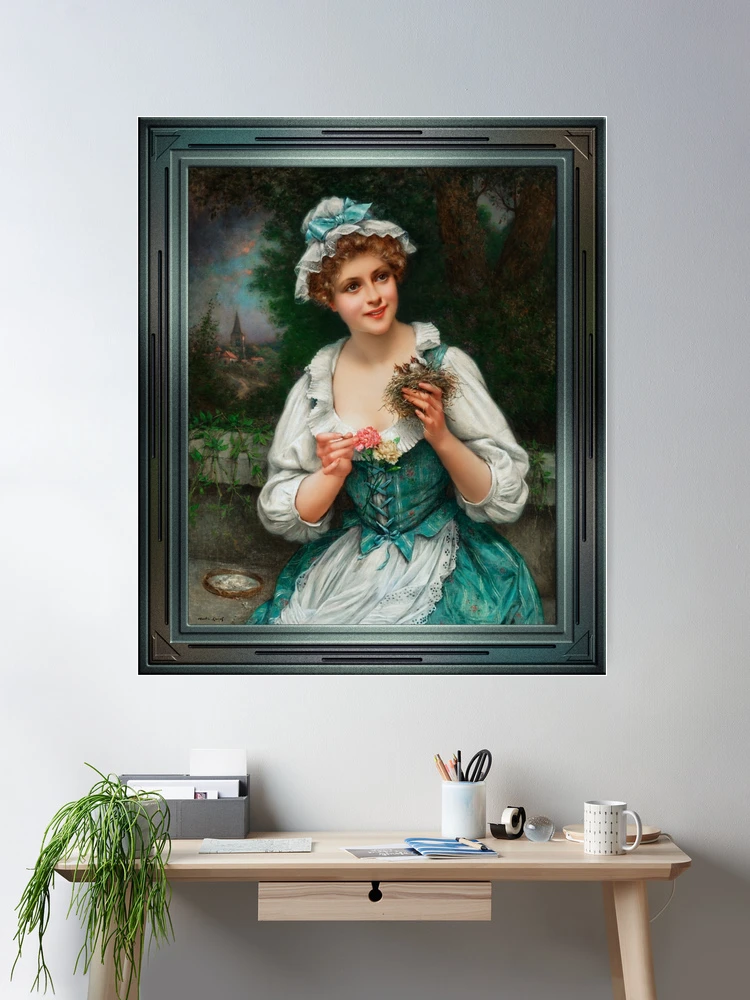
“Feeding Time,” painted in the late 19th century by the renowned French artist François Martin-Kavel (1861 – 1931), is a captivating and serene scene that masterfully blends elements of realism with the softness of romanticism. Martin-Kavel’s work frequently explores themes of youth, Natur, and domestic life, an dëst Stéck ass keng Ausnahm. The painting portrays a young woman in a pastoral setting, standing in a lush garden or field, gently holding a nest with small birds. The artist captures her tender interaction with nature, evoking a mood of peacefulness, Onschëlleg, and harmony between humankind and the environment.
Inhaltsverzeechnes
Haaptthemium: The Woman and Her Connection to Nature
Déi zentral Figur an “Feeding Time” ass eng jonk Fra, an enger Period spezifesch gekleet, delikat Ensembel. Si huet e liicht türkisbloe Kleed un, dekoréiert mat Spëtzekleeder an engem Satinband, déi Textur an e Gefill vu Weiblechkeet bäidréit. Hir wäiss Blouse mat geruffen Ärmelen kontrastéiert schéin mat der mëller, gedämpfte Faarwen vum Kleed. D'Detailer vum Kleed verroden d'Kënschtler suergfälteg Opmierksamkeet op d'Stofftextur, e Gefill vu Realismus ze kreéieren an der Aart a Weis wéi d'Liicht mam Stoff interagéiert. Op hirem Kapp, hatt huet eng wäiss Spëtzekapp, déi elegant mat engem mëllen bloe Bändchen gebonnen ass, weider hir sanft Erscheinung verbesseren.
An hiren Hänn, d'Fra wéckelt e klengt Vullennascht, e bedeitende Objet an der Zesummesetzung. D'Nascht, mat klenge Villercher gefëllt, symboliséiert neit Liewen, Onschëlleg, an pflegen. It is a powerful symbol of the cyclical nature of life and the bond between the natural world and humankind. Her delicate touch as she holds the nest demonstrates a deep respect and care for the creatures she tends to. D'Villercher, though not the main focus, are an integral part of the scene, emphasizing the tenderness of the moment and the artist’s thematic exploration of human interaction with nature.
Objeten: The Nest, Blummen, and Additional Symbols
The nest is not just a prop in the artwork, but a central symbol of life and care. The small birds inside appear to be receiving nourishment from the woman, underscoring the nurturing role of the female figure. The nest is placed against her chest, where it seems to be almost cradled like a child. This act of care and feeding is also mirrored by the woman’s other hand, which gently holds a pink flower, possibly a rose or carnation. The flower adds a touch of color to the scene and reinforces the motif of life, Schéinheet, an pflegen. It suggests a subtle connection to nature, with the woman herself acting as a bridge between the natural and human worlds.
The background of the painting includes a glimpse of a distant landscape, possibly a garden or meadow, shrouded in a soft, muted haze. The figures in the distance could be indicative of a nearby town or village, though they are not the main focus. This distant view adds depth and perspective to the painting, grounding the more intimate scene in a broader natural setting. The juxtaposition of the small-scale, delicate interaction in the foreground against the larger, more expansive natural landscape amplifies the idea that the harmony of the human world is inextricably linked to nature.
Terrain: A Quiet Garden or Pastoral Setting
The scene is set outdoors, possibly in a garden or a lush, green pasture, as evidenced by the vibrant foliage and the gentle roll of the landscape in the background. The garden is likely a symbol of tranquility and beauty, providing a natural, peaceful environment in which the central character can engage with nature. D'Luucht, which filters through the leaves of trees in the background, bascht d'Szen an engem waarme Glanz, further enhancing the serenity and calmness of the moment. The artist uses subtle, natural lighting to highlight the key elements of the composition, giving the painting an ethereal quality.
The terrain is rich in color, mat gréngen Téin déi den Hannergrond an d'Ëmgéigend Blieder dominéieren. D'Spill vu Liicht a Schied kreéiert eng mëll, bal dreemen Atmosphär, invitéieren den Zuschauer sech an dësem friddlechen virzestellen, bucolic Kader. D'Szene rifft e Gefill vun Zäitlosegkeet op, suggeréiert datt Momenter wéi dës, wou d'Mënschheet an der Harmonie mat der Natur ass, sinn universell an onverännert.
Stil, Thema, a Stëmmung vum Konschtwierk
Dem François Martin-Kavel säi Stil op “Feeding Time” ass am Realismus verwuerzelt, mat engem Touch vu Romantik, déi d'Szene mat enger idealiséierter Schéinheet infuséiert. Déi virsiichteg Rendering vum Stoff, Liicht, an Texturen beweist dem Kënschtler seng Fäegkeet fir déi komplizéiert Detailer vu senge Sujeten z'erhalen. Der mëller, bal verschwonneg Rendering vum Hannergrond, mat der doucer Porträtatioun vun der jonker Fra, schaaft e Kontrast, deen d'Klarheet verbessert an d'Zentralfigur konzentréiert.
D'Thema vum Bild dréint sech ëm d'Pfleeg, Onschëlleg, an déi enk Relatioun tëscht Mënsch an Natur. Déi suergfälteg Interaktioun vun der jonker Fra mam Nascht vun de Villercher bedeit eng idealiséiert Versioun vu Weiblechkeet a Mammheet, wat dacks an der Zäitkonscht gefeiert gouf. D'Szen ass net nëmmen eng Representatioun vun der Roll vun enger Fra an der Natur, awer och eng Reflexioun vun enger Ära wou d'Verbindung tëscht Mënschheet an Ëmwelt geéiert gouf. Dës harmonesch Relatioun ass wat d'Stëmmung vum Bild setzt - roueg, roueg, a sanft idealiséiert.
D'Stëmmung ass onweigerlech friddlech a frou, e Gefill vu Gléck vermëttelen ofgeleet vun einfachen, natierlech Akten. Den Ausdrock vun der Fra ass roueg an zefridden, an hir Haltung proposéiert souwuel Gentilitéit a Kraaft. She is not merely a passive figure in this scene; she actively engages with the birds, suggesting that she is a part of the natural cycle, fostering life and growth.
Conclusioun
“Feeding Time” by François Martin-Kavel is a stunning example of 19th-century French realism blended with romantic elements. The painting captures a serene and intimate moment of human interaction with nature, highlighting themes of nurturing, ee Wäissman, and the beauty of the natural world. Through meticulous attention to detail and a masterful use of light and texture, Martin-Kavel evokes a timeless mood that invites the viewer to pause and reflect on the delicate balance between humanity and nature.
Dëst ass eng retouchéiert digital Konscht al Meeschterreproduktioun vun engem ëffentleche Domain Bild.
Kënschtler Bio ofgeleet vun Artnet.com
De François Martin-Kavel war e franséische Genremaler, dee bekanntst ass fir seng idealiséiert Portraite vu schéine jonke Fraen, déi hien dacks an exotesche Kostümer oder an titilléierende Staaten vun der Undress duergestallt huet.
De Martin-Kavel huet besonnesch dacks seng weiblech Portraite gemoolt an zentréiert Kompositiounen, déi vun donkelen Stoffhannergrënn ëmginn waren, an teatralesch beliicht wéi wann duerch Spotlight op de Modell blénkt.
Och wann de François bekannt ass fir seng populär weiblech Figur Portraite, hie war och bekannt fir säi Stilleben Blummenkonscht a Landschaftsbiller; a war e reegelméissegen Aussteller am Salon des Artistes Français.
Als Member vum Salon, hie krut eng Medaille fir seng artistesch Contributiounen am 1881.