

Girl with a Poppy
“Girl with a Poppy” is a timeless portrayal by French painter Emile vernon, dee gelieft huet 1872 an 1919. The artwork depicts a young woman adorned with poppies, a theme often associated with both beauty and transience. Known for his skill in capturing delicate, naturalistic beauty, Vernon employed a detailed and precise style that resonates with the elegance of the early 20th century. This painting showcases Vernon’s finesse in using color and light to create a harmonious blend of realism and romanticism.
Inhaltsverzeechnes
Haaptthemium: A Woman of Grace
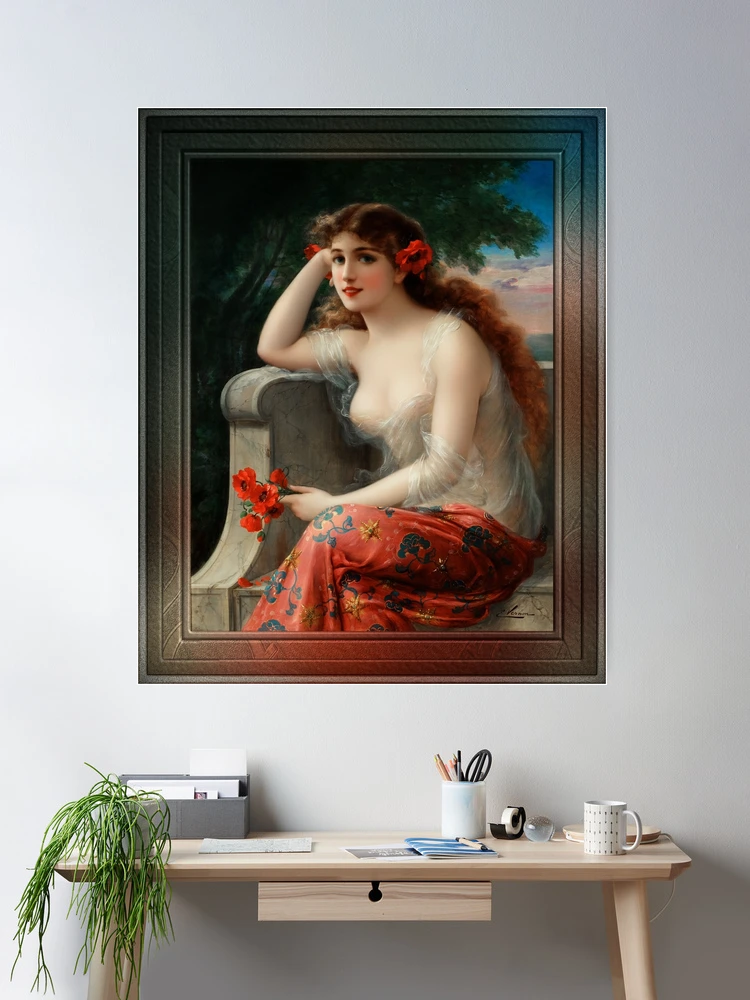
At the heart of this piece is the woman with her radiant features and serene expression. Her rich auburn hair is styled with delicate curls that frame her face, with two bold red poppies tucked in the loose strands, adding a vivid contrast to her pale complexion.
The woman gazes gently toward the viewer, her expression calm yet filled with subtle mystery. Hir Pose, slightly tilted to the side as she rests on a stone bench, gives an air of introspection, and her posture exudes both grace and elegance.
Hirem Kleedung, while simple, is imbued with luxurious softness. She wears a light, transparent garment that appears almost ethereal, flowing over her shoulder and extending in loose folds. The fine details of her garment’s fabric subtly reveal the artist’s attention to texture and depth, particularly in the way light catches on the translucent material. The poppies she holds in her left hand are vibrant and alive, contrasting with the softness of her skin and dress, symbolizing fleeting beauty and the passage of time.
Objects and Surrounding Elements
The focus on the young woman’s figure is surrounded by several key elements that enhance the painting’s romantic and contemplative atmosphere. She is seated on a marble bench, set against a lush, green landscape that suggests a garden or an outdoor space. The background is filled with dense foliage, including trees that reach upward toward the sky. This natural environment emphasizes the harmony between the subject and the world around her, as if she is one with the serene beauty of the landscape.
Am Hannergrond, the sky transitions from a soft blue to a gentle, warm pinkish hue near the horizon, perhaps indicating either early morning or late afternoon. This delicate use of color invokes a sense of quietude, allowing the viewer to feel the calmness of the scene while drawing attention back to the subject at the forefront. De Kader, with its natural details and soft lighting, creates an idealized world that complements the theme of timeless beauty and femininity.
Styl an Technik: Impressionistic Realism
Vernon’s artistic style is heavily influenced by both realism and impressionism. While his subject is depicted with lifelike accuracy, there is a distinct softness in the brushwork that allows the light to dance delicately on the surface of her skin and clothing. This effect contributes to a dreamy, bal anerweltlech Atmosphär, in which every detail, from the subtle contour of the figure to the play of light on her fabric, conveys the tenderness of the moment.
The artist’s approach to texture is particularly notable, as the fine details in the woman’s dress and the flowers she holds bring them to life. The translucent fabric of her dress seems to shimmer with the reflection of light, lending it a delicate, almost weightless quality. The poppies, vibrant in contrast to the muted tones of her attire and the soft, natural surroundings, symbolize the fleeting nature of youth and beauty, echoing the themes of impermanence in the piece.
The painting’s composition is carefully structured, drawing the viewer’s eye from the woman’s face to her hand, where she holds the poppies, and then outward to the lush background. The sense of depth in the piece, particularly in how the foliage recedes into the distance, verbessert d'Gefill vu Rou a Rou. De Wee wéi de Vernon d'Liicht benotzt fir d'Figur subtil ze modelléieren, zesumme mat der Opmierksamkeet op Detailer an de Blummen an der Natur ronderëm, proposéiert en déiwe Verständnis vu béiden natierleche Formen a mënschlecher Anatomie.
Stëmmung an Thema: Transience and Beauty
Déi allgemeng Stëmmung vun “Girl with a Poppy” ass eng vu Kontemplatioun a Rou. De mëllen Ausdrock vun der jonker Fra, kombinéiert mat der Genauegkeet vum Liicht an den natierlechen Elementer ronderëm hatt, invitéiert den Zuschauer an eng Welt, déi aus de Bedenken vum modernen Liewen ewechgehäit schéngt. Et gëtt eng Loft vu Geheimnis iwwer hatt, wéi wann si am Gedanken verluer ass oder an engem flüchtege Moment vu Rou gefaange wier.
D'Benotzung vu Mohnen am Konschtwierk spillt eng bedeitend symbolesch Roll. Poppies ginn dacks mat Themen vu Schéinheet an Vergänglechkeet verbonnen, well se delikat Blummen sinn, déi fir eng kuerz Zäit hell bléien ier se verschwonnen sinn. Dës Symbolik kéint als Meditatioun iwwer déi flüchteg Natur vu Jugend a Schéinheet gesi ginn, e gemeinsamt Thema an der Konscht a Literatur vun der Zäit. Déi roueg awer ephemeral Qualitéit vum Stéck suggeréiert datt d'Schéinheet vum Thema, wéi d'Mohnen déi hatt hält, ass momentan, awer déif sënnvoll a sech selwer.
Zousätzlech, den natierlechen Ëmfeld an déi sanft Pose vum Sujet schéngen eng zäitlos Verbindung mat der Äerd ze vermëttelen, en Thema dat dacks an der Konscht exploréiert gëtt als Reflexioun iwwer d'Relatioun tëscht Mënschheet an der natierlecher Welt. Andeems Dir déi jonk Fra an esou enger roueger Plaz setzt, bal idealiséiert Landschaft, De Vernon erfaasst en universellt Gefill vun Harmonie tëscht mënschlecht Liewen an der Schéinheet vun der natierlecher Welt.
Materialien an Techniken
Émile Vernon’s skillful use of oil paint in this piece is evident in the depth and richness of the colors, particularly the contrast between the soft skin tones of the woman and the vibrant red poppies. The fine brushstrokes used to capture the delicate textures of her skin, Hoer, and clothing are indicative of the artist’s meticulous attention to detail. D'Benotzung vu Liicht, both to illuminate the figure and to create soft shadows, adds dimension to the painting, making it not only a visual feast but an emotionally resonant experience.
The subtle gradations of color, from the soft pinkish light in the background to the deep, earthy tones of the marble bench, contribute to a sense of balance and serenity. The artist’s technique emphasizes texture and the interplay of light and shadow, creating a timeless piece that draws the viewer’s eye and encourages a deeper reflection on the themes of beauty and transience.
Girl with a Poppy by French Painter Emile vernon (1872 – 1919); dee sech spezialiséiert huet fir Aquarelle ze molen, mat sengem Haaptthema Fraen a Kanner an helle a faarwege ländleche Kader. Hien huet ënner dem William Bouguereau an dem Auguste Trouphème an der School of Fine Arts zu Paräis Frankräich trainéiert.
This is a wonderful idyllic portrait of a beautiful young lady sitting on a marble bench in a garden wearing a very sheer and flimsy white silk blouse and red skirt with blue embroidered flowers and gold star accents.
She has poppy flowers in her hair on both sides of her head while support the right side of her head with her folded arm on the high ledge of the bench; and holding a collection of poppy flowers in her left hand that is resting on her left leg that is folded over her right leg.
In the background we can see very large trees to her right and just behind her, as well a river in the distance bound by a very large forest and a beautiful of blue, wäiss, pink and orange hues.
Dëst ass eng retouchéiert digital Konscht al Meeschterreproduktioun vun engem ëffentleche Domain Bild.
Kënschtler Bio
Info Ënnen Vun Beauty Under The Orange Tree vum Émile Vernon
Den Émile Vernon war e Student an der Fine Arts School zu Tours, wou hien den éischte Präis fir Zeechnen gewonnen huet 1888; Den Émile Vernon war e Student an der Fine Arts School zu Tours, wou hien den éischte Präis fir Zeechnen gewonnen huet.
Den Émile Vernon war e Student an der Fine Arts School zu Tours, wou hien den éischte Präis fir Zeechnen gewonnen huet 1898 Den Émile Vernon war e Student an der Fine Arts School zu Tours, wou hien den éischte Präis fir Zeechnen gewonnen huet, Den Émile Vernon war e Student an der Fine Arts School zu Tours, wou hien den éischte Präis fir Zeechnen gewonnen huet 1898 an 1913; Den Émile Vernon war e Student an der Fine Arts School zu Tours, wou hien den éischte Präis fir Zeechnen gewonnen huet, Den Émile Vernon war e Student an der Fine Arts School zu Tours, wou hien den éischte Präis fir Zeechnen gewonnen huet, Den Émile Vernon war e Student an der Fine Arts School zu Tours, wou hien den éischte Präis fir Zeechnen gewonnen huet, Den Émile Vernon war e Student an der Fine Arts School zu Tours, wou hien den éischte Präis fir Zeechnen gewonnen huet, Den Émile Vernon war e Student an der Fine Arts School zu Tours, wou hien den éischte Präis fir Zeechnen gewonnen huet, Den Émile Vernon war e Student an der Fine Arts School zu Tours, wou hien den éischte Präis fir Zeechnen gewonnen huet.
Den Émile Vernon war e Student an der Fine Arts School zu Tours, wou hien den éischte Präis fir Zeechnen gewonnen huet, Den Émile Vernon war e Student an der Fine Arts School zu Tours, wou hien den éischte Präis fir Zeechnen gewonnen huet, Den Émile Vernon war e Student an der Fine Arts School zu Tours, wou hien den éischte Präis fir Zeechnen gewonnen huet, Den Émile Vernon war e Student an der Fine Arts School zu Tours, wou hien den éischte Präis fir Zeechnen gewonnen huet, Den Émile Vernon war e Student an der Fine Arts School zu Tours, wou hien den éischte Präis fir Zeechnen gewonnen huet, Den Émile Vernon war e Student an der Fine Arts School zu Tours, wou hien den éischte Präis fir Zeechnen gewonnen huet; mee hien war och e ganz versatile Kënschtler, dee mat Streng a Kraaft molen konnt wéi a senge Wierker de Portrait vun der Madame Vernon a Sous la Lampe (mee hien war och e ganz versatile Kënschtler, dee mat Streng a Kraaft molen konnt wéi a senge Wierker de Portrait vun der Madame Vernon a Sous la Lampe).