

Fleurs De Printemps – Flowers Of Spring
Introduction to the Artwork
Fleurs De Printemps (“Flowers of Spring”) is an exquisite work painted in 1878 by the renowned French artist William-Adolphe Bouguereau (1825 – 1905). Known for his mastery in rendering human figures with astonishing realism, Bouguereau’s “Fleurs De Printemps” epitomizes his prowess in depicting delicate details and soft textures, capturing the purity of youth and the vibrancy of springtime. This painting is a perfect example of Bouguereau’s signature style, showcasing his ability to merge portraiture with the natural world, offering an intimate glimpse into the innocence of childhood and the richness of nature.
Sisällysluettelo
Aihe
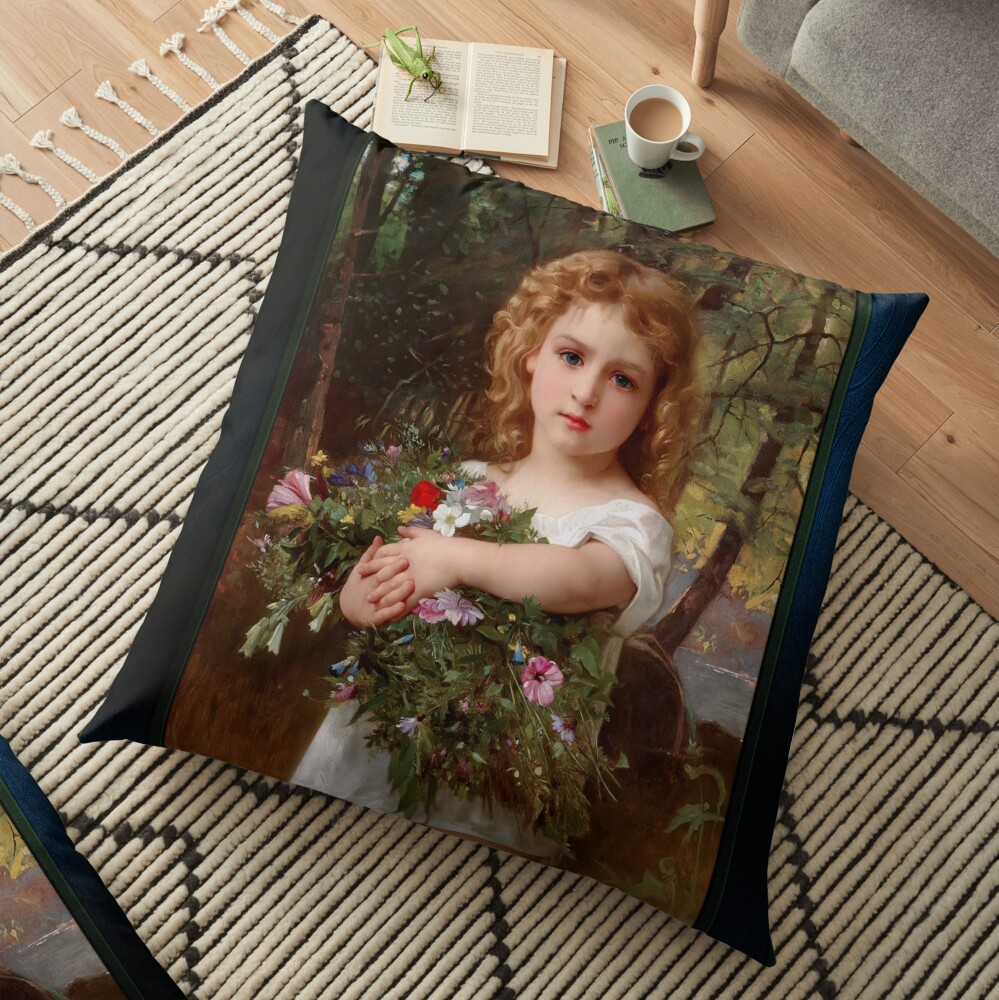
At the heart of the composition is a nuori tyttö, delicately posed as if she were an embodiment of spring itself. She is dressed in a simple white gown, her bare feet standing on the soft, earthy ground as she cradles an abundant bouquet of wildflowers against her chest. The floral arrangement she holds is a mixture of vibrant colors—deep purples, pinkit, valkoiset, and reds, evoking the fresh blossoms of the season. Her golden curls tumble down around her shoulders, contrasting against the pure whiteness of her garment. The girl gazes softly at the viewer with a subtle, almost shy expression, her features marked by a youthful innocence and purity that evoke a sense of nostalgia and tranquility.
The girl’s portrayal exudes the timeless theme of childhood innocence, yet it is also a nod to the floral symbolism of spring—a time of renewal, kasvu, ja hedelmällisyyteen. The flowers are as much a part of her as she is a part of them, suggesting a harmonious connection between human and nature.
Asetus
Taustalla “Fleurs De Printemps” is equally significant, as it sets the stage for the narrative of the young girl. The artist has chosen a wooded, sunlit landscape, with trees partially obscured by a soft mist of morning dew. This ethereal backdrop suggests a tranquil rural setting, possibly near a forest or meadow, and reflects the peaceful serenity of nature. The earthy tones of the surrounding trees, foliage, and ground create a contrast with the purity and brightness of the girl’s figure. The light filters through the foliage, casting dappled shadows on the earth, which enhances the sense of a serene and harmonious relationship between the figure and the environment.
Bouguereau’s attention to detail in the landscape—each leaf, each flower, and each blade of grass—is striking, further elevating the realism of the work. The natural surroundings appear to frame the girl, subtly emphasizing her as the focal point while also suggesting her belonging to the world around her.
Tyyli ja tekniikka
William-Adolphe Bouguereau was a master of the academic style, which was rooted in the traditions of realism and fine detail. His technique in “Fleurs De Printemps” showcases the soft, almost ethereal quality of light and texture that defined his work. Bouguereau’s use of light is exceptional, with the interplay of soft sunlight across the girl’s face and the flowers accentuating the contours of her delicate features. The fine brushwork creates a smooth surface, lähes samettisen näköinen, making the girl’s skin seem radiant and lifelike.
The precise modeling of the face and hands is characteristic of Bouguereau’s meticulous approach to human anatomy. The tender folds of the gown, the gentle curve of the child’s arms, and the weightlessness of her pose all reflect a sophisticated understanding of human form. This technique not only gives a sense of realism but also imbues the figure with a sense of inner life, as though the viewer is encountering a moment of real beauty rather than a mere representation.
The flowers themselves are rendered with an almost botanical accuracy. Bouguereau was particularly adept at painting flora and fauna, and the bouquet in this painting is a testament to his skill in capturing the intricate textures and colors of nature. The flowers appear fresh and vibrant, as if plucked from the ground just moments before.
Tunnelma ja teema
Mieliala “Fleurs De Printemps” is serene and contemplative, evoking a sense of nostalgia for a simpler, more innocent time. The young girl’s gaze, though soft, carries a depth of emotion that invites the viewer to reflect on themes of purity, nuori, and the fleeting nature of time. The softness of the figure, the gentle curvature of her body, and the expression on her face all suggest a sense of vulnerability, yet also an inherent strength. The connection to the natural world further amplifies these emotions, symbolizing life’s transient beauty, much like the blooming of flowers in spring that are destined to wither, only to be replaced by new growth.
The flowers themselves play a symbolic role in this painting. Traditionally, flowers represent the cycle of life, kasvu, and death, and here, they symbolize the innocence and vitality of youth. In spring, the flowers’ bloom mirrors the girl’s own youthful energy and unspoiled beauty. Bouguereau’s careful juxtaposition of the girl’s purity with the vibrant spring flowers suggests an inevitable passage of time, a theme that resonates deeply in the art of the 19th century.
Johtopäätös
“Fleurs De Printemps” is a quintessential example of William-Adolphe Bouguereau’s mastery in blending realism with emotional depth. The artwork encapsulates the beauty of the natural world and the fragility of youth, themes that were deeply significant to the artist and his contemporaries. Bouguereau’s attention to detail, his gentle rendering of the human form, and his understanding of light and shadow combine to create a painting that is not only visually stunning but also rich with emotional resonance. This work continues to be a testament to Bouguereau’s legacy as one of the finest painters of the 19th century.
Tietoja Taideteoksesta
Fleurs De Printemps is another version of William Bouguereau’s piece Little Girl With Flowers c1878; with a complete background.
While the other version of this piece was trimmed off just below the knees and had a black background; this version has a forest settings.
I was forced to modify the piece as the background of this version was in a shambles with most of the forest background being wiped away and the portions that were visible were almost completely black.
To remedy this an give the artwork a fresh new look, I decided to replace the background with the landscape piece Kahnpartie im Spreewald c1910 by German Painter Edward Theodore Compton (1849 – 1921).
This modification produces a background of trees and plants that blends nicely with the young girl and the tall grass behind her; and adds an additional light source and river to the far right.
I then went about repairing the cuts, cracks, dropouts and dirt from the painting; as well as blending the ground that had lost paint and just looked bad, so that it would blend with the rest of the scene.
The final result is that of an adorable bare foot lovely little girl, with light brown golden hair dressed in a white robe, with an angelic look to her; that is standing on a forest path carrying in her arms and close to her body, a very large assortment of wild flowers and plants that she has gathered during her forest outing.
Fleurs De Printemps is a remastered digital art old masters reproduction of a public domain image that is available as a rolled canvas, akryyli, metal and wood prints online.
Tietoja Taiteilijasta
Alla olevat tiedot ovat peräisin Wikipedia.org
William-Adolphe Bouguereau syntyi La Rochellessa, Ranska, päällä 30 marraskuu 1825, viini- ja oliiviöljykauppiaiden perheeseen. Katolisten vanhempien poika Théodore Bouguereau s.1800 ja Marie Bonnin s1804, tunnetaan nimellä Adeline.
Hänellä oli vanhempi veli, Alfred, ja nuorempi sisko, Marie (tunnetaan nimellä Hanna), joka kuoli seitsemän vuoden iässä. Perhe muutti Saint-Martin-de-Réen vuonna 1832. Toinen sisar syntyi vuonna 1834, Kisu.
Iässä 12, Bouguereau meni Mortagneen asumaan setänsä Eugènen luo, pappi ja kehitti rakkautta luontoon, uskontoa ja kirjallisuutta. Sisään 1839, hänet lähetettiin opiskelemaan pappeutta Ponsin katoliseen korkeakouluun.
Katolisessa korkeakoulussa Louis Sage opetti hänet piirtämään ja maalaamaan, joka opiskeli Ingresin johdolla. Bouguereau jätti vastahakoisesti opintonsa palatakseen perheelleen, asuu nyt Bordeaux'ssa. Ollessaan Bordeaux'ssa marraskuussa 1841 hän tapasi paikallisen taiteilijan, Charles Marionneau, ja jatkoi taiteellisia opintojaan piirustus- ja maalauskoulussa.
Bouguereau työskenteli myös kauppa -avustajana, litografioiden värjääminen käsin ja pienten maalausten tekeminen kromolitografialla. Hän oli pian luokkansa paras oppilas, ja päätti tulla taiteilijaksi Pariisissa. Muuton rahoittamiseksi, hän myi 33 allekirjoittamattomat öljymuotokuvat kolmessa kuukaudessa; ja ansaituilla rahoilla, saapui Pariisiin vuoden iässä 20 maaliskuussa 1846.
Saapuessaan Pariisiin Bouguereausta tuli École des Beaux-Artsin opiskelija; ja täydentää muodollista piirustuskoulutustaan, hän osallistui anatomisiin leikkauksiin ja opiskeli historiallisia pukuja ja arkeologiaa. Sisään 1848 hän loi tasa -arvon ennen kuolemaa (Tasa -arvo ennen kuolemaa), hänen ensimmäinen Bmajor -maalauksensa.
Myöhemmin hän sai aseman François-Édouard Picotin studiossa, jossa hän opiskeli maalausta akateemiseen tyyliin; Dante ja Virgil tuottavat helvetissä c1850, joka on varhainen esimerkki hänen uusklassisesta taiteestaan.
Bouguereau nautti elämänsä aikana huomattavaa suosiota Ranskassa ja Yhdysvalloissa, ja sai lukuisia virallisia kunnianosoituksia, samalla kun hän nauttii siitä, että hänen taideteoksestaan maksetaan korkein hinta. Sukupolvensa pohjimmaisena salonkimaalarina, Impressionistinen avantgarde häpäisi hänet.
Koko elämänsä ajan, Bouguereau teloitettiin 822 tunnettuja valmiita maalauksia, vaikka monien olinpaikka ei ole vielä tiedossa.