

Vorblóm – Flowers Of Spring
Introduction to the Artwork
Vorblóm (“Flowers of Spring”) is an exquisite work painted in 1878 by the renowned French artist William-Adolphe Bouguereau (1825 – 1905). Known for his mastery in rendering human figures with astonishing realism, Bouguereau’s “Vorblóm” epitomizes his prowess in depicting delicate details and soft textures, capturing the purity of youth and the vibrancy of springtime. This painting is a perfect example of Bouguereau’s signature style, showcasing his ability to merge portraiture with the natural world, offering an intimate glimpse into the innocence of childhood and the richness of nature.
Efnisyfirlit
Viðfangsefnið
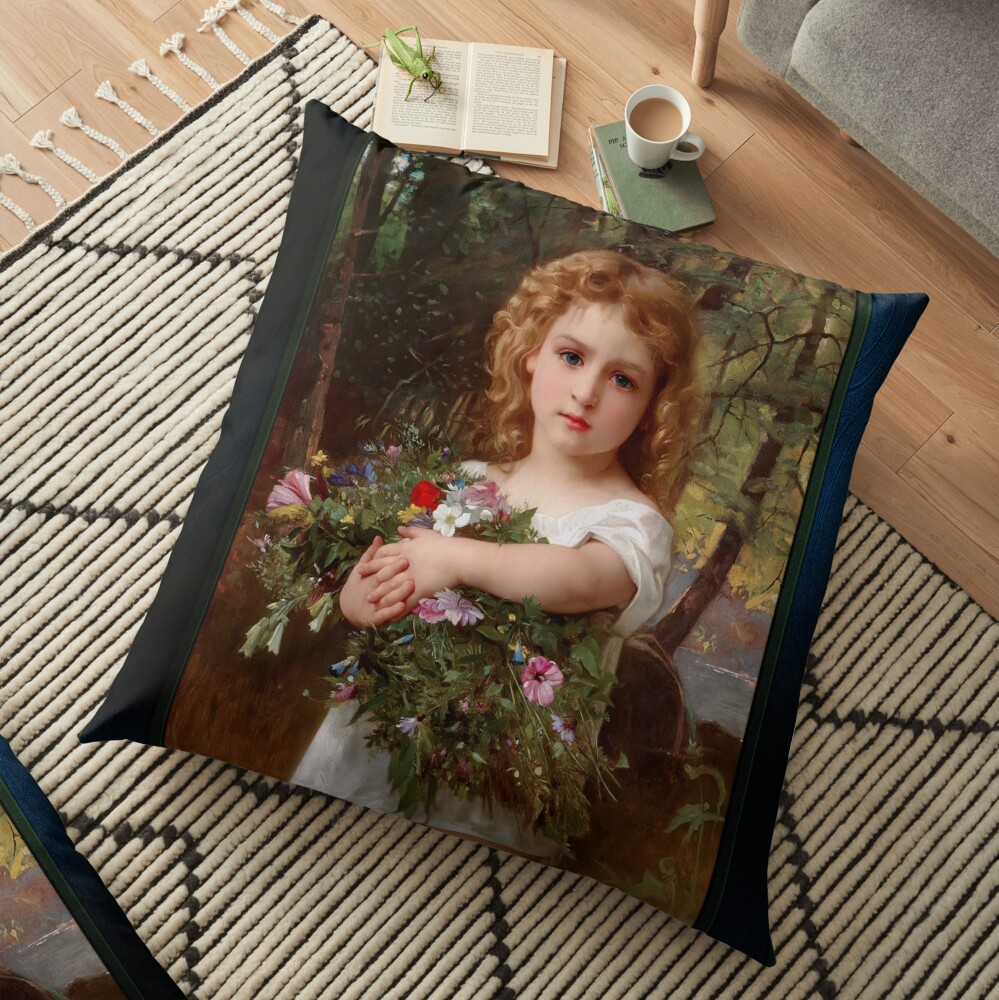
At the heart of the composition is a young girl, delicately posed as if she were an embodiment of spring itself. She is dressed in a simple white gown, her bare feet standing on the soft, earthy ground as she cradles an abundant bouquet of wildflowers against her chest. The floral arrangement she holds is a mixture of vibrant colors—deep purples, Bleikir, hvítum, and reds, evoking the fresh blossoms of the season. Her golden curls tumble down around her shoulders, contrasting against the pure whiteness of her garment. The girl gazes softly at the viewer with a subtle, almost shy expression, her features marked by a youthful innocence and purity that evoke a sense of nostalgia and tranquility.
The girl’s portrayal exudes the timeless theme of childhood innocence, yet it is also a nod to the floral symbolism of spring—a time of renewal, vöxtur, og frjósemi. The flowers are as much a part of her as she is a part of them, suggesting a harmonious connection between human and nature.
Umgjörðin
The backdrop of “Vorblóm” is equally significant, as it sets the stage for the narrative of the young girl. The artist has chosen a wooded, sunlit landscape, with trees partially obscured by a soft mist of morning dew. This ethereal backdrop suggests a tranquil rural setting, possibly near a forest or meadow, and reflects the peaceful serenity of nature. The earthy tones of the surrounding trees, foliage, and ground create a contrast with the purity and brightness of the girl’s figure. The light filters through the foliage, casting dappled shadows on the earth, which enhances the sense of a serene and harmonious relationship between the figure and the environment.
Bouguereau’s attention to detail in the landscape—each leaf, each flower, and each blade of grass—is striking, further elevating the realism of the work. The natural surroundings appear to frame the girl, subtly emphasizing her as the focal point while also suggesting her belonging to the world around her.
Stíllinn og tæknin
William-Adolphe Bouguereau was a master of the academic style, which was rooted in the traditions of realism and fine detail. His technique in “Vorblóm” showcases the soft, almost ethereal quality of light and texture that defined his work. Bouguereau’s use of light is exceptional, with the interplay of soft sunlight across the girl’s face and the flowers accentuating the contours of her delicate features. The fine brushwork creates a smooth surface, almost velvety in appearance, making the girl’s skin seem radiant and lifelike.
The precise modeling of the face and hands is characteristic of Bouguereau’s meticulous approach to human anatomy. The tender folds of the gown, the gentle curve of the child’s arms, and the weightlessness of her pose all reflect a sophisticated understanding of human form. This technique not only gives a sense of realism but also imbues the figure with a sense of inner life, as though the viewer is encountering a moment of real beauty rather than a mere representation.
The flowers themselves are rendered with an almost botanical accuracy. Bouguereau was particularly adept at painting flora and fauna, and the bouquet in this painting is a testament to his skill in capturing the intricate textures and colors of nature. The flowers appear fresh and vibrant, as if plucked from the ground just moments before.
Skapið og þemað
Stemningin á “Vorblóm” is serene and contemplative, evoking a sense of nostalgia for a simpler, more innocent time. The young girl’s gaze, though soft, carries a depth of emotion that invites the viewer to reflect on themes of purity, æsku, and the fleeting nature of time. The softness of the figure, the gentle curvature of her body, and the expression on her face all suggest a sense of vulnerability, yet also an inherent strength. The connection to the natural world further amplifies these emotions, symbolizing life’s transient beauty, much like the blooming of flowers in spring that are destined to wither, only to be replaced by new growth.
The flowers themselves play a symbolic role in this painting. Traditionally, flowers represent the cycle of life, vöxtur, and death, and here, they symbolize the innocence and vitality of youth. In spring, the flowers’ bloom mirrors the girl’s own youthful energy and unspoiled beauty. Bouguereau’s careful juxtaposition of the girl’s purity with the vibrant spring flowers suggests an inevitable passage of time, a theme that resonates deeply in the art of the 19th century.
Niðurstaða
“Vorblóm” is a quintessential example of William-Adolphe Bouguereau’s mastery in blending realism with emotional depth. The artwork encapsulates the beauty of the natural world and the fragility of youth, themes that were deeply significant to the artist and his contemporaries. Bouguereau’s attention to detail, his gentle rendering of the human form, and his understanding of light and shadow combine to create a painting that is not only visually stunning but also rich with emotional resonance. This work continues to be a testament to Bouguereau’s legacy as one of the finest painters of the 19th century.
About The Artwork
Fleurs De Printemps is another version of William Bouguereau’s piece Little Girl With Flowers c1878; with a complete background.
While the other version of this piece was trimmed off just below the knees and had a black background; this version has a forest settings.
I was forced to modify the piece as the background of this version was in a shambles with most of the forest background being wiped away and the portions that were visible were almost completely black.
Til að ráða bót á þessu og gefa listaverkinu ferskt nýtt útlit, Ég ákvað að skipta bakgrunninum út fyrir landslagsverkið Kahnpartie im Spreewald c1910 eftir þýska málarann Edward Theodore Compton (1849 – 1921).
Þessi breyting framleiðir bakgrunn af trjám og plöntum sem blandast vel við ungu stúlkuna og háa grasið fyrir aftan hana; og bætir við viðbótar ljósgjafa og á lengst til hægri.
Ég fór svo að gera við skurðina, sprungur, brottfall og óhreinindi úr málverkinu; auk þess að blanda jörðinni sem hafði misst málningu og leit bara illa út, þannig að það myndi blanda saman við restina af atriðinu.
Lokaniðurstaðan er yndisleg, berfætt yndisleg lítil stúlka, með ljósbrúnt gyllt hár klæddur hvítum skikkju, með englasvip til hennar; that is standing on a forest path carrying in her arms and close to her body, a very large assortment of wild flowers and plants that she has gathered during her forest outing.
Fleurs De Printemps is a remastered digital art old masters reproduction of a public domain image that is available as a rolled canvas, akrýl, málm- og viðarprentun á netinu.
Um Listamanninn
Upplýsingar hér að neðan fengnar af Wikipedia.org
William Adolphe Bouguereau fæddist í La Rochelle, Frakklandi, á 30 nóvember 1825, inn í fjölskyldu vín- og ólífuolíukaupmanna. Sonur kaþólskra foreldra Théodore Bouguereau f1800 og Marie Bonnin f1804, þekkt sem Adeline.
Hann átti eldri bróður, Alfreð, og yngri systir, Marie (þekkt sem Hanna), sem lést sjö ára að aldri. Fjölskyldan flutti til Saint-Martin-de-Ré í 1832. Annað systkini fæddist í 1834, Kitty.
Á aldrinum 12, Bouguereau fór til Mortagne til að vera hjá frænda sínum Eugène, prestur og þróaði með sér ást á náttúrunni, trúarbrögð og bókmenntir. Í 1839, hann var sendur til prestsnáms við kaþólskan háskóla í Pons.
Í kaþólska háskólanum var honum kennt að teikna og mála af Louis Sage, sem hafði numið hjá Ingres. Bouguereau yfirgaf námið með tregðu til að snúa aftur til fjölskyldu sinnar, býr nú í Bordeaux. Á meðan hann var í Bordeaux í nóvember 1841 hann hitti listamann á staðnum, Charles Marioneau, og hélt áfram myndlistarnámi við teikni- og málaraskólann.
Bouguereau starfaði einnig sem verslunarmaður, handlita litógrafíur og gera lítil málverk sem voru afrituð með litskiljun. Hann var fljótlega besti nemandinn í bekknum sínum, og ákvað að verða listamaður í París. Til að fjármagna flutninginn, hann seldi 33 óundirritaðar olíuportrettmyndir á þremur mánuðum; og með þeim peningum sem aflað er, kom til Parísar um árabil 20 í mars 1846.
Eftir að hann kom til Parísar varð Bouguereau nemandi við École des Beaux-Arts; og til að bæta við formlega þjálfun hans í teikningu, hann sótti líffærafræðilegar krufningar og lærði sögulega búninga og fornleifafræði. Í 1848 hann skapaði jafnrétti fyrir dauðann (Jafnrétti fyrir dauðann), fyrsta Bmajor málverk hans.
Síðar fékk hann stöðu í vinnustofu François-Édouard Picot, þar sem hann lærði málaralist í akademískum stíl; framleiðandi Dante og Virgil í helvíti c1850, sem er snemma dæmi um nýklassísk listaverk hans.
Á meðan hann lifði naut Bouguereau umtalsverðra vinsælda í Frakklandi og Bandaríkjunum, og var veittur fjöldi opinberra heiðursmanna, á sama tíma og hann naut þess að fá greitt hæsta verð fyrir listaverkin sín. Sem aðalsnyrtistofa málari sinnar kynslóðar, hann var smánaður af framúrstefnu impressjónista.
Alla ævi hans, Bouguereau tekinn af lífi 822 þekkt fullunnin málverk, þó að enn sé ekki vitað hvar margir eru.