

Flowers Of Gardens
Cyflwyniad i'r Gwaith Celf
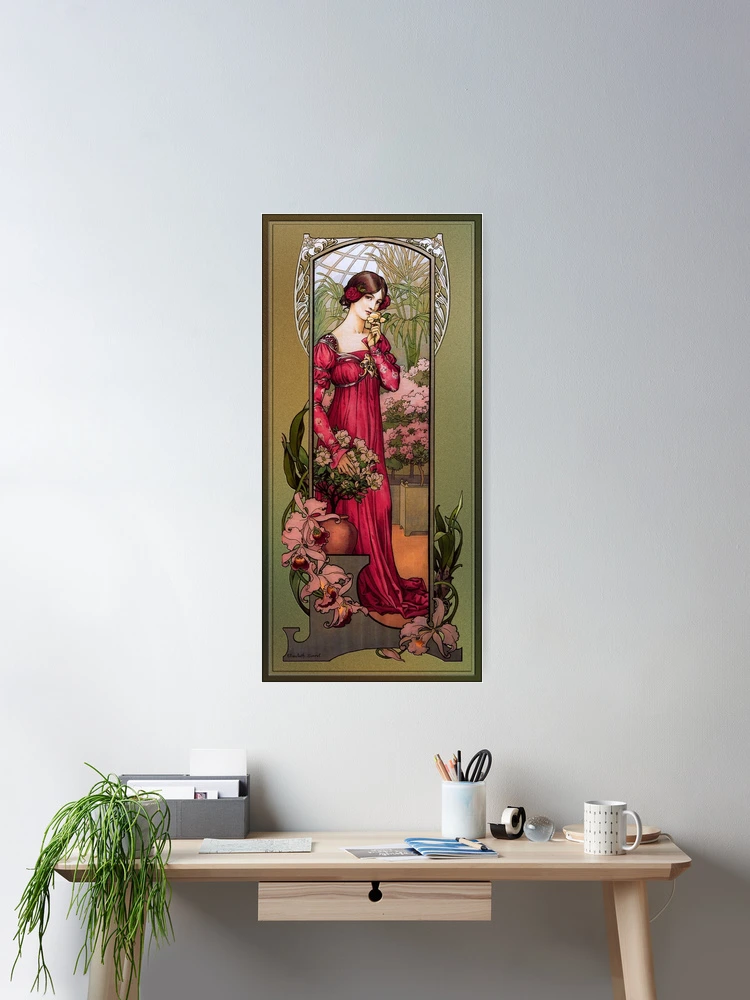
Teitl y paentiad Flowers Of Gardens, creu o gwmpas 1900 by French artist Elisabeth Sonrel, exemplifies the Art Nouveau style with its refined blend of nature and feminine grace. Elisabeth Sonrel (1874–1953) was an accomplished painter who, much like other artists of her time, sought to integrate decorative arts and natural elements into her work, creating serene and idealized depictions of women in harmony with their surroundings. Flowers Of Gardens stands as a testament to Sonrel’s mastery of capturing beauty, both in the human form and the natural world, within the confines of a highly stylized framework.
Yn y darn hwn, the artist presents a young woman amidst a lush garden filled with blossoming flowers, creating a sense of peace, meddalwch, a cheinder oesol. The work belongs to the transition period of the late 19th and early 20th century, when artists began to experiment with more decorative elements in their work, setting the stage for the Art Nouveau movement to flourish.
Tabl Cynnwys
Y Ffigur Canolog: The Woman in the Garden
The focal point of the painting is the elegant woman, who stands poised amidst a garden of flourishing plants. She gazes slightly off to the side, gently holding a flower to her lips. Her expression is one of quiet contemplation, almost as if she is lost in thought, making the viewer ponder what she may be contemplating. The artist uses soft, fluid lines to create the delicate figure, accentuating her grace and beauty. Her posture is stately, yet relaxed, as though she is one with the flowers around her.
The woman is dressed in a flowing gown of deep pink, which enhances her romantic, almost ethereal appearance. Y gŵn, with its intricate folds and soft fabric, yn ategu ei nodweddion cain. The long sleeves of her dress, which gather slightly at the wrists, suggest a gentle yet refined femininity, while the delicate rose-colored flowers in her hair add an extra layer of romanticism and connection to the floral surroundings. There is a sense of timelessness about her, as though she could exist in any era, embodying the ideal of beauty and serenity that Sonrel sought to portray.
The Floral and Botanical Setting
The garden setting in Flowers Of Gardens is lush and detailed, and it plays a crucial role in enhancing the overall theme of the painting. Surrounding the central figure is a profusion of flowers in various stages of bloom. The woman’s proximity to these plants, coupled with her tender interaction with them, suggests a deep connection between the human and natural worlds. Y blodau, though not named specifically, are painted with exquisite detail, and they seem to spring to life with every brushstroke. Their delicate petals, some of which are white or pale pink, contribute to the overall softness of the scene, reinforcing the tranquility of the moment.
The garden setting itself is depicted as a tranquil, slightly enclosed space, with the glass structure in the background resembling a greenhouse or garden conservatory. The latticework of the glass and the intertwining plants visible through it provide a sense of depth and structure within the composition. The background setting, with its muted greens and beiges, contrasts with the vibrant colors of the flowers and the woman’s gown, drawing attention to the central figure without overpowering the scene.
At the lower corners of the painting, large blooms—perhaps orchids—add another layer of complexity and interest to the piece. The intricate depiction of these flowers, with their sinuous curves and graceful form, echoes the flowing lines of the woman’s gown and hair, further blending human and natural elements.
Deunyddiau a Thechneg
Sonrel’s technique in Flowers Of Gardens reflects her skill in creating harmony between color, llinell, a ffurf. The painting is rendered with soft, flowing lines typical of the Art Nouveau style, which often favors organic shapes and an emphasis on decoration. The use of pastel tones—soft pinks, gwyrddion, and pale yellows—creates a serene, awyrgylch bron yn freuddwydiol. The lightness of the color palette adds to the feeling of delicacy and elegance, as if the entire composition exists in a peaceful reverie.
The artist’s handling of light and shadow is subtle but effective. The soft shading around the figure and the background flowers suggests a gentle, diffused light source, as though the woman is bathed in the glow of a late afternoon sun. The absence of harsh shadows gives the painting a soft, inviting quality, reinforcing the tranquil mood.
The Mood and Theme
Mae naws Flowers Of Gardens is one of harmony, harddaf, and reflection. The artist’s emphasis on a young woman in a peaceful garden, surrounded by blooming flowers, speaks to the broader themes of natural beauty and the idealization of femininity. Sonrel creates an environment that is not only visually pleasing but emotionally evocative. The viewer is invited to pause and reflect on the natural beauty of the world, and the way in which human beings can interact with and appreciate the natural world in a delicate, almost spiritual way.
The theme of femininity is prevalent throughout the artwork, with the woman portrayed as the central figure of beauty and grace. She is not merely a passive object of admiration but is instead actively engaged with her surroundings, holding a flower as if it were an extension of herself. This interaction suggests a deeper connection with nature, a theme often found in the works of Art Nouveau artists.
Sonrel’s painting also carries a timeless quality, as if the scene could belong to any era in which beauty and nature were revered. The garden, with its rich symbolism, alludes to themes of growth, renewal, and the cycles of life, while the woman’s elegant pose conveys a sense of enduring beauty that transcends time.
Nghasgliad
Élisabeth Sonrel’s Flowers Of Gardens is a masterful representation of Art Nouveau’s emphasis on beauty, natur, and the female form. The artist’s ability to capture the soft harmony between the woman and her floral surroundings speaks to her deep understanding of both the natural world and human grace. The painting evokes a mood of serenity and timeless elegance, offering the viewer a moment of reflection and appreciation for the simple yet profound beauty of nature. Through her skillful use of color, llinell, a ffurf, Sonrel invites us to experience a world where beauty is both delicate and enduring, where humans and nature exist in a perfect, harmonious balance.
Flowers Of Gardens is a retouched digital art old masters reproduction of a public domain image.
Am Yr Artist
Gwybodaeth Isod Trwy garedigrwydd Wikipedia.org
Elisabeth Sonrel (1874 Teithiau - 1953 Morloi) yn arlunydd a darlunydd Ffrengig yn arddull Art Nouveau. Roedd ei gweithiau'n cynnwys pynciau alegorïaidd, cyfriniaeth a symbolaeth, portreadau a thirweddau.
Roedd hi'n ferch i Nicolas Stéphane Sonrel, paentiwr o Tours, a derbyniodd ei hyfforddiant cynnar ganddo. Am astudiaeth bellach aeth ymlaen i Baris fel myfyriwr Jules Lefebvre yn yr Ecole des Beaux-Arts.
Yn 1892 paentiodd ei gwaith diploma, ‘Pax et Labour’, gwaith i'w weld yn y Musée des Beaux-Arts de Tours. O hynny ymlaen bu’n arddangos yn y Salon des Artistes Français rhwng 1893 a 1941, ei darnau llofnod yw dyfrlliwiau mawr mewn dull Cyn-Raffaelaidd, a fabwysiadodd ar ôl taith i Fflorens a Rhufain, darganfod paentwyr y Dadeni – peth o'i gwaith yn cael gwrthdroadau clir o Botticelli. Roedd ei phaentiadau yn aml yn cael eu hysbrydoli gan ramant Arthuraidd, Comedi Ddwyfol Dante Alighieri’ a 'Y Bywyd Newydd', themâu Beiblaidd, a chwedlau canoloesol. Mae ei gweithiau cyfriniol yn cynnwys ‘Ames errantes’ (Salon o 1894) a ‘Gwirodydd yr Abyss’ (Salon o 1899) a "Menyw ifanc gyda'r tapestri".
Yn yr Exposition Universelle o 1900, ei brif thema oedd Art Nouveau, hi 1895 paentio ‘Cwsg y Forwyn’ (Cwsg y Forwyn), dyfarnwyd medal efydd iddo, a gwobr Henri Lehmann o 3000 ffranc gan Academi y Celfyddydau Cain.[3] O 1900 ymlaen cyfyngodd ei llun i bortreadau, tirweddau golygfaol Llydaw, ac ambell astudiaeth flodau.
Roedd hi'n gwneud teithiau paentio rheolaidd i Lydaw, wedi'i ysbrydoli gan goedwig Brocéliande, ac o 1910 i amrywiol leoedd ar yr arfordir fel Concarneau, Plougastel, Pont-l'Abbé a Loctudy, yn aml yn aros mewn tafarndai ac yng nghwmni un neu ddau o fyfyrwyr. Peintiodd sawl gwaith yn Le Faouët cyn adeiladu fila yn La Baule yn y 1930au. Gweithio'n bennaf mewn dyfrlliw a gouache, darganfu gyflenwad parod o fodelau ymhlith merched ifanc yr ardal, a chanfu fod Bretons yn gyffredinol yn gyfeillgar, onest a hunanhyderus.
Roedd ei harddangosfa olaf yn y Salon i mewn 1941 yn oed 67. Mae yna gofnod hefyd iddi arddangos yn Lerpwl. Yn ei blynyddoedd cynnar cynhyrchodd Sonrel bosteri, cardiau post a lluniau, yn arddull Art Nouveau.