

Flowers Of Mountains
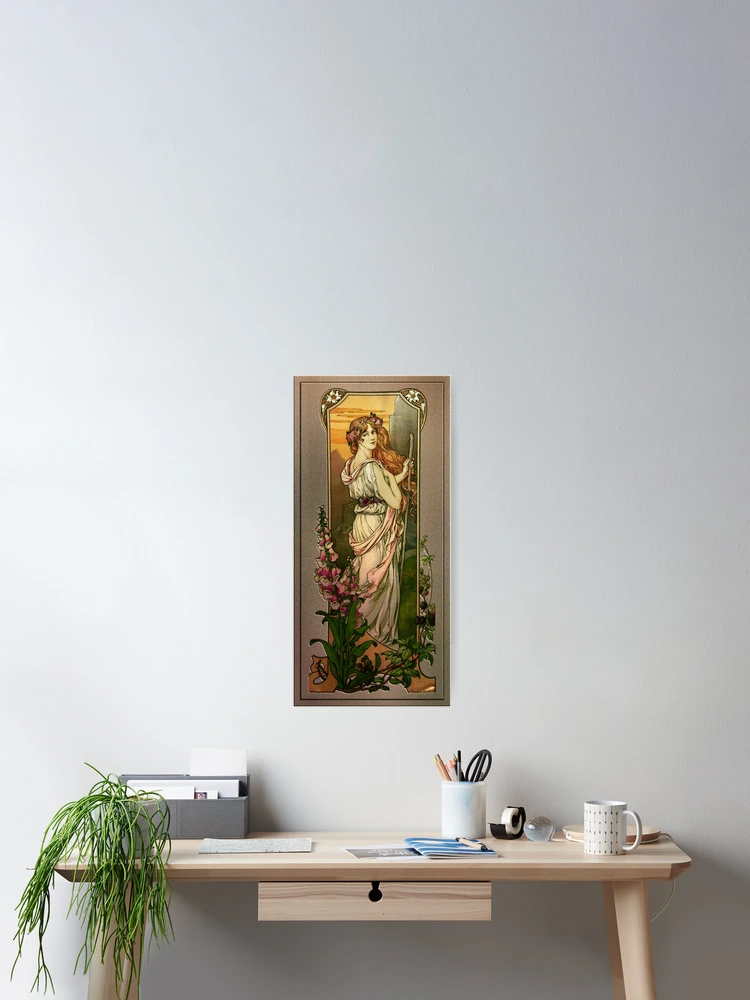
Flowers Of Mountains c1900 by French Painter Elisabeth Sonrel (1874 – 1953); a darlunydd o arddull Art Nouveau; roedd pwy oedd yn gweithio yn cynnwys pynciau alegorïaidd, cyfriniaeth a symbolaeth, portreadau a thirweddau.
This exquisite artwork, Sonrel draws upon the allure of both mythology and nature, bringing together the two elements with a delicate balance of beauty, harddaf, and introspective solitude.
Tabl Cynnwys
Prif Bwnc
The central figure in this painting is a female figure of ethereal beauty, who stands tall and poised against a backdrop of towering mountains and a soft, warm sky. The figure is a young woman, draped in a flowing white gown that billows gently in the breeze, the fabric rendered with soft folds that add texture and depth. Y gŵn, cinched at the waist with a simple yet elegant belt, enhances the fluidity of her form, emphasizing the harmony between the figure and nature.
Ei gwallt, a cascade of rich auburn locks, tumbles loosely over her shoulders, further evoking the timeless quality of her beauty. A wreath of flowers rests atop her head, creating a delicate coronet that brings an air of wildness to her femininity. The flowers in the wreath are small and vibrant, suggesting a connection to the natural world, as though the woman is an embodiment of the flora around her. This crown of blossoms enhances her ethereal, almost divine presence.
Yn ei llaw dde, she holds a long, slender staff, which could be interpreted as a symbol of wisdom or guidance. The staff is simple yet dignified, acting as a subtle reminder of the woman’s authority and connection to the surrounding terrain. The gentle grip and relaxed posture suggest that the figure is at ease within her environment, exuding a calm confidence in her role.
Gwrthrychau a Manylion
Flanking the woman on either side are two prominent floral elements, one of foxglove flowers (Digitalis) on the left and a rich array of blackberry vines and leaves on the right. These plants serve to frame the central figure, drawing the viewer’s eye toward her while enhancing the narrative of nature’s embrace. The foxgloves, with their tall spires of bell-shaped flowers, are vibrant and reach towards the sky, creating a visual contrast to the woman’s grounded, earthbound posture. The blackberry vines, full of lush green leaves and dark, ripening berries, offer a sense of wildness and fertility, reinforcing the theme of the woman’s natural connection to the land.
The mountains in the background, though not dominant in their portrayal, provide a sense of scale and depth. They rise majestically in the distance, their peaks partially obscured by mist, giving them a mysterious and timeless quality. The sky above is awash in warm, tonau aur, with hints of soft pink and orange, gan awgrymu naill ai'r wawr neu'r cyfnos, times of transition and introspection. This choice of color palette infuses the work with a sense of tranquility and quiet contemplation.
Tir a Defnyddiau
The terrain is rugged and unyielding, yet it complements the softness of the woman’s figure. It is a place where life flourishes despite its harshness, as seen in the surrounding flora. The colors used for the terrain and flowers are earthy and natural, suggesting that Sonrel was inspired by the rugged landscapes of the French countryside or perhaps the mythical landscapes of ancient Greece. The artist’s careful attention to detail in the plants and the mountains shows her deep understanding of both nature and the human form, blending them seamlessly in this piece.
Arddull a Thema
The style of this artwork is deeply rooted in the Art Nouveau movement, which flourished in the late 19th and early 20th centuries. Characterized by its emphasis on organic forms, llinellau llifo, and harmonious integration of nature and human figures, the Art Nouveau style is exemplified here through the graceful curvature of the woman’s pose and the intricate floral details surrounding her. Sonrel’s use of soft, blended colors and flowing lines imbues the piece with a dreamlike quality, inviting the viewer into a world where nature and humanity coexist in perfect balance.
Thematically, Flowers of the Mountains explores the connection between the human figure and the natural world. The woman in the painting is not just a figure of beauty but also a symbol of nature itself. Her presence among the flowers, her wreath, and the connection to the mountains all suggest a deeper bond between humanity and the earth, perhaps drawing from ancient mythologies where women often represented the earth, ffrwythlondeb, or nature’s vitality. The use of flowers, especially those associated with healing and growth like foxglove, suggests that the figure is not just passive in her environment but an active participant in the life force of nature.
Hwyliau ac Atmosffer
The mood of the painting is one of serene contemplation. There is no rush in the figure’s posture, no urgency in her gaze, which is directed off to the side, as if she is lost in thought or in quiet communion with the natural world around her. Y palet lliw, with its soft pinks, porffor, and greens, further contributes to the tranquil atmosphere. Y mynyddoedd, while present, are distant and unobtrusive, further adding to the sense of solitude and peace. The entire piece invites the viewer to pause and reflect, offering a moment of stillness in the midst of a busy world.
Nghasgliad
Yn Flowers of the Mountains, Elisabeth Sonrel has created not just a portrait of a woman but a celebration of nature’s beauty and its eternal connection to the human spirit. The blending of the figure with the flowers, the gentle, flowing lines of her form, and the serene landscape all convey a message of harmony, tranquility, and reverence for the natural world. Through her delicate use of color, golau, a chyfansoddiad, Sonrel has produced a work that stands as a timeless reflection of the beauty of nature and the human soul’s connection to it.
Mae Flowers Of Mountains yn hen feistri celf ddigidol wedi'i ail-atgynhyrchu sy'n atgynhyrchu delwedd parth cyhoeddus.
Gwybodaeth Isod Trwy garedigrwydd Wikipedia.org
Elisabeth Sonrel (1874 Teithiau - 1953 Morloi) yn arlunydd a darlunydd Ffrengig yn arddull Art Nouveau. Roedd ei gweithiau'n cynnwys pynciau alegorïaidd, cyfriniaeth a symbolaeth, portreadau a thirweddau.
Roedd hi'n ferch i Nicolas Stéphane Sonrel, paentiwr o Tours, a derbyniodd ei hyfforddiant cynnar ganddo. Am astudiaeth bellach aeth ymlaen i Baris fel myfyriwr Jules Lefebvre yn yr Ecole des Beaux-Arts.
Yn 1892 paentiodd ei gwaith diploma, ‘Pax et Labour’, gwaith i'w weld yn y Musée des Beaux-Arts de Tours. O hynny ymlaen bu’n arddangos yn y Salon des Artistes Français rhwng 1893 a 1941, ei darnau llofnod yw dyfrlliwiau mawr mewn dull Cyn-Raffaelaidd, a fabwysiadodd ar ôl taith i Fflorens a Rhufain, darganfod paentwyr y Dadeni – peth o'i gwaith yn cael gwrthdroadau clir o Botticelli. Roedd ei phaentiadau yn aml yn cael eu hysbrydoli gan ramant Arthuraidd, Comedi Ddwyfol Dante Alighieri’ a 'Y Bywyd Newydd', themâu Beiblaidd, a chwedlau canoloesol. Mae ei gweithiau cyfriniol yn cynnwys ‘Ames errantes’ (Salon o 1894) a ‘Gwirodydd yr Abyss’ (Salon o 1899) a "Menyw ifanc gyda'r tapestri".
Yn yr Exposition Universelle o 1900, ei brif thema oedd Art Nouveau, hi 1895 paentio ‘Cwsg y Forwyn’ (Cwsg y Forwyn), dyfarnwyd medal efydd iddo, a gwobr Henri Lehmann o 3000 ffranc gan Academi y Celfyddydau Cain.[3] O 1900 ymlaen cyfyngodd ei llun i bortreadau, tirweddau golygfaol Llydaw, ac ambell astudiaeth flodau.
Roedd hi'n gwneud teithiau paentio rheolaidd i Lydaw, wedi'i ysbrydoli gan goedwig Brocéliande, ac o 1910 i amrywiol leoedd ar yr arfordir fel Concarneau, Plougastel, Pont-l'Abbé a Loctudy, yn aml yn aros mewn tafarndai ac yng nghwmni un neu ddau o fyfyrwyr. Peintiodd sawl gwaith yn Le Faouët cyn adeiladu fila yn La Baule yn y 1930au. Gweithio'n bennaf mewn dyfrlliw a gouache, darganfu gyflenwad parod o fodelau ymhlith merched ifanc yr ardal, a chanfu fod Bretons yn gyffredinol yn gyfeillgar, onest a hunanhyderus.
Roedd ei harddangosfa olaf yn y Salon i mewn 1941 yn oed 67. Mae yna gofnod hefyd iddi arddangos yn Lerpwl. Yn ei blynyddoedd cynnar cynhyrchodd Sonrel bosteri, cardiau post a lluniau, yn arddull Art Nouveau.