

Flowers Of Gardens
Introdução à obra de arte
The painting titled Flowers Of Gardens, criado em torno 1900 by French artist Elisabeth Sonrel, exemplifies the Art Nouveau style with its refined blend of nature and feminine grace. Elisabeth Sonrel (1874–1953) was an accomplished painter who, much like other artists of her time, sought to integrate decorative arts and natural elements into her work, creating serene and idealized depictions of women in harmony with their surroundings. Flowers Of Gardens stands as a testament to Sonrel’s mastery of capturing beauty, both in the human form and the natural world, within the confines of a highly stylized framework.
Nesta peça, the artist presents a young woman amidst a lush garden filled with blossoming flowers, creating a sense of peace, softness, and timeless elegance. The work belongs to the transition period of the late 19th and early 20th century, when artists began to experiment with more decorative elements in their work, setting the stage for the Art Nouveau movement to flourish.
Índice
A Figura Central: The Woman in the Garden
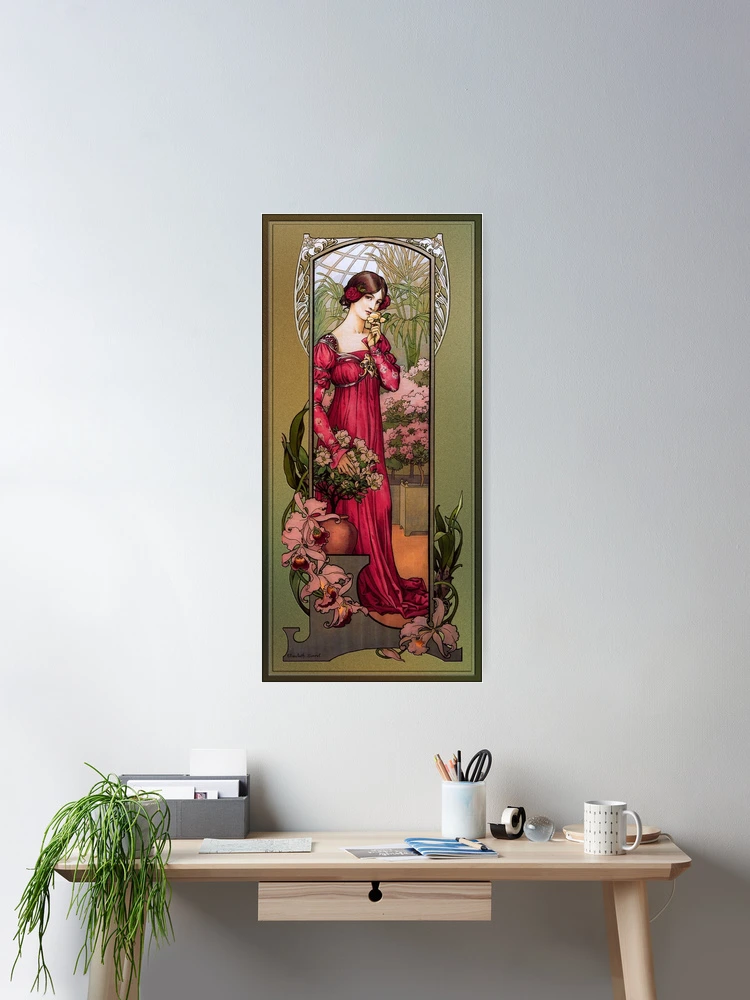
The focal point of the painting is the elegant woman, who stands poised amidst a garden of flourishing plants. She gazes slightly off to the side, gently holding a flower to her lips. Her expression is one of quiet contemplation, almost as if she is lost in thought, making the viewer ponder what she may be contemplating. The artist uses soft, fluid lines to create the delicate figure, accentuating her grace and beauty. Her posture is stately, yet relaxed, as though she is one with the flowers around her.
The woman is dressed in a flowing gown of deep pink, which enhances her romantic, almost ethereal appearance. O vestido, with its intricate folds and soft fabric, complements her delicate features. The long sleeves of her dress, which gather slightly at the wrists, suggest a gentle yet refined femininity, while the delicate rose-colored flowers in her hair add an extra layer of romanticism and connection to the floral surroundings. There is a sense of timelessness about her, as though she could exist in any era, embodying the ideal of beauty and serenity that Sonrel sought to portray.
The Floral and Botanical Setting
The garden setting in Flowers Of Gardens is lush and detailed, and it plays a crucial role in enhancing the overall theme of the painting. Surrounding the central figure is a profusion of flowers in various stages of bloom. The woman’s proximity to these plants, coupled with her tender interaction with them, suggests a deep connection between the human and natural worlds. As flores, though not named specifically, are painted with exquisite detail, and they seem to spring to life with every brushstroke. Their delicate petals, some of which are white or pale pink, contribute to the overall softness of the scene, reinforcing the tranquility of the moment.
The garden setting itself is depicted as a tranquil, slightly enclosed space, with the glass structure in the background resembling a greenhouse or garden conservatory. The latticework of the glass and the intertwining plants visible through it provide a sense of depth and structure within the composition. The background setting, with its muted greens and beiges, contrasts with the vibrant colors of the flowers and the woman’s gown, drawing attention to the central figure without overpowering the scene.
At the lower corners of the painting, large blooms—perhaps orchids—add another layer of complexity and interest to the piece. The intricate depiction of these flowers, with their sinuous curves and graceful form, echoes the flowing lines of the woman’s gown and hair, further blending human and natural elements.
Materiais e Técnica
Sonrel’s technique in Flowers Of Gardens reflects her skill in creating harmony between color, line, e forma. The painting is rendered with soft, flowing lines typical of the Art Nouveau style, which often favors organic shapes and an emphasis on decoration. The use of pastel tones—soft pinks, verdes, and pale yellows—creates a serene, atmosfera quase onírica. A leveza da paleta de cores soma-se à sensação de delicadeza e elegância, como se toda a composição existisse em um devaneio pacífico.
O tratamento de luz e sombra do artista é sutil, mas eficaz. O sombreamento suave ao redor da figura e das flores de fundo sugere uma suave, fonte de luz difusa, como se a mulher estivesse banhada pelo brilho do sol do fim da tarde. A ausência de sombras fortes confere à pintura um aspecto suave, qualidade convidativa, reforçando o clima tranquilo.
O humor e o tema
O humor de Flowers Of Gardens é de harmonia, graça, e reflexão. A ênfase do artista em uma jovem em um jardim tranquilo, cercado por flores desabrochando, fala dos temas mais amplos da beleza natural e da idealização da feminilidade. Sonrel cria um ambiente que não é apenas visualmente agradável, mas também emocionalmente evocativo. The viewer is invited to pause and reflect on the natural beauty of the world, and the way in which human beings can interact with and appreciate the natural world in a delicate, almost spiritual way.
The theme of femininity is prevalent throughout the artwork, with the woman portrayed as the central figure of beauty and grace. She is not merely a passive object of admiration but is instead actively engaged with her surroundings, holding a flower as if it were an extension of herself. This interaction suggests a deeper connection with nature, a theme often found in the works of Art Nouveau artists.
Sonrel’s painting also carries a timeless quality, as if the scene could belong to any era in which beauty and nature were revered. O jardim, with its rich symbolism, alludes to themes of growth, renovação, e os ciclos da vida, enquanto a pose elegante da mulher transmite uma sensação de beleza duradoura que transcende o tempo.
Conclusão
Elisabeth Sonrel Flowers Of Gardens é uma representação magistral da ênfase da Art Nouveau na beleza, natureza, e a forma feminina. A capacidade da artista de capturar a harmonia suave entre a mulher e o ambiente floral demonstra sua profunda compreensão do mundo natural e da graça humana.. A pintura evoca um clima de serenidade e elegância atemporal, oferecendo ao espectador um momento de reflexão e apreciação pela beleza simples, mas profunda, da natureza. Através de seu uso habilidoso da cor, line, e forma, Sonrel nos convida a vivenciar um mundo onde a beleza é delicada e duradoura, onde os humanos e a natureza existem em perfeita, equilíbrio harmonioso.
Flowers Of Gardens is a retouched digital art old masters reproduction of a public domain image.
Sobre o Artista
Info Below Courtesy Wikipédia.org
Elisabeth Sonrel (1874 Tours – 1953 Sceaux) was a French painter and illustrator in the Art Nouveau style. Her works included allegorical subjects, misticismo e simbolismo, retratos e paisagens.
She was the daughter of Nicolas Stéphane Sonrel, a painter from Tours, and received her early training from him. For further study she went on to Paris as a student of Jules Lefebvre at the Ecole des Beaux-Arts.
Em 1892 she painted her diploma work, ‘Pax et Labor’, a work to be seen at the Musée des Beaux-Arts de Tours. From then on she exhibited at the Salon des Artistes Français between 1893 e 1941, her signature pieces being large watercolors in a Pre-Raphaelite manner, which she adopted after a trip to Florence and Rome, discovering the Renaissance painters – some of her work having clear overtones of Botticelli. Her paintings were often inspired by Arthurian romance, Dante Alighieri’s ‘Divine Comedy’ and ‘La Vita Nuova’, biblical themes, and medieval legends. Her mystical works include ‘Ames errantes’ (Salon of 1894) and ‘Les Esprits de l’abime’ (Salon of 1899) and ‘Jeune femme a la tapisserie’.
At the Exposition Universelle of 1900, the primary theme of which was Art Nouveau, her 1895 painting ‘Le Sommeil de la Vierge’ (Sleep of the Virgin), was awarded a bronze medal, and the Henri Lehmann prize of 3000 francs by L’académie des Beaux-Arts.[3] De 1900 onwards she confined her painting to portraits, scenic Brittany landscapes, and the occasional flower study.
She made regular painting trips to Brittany, inspired by the forest of Brocéliande, e de 1910 to various places on the coast such as Concarneau, Plougastel, Pont-l’Abbé and Loctudy, often staying at inns and accompanied by one or two students. She painted several works in Le Faouët before constructing a villa in La Baule in the 1930s. Working mainly in watercolour and gouache, she discovered a ready supply of models among young girls in the area, and found Bretons generally to be friendly, honest and self-confident.
Her final exhibit at the Salon was in 1941 com a idade de 67. There is also a record of her having exhibited at Liverpool. In her early years Sonrel produced posters, postcards and illustrations, in Art Nouveau style.