

Цветы садов
Знакомство с произведением искусства
Картина под названием Цветы садов, созданный вокруг 1900 by French artist Элизабет Сонрель, exemplifies the Art Nouveau style with its refined blend of nature and feminine grace. Элизабет Сонрель (1874–1953) was an accomplished painter who, much like other artists of her time, sought to integrate decorative arts and natural elements into her work, creating serene and idealized depictions of women in harmony with their surroundings. Цветы садов stands as a testament to Sonrel’s mastery of capturing beauty, both in the human form and the natural world, within the confines of a highly stylized framework.
В этом фрагменте, the artist presents a young woman amidst a lush garden filled with blossoming flowers, creating a sense of peace, мягкость, и вневременная элегантность. The work belongs to the transition period of the late 19th and early 20th century, when artists began to experiment with more decorative elements in their work, setting the stage for the Art Nouveau movement to flourish.
Оглавление
Центральная фигура: The Woman in the Garden
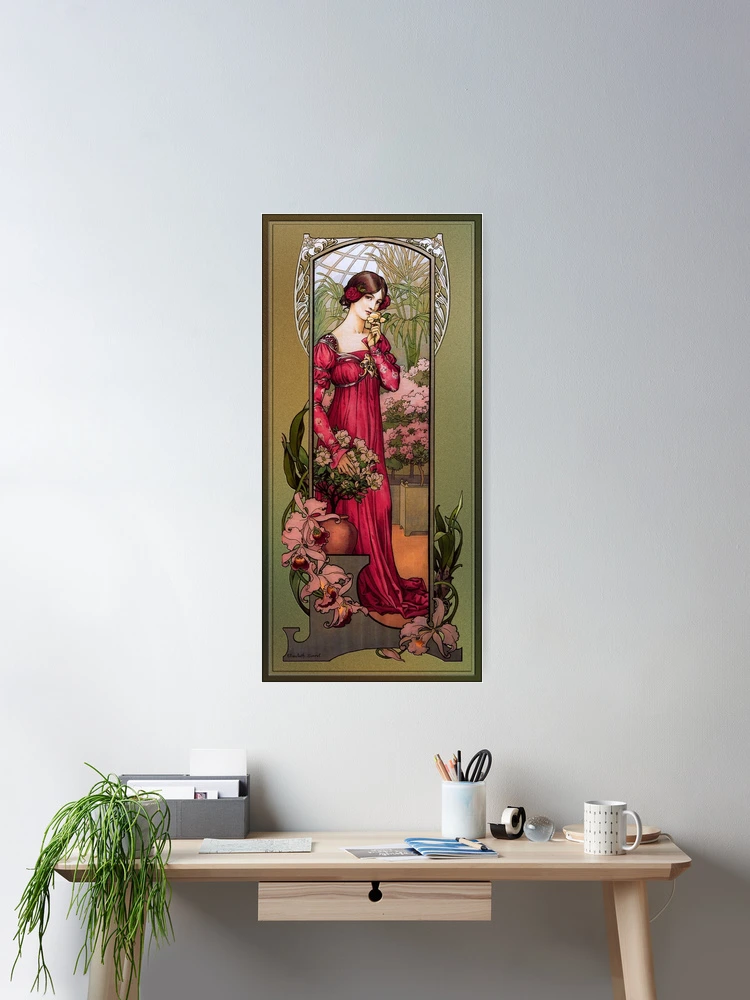
The focal point of the painting is the elegant woman, who stands poised amidst a garden of flourishing plants. She gazes slightly off to the side, gently holding a flower to her lips. Her expression is one of quiet contemplation, almost as if she is lost in thought, making the viewer ponder what she may be contemplating. The artist uses soft, fluid lines to create the delicate figure, accentuating her grace and beauty. Her posture is stately, yet relaxed, as though she is one with the flowers around her.
The woman is dressed in a flowing gown of deep pink, which enhances her romantic, почти эфирная внешность. Платье, with its intricate folds and soft fabric, дополняет ее тонкие черты. The long sleeves of her dress, which gather slightly at the wrists, suggest a gentle yet refined femininity, while the delicate rose-colored flowers in her hair add an extra layer of romanticism and connection to the floral surroundings. There is a sense of timelessness about her, as though she could exist in any era, embodying the ideal of beauty and serenity that Sonrel sought to portray.
The Floral and Botanical Setting
The garden setting in Цветы садов is lush and detailed, and it plays a crucial role in enhancing the overall theme of the painting. Surrounding the central figure is a profusion of flowers in various stages of bloom. The woman’s proximity to these plants, coupled with her tender interaction with them, suggests a deep connection between the human and natural worlds. Цветы, though not named specifically, окрашены в изысканные детали, and they seem to spring to life with every brushstroke. Their delicate petals, some of which are white or pale pink, contribute to the overall softness of the scene, reinforcing the tranquility of the moment.
The garden setting itself is depicted as a tranquil, slightly enclosed space, with the glass structure in the background resembling a greenhouse or garden conservatory. The latticework of the glass and the intertwining plants visible through it provide a sense of depth and structure within the composition. The background setting, with its muted greens and beiges, contrasts with the vibrant colors of the flowers and the woman’s gown, drawing attention to the central figure without overpowering the scene.
At the lower corners of the painting, large blooms—perhaps orchids—add another layer of complexity and interest to the piece. The intricate depiction of these flowers, with their sinuous curves and graceful form, echoes the flowing lines of the woman’s gown and hair, further blending human and natural elements.
Материалы и техника
Sonrel’s technique in Цветы садов reflects her skill in creating harmony between color, линия, и форма. The painting is rendered with soft, flowing lines typical of the Art Nouveau style, which often favors organic shapes and an emphasis on decoration. The use of pastel tones—soft pinks, зелень, and pale yellows—creates a serene, Почти сказочная атмосфера. The lightness of the color palette adds to the feeling of delicacy and elegance, as if the entire composition exists in a peaceful reverie.
The artist’s handling of light and shadow is subtle but effective. The soft shading around the figure and the background flowers suggests a gentle, diffused light source, as though the woman is bathed in the glow of a late afternoon sun. The absence of harsh shadows gives the painting a soft, inviting quality, reinforcing the tranquil mood.
Настроение и тема
Настроение Цветы садов is one of harmony, милость, and reflection. The artist’s emphasis on a young woman in a peaceful garden, surrounded by blooming flowers, speaks to the broader themes of natural beauty and the idealization of femininity. Sonrel creates an environment that is not only visually pleasing but emotionally evocative. The viewer is invited to pause and reflect on the natural beauty of the world, and the way in which human beings can interact with and appreciate the natural world in a delicate, almost spiritual way.
The theme of femininity is prevalent throughout the artwork, with the woman portrayed as the central figure of beauty and grace. She is not merely a passive object of admiration but is instead actively engaged with her surroundings, holding a flower as if it were an extension of herself. This interaction suggests a deeper connection with nature, a theme often found in the works of Art Nouveau artists.
Sonrel’s painting also carries a timeless quality, as if the scene could belong to any era in which beauty and nature were revered. Сад, with its rich symbolism, alludes to themes of growth, обновление, and the cycles of life, while the woman’s elegant pose conveys a sense of enduring beauty that transcends time.
Заключение
Élisabeth Sonrel’s Цветы садов is a masterful representation of Art Nouveau’s emphasis on beauty, природа, and the female form. The artist’s ability to capture the soft harmony between the woman and her floral surroundings speaks to her deep understanding of both the natural world and human grace. The painting evokes a mood of serenity and timeless elegance, offering the viewer a moment of reflection and appreciation for the simple yet profound beauty of nature. Through her skillful use of color, линия, и форма, Sonrel invites us to experience a world where beauty is both delicate and enduring, where humans and nature exist in a perfect, harmonious balance.
Flowers Of Gardens — это отретушированная цифровая репродукция изображения старых мастеров, являющаяся общественным достоянием..
О художнике
Информация ниже любезно предоставлена Wikipedia.org
Элизабет Сонрель (1874 Туры - 1953 Уплотнения) был французским художником и иллюстратором в стиле модерн.. Ее работы включали аллегорические сюжеты., мистицизм и символизм, портреты и пейзажи.
Она была дочерью Николаса Стефана Сонреля., художник из Тура, и получила от него раннее обучение. Для дальнейшего обучения она отправилась в Париж в качестве ученицы Жюля Лефевра в Ecole des Beaux-Arts..
В 1892 она нарисовала свою дипломную работу, «Pax et Labor», работа, которую можно увидеть в Musée des Beaux-Arts de Tours. С тех пор она выставлялась в Salon des Artistes Français между 1893 и 1941, ее фирменные работы - большие акварели в прерафаэлитской манере., которую она приняла после поездки во Флоренцию и Рим, открытие художников эпохи Возрождения – некоторые из ее работ с явным подтекстом Боттичелли. Ее картины часто были вдохновлены романами о короле Артуре., "Божественная комедия" Данте Алигьери’ и "Новая жизнь", библейские темы, и средневековые легенды. Среди ее мистических работ «Эймс эрантес»’ (Салон 1894) и «Духи бездны»’ (Салон 1899) и "Молодая женщина с гобеленом".
На Всемирной выставке 1900, основной темой которого был модерн, ее 1895 картина «Сон Богородицы»’ (Сон Богородицы), был награжден бронзовой медалью, и премию Анри Лемана 3000 франков Академии художеств.[3] Из 1900 Впоследствии она ограничилась своей живописью портретами, живописные пейзажи Бретани, и случайное цветочное исследование.
Она совершала регулярные поездки в Бретань для рисования., вдохновленный лесом Brocéliande, и из 1910 в различные места на побережье, такие как Конкарно, Plougastel, Пон-л'Аббе и Локтуди, часто останавливаются в гостиницах в сопровождении одного или двух студентов. Она написала несколько работ в Le Faouët, прежде чем построить виллу в La Baule в 1930-х годах.. Работаю в основном акварелью и гуашью., она обнаружила готовый набор моделей среди молодых девушек в этом районе, и обнаружил, что бретонцы в целом дружелюбны, честный и уверенный в себе.
Ее последняя выставка в Салоне была в 1941 в возрасте 67. Есть также запись о том, что она выставлялась в Ливерпуле.. В ранние годы Сонрель выпускала плакаты., открытки и иллюстрации, в стиле модерн.