

Galatea
Galatea, stworzony przez francuskiego malarza Anne Louis Girodet-Trioson (1767 – 1824), który był uczniem Jacques-Louis David; to przykładowy obraz z okresu neoklasycyzmu, ukazujący mistrzostwo artysty w uchwyceniu zarówno wdzięku, jak i intensywności tematów mitologicznych. Kawałek, namalowany pod koniec XVIII w, oferuje potężną i pełną niuansów reprezentację greckiej postaci mitologicznej Galatei, znana ze swojej urody. Ta praca jest eksploracją boskiej kobiecości i napięcia między mitem a emocjami. Przekazany nastrój jest pogodnym wdziękiem, zabarwiony subtelną melancholią, która odzwierciedla złożoną naturę mitologicznej egzystencji Galatei.
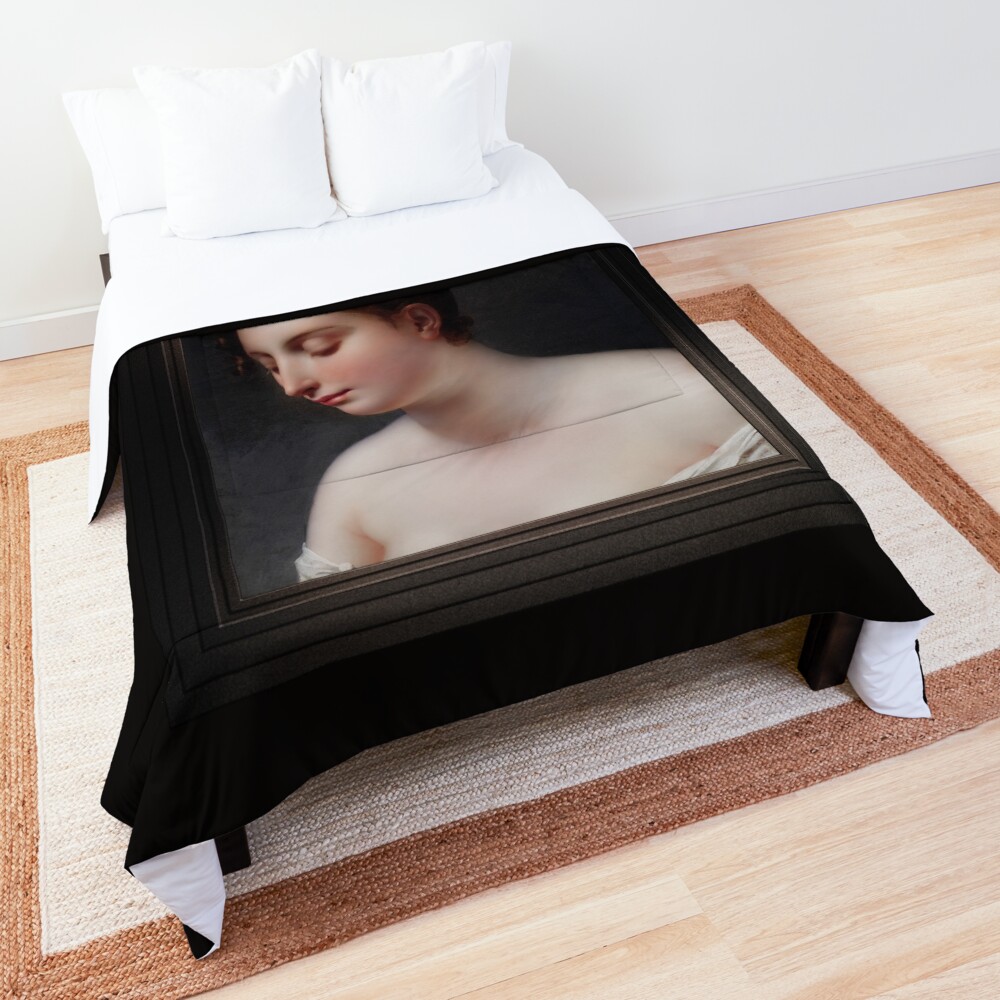
Pokazuje ją w tej samej formie i pozycji, co w pełnym dramacie Pigmalion i Galatea w którym to zrobił 1819, z głową pochyloną ku ziemi i oczami dopiero zaczynającymi się otwierać; z nią ubraną w białą sukienkę z odsłoniętymi ramionami.
Spis treści
Temat: Galatea
Sercem kompozycji jest postać Galatea, przedstawiana jako eteryczna piękność ubrana w miękkość, zwiewne tkaniny, które kaskadą otaczają jej sylwetkę. Ukazana jest w chwili kontemplacji, Jej głowa była lekko przechylona, a wzrok skierowany w dół, jakby pogrążony w myślach lub zachwycie. Ta poza jest charakterystyczna dla romantycznej i klasycznej wrażliwości tamtych czasów, pozwalając artystce wyrazić zarówno boskie piękno Galatei, jak i jej wewnętrzny niepokój. Jej twarz, delikatny i spokojny, jest delikatnie oświetlony, uchwycił jej ponadczasową młodość i nieziemski urok.
Jej skóra, podane z niezwykłą delikatnością, lśni miękką porcelaną, cecha charakterystyczna dbałości Girodet o szczegóły. Pełen wdzięku kształt jej szyi i gładkość jej sylwetki dają poczucie bezbronności i czystości, podkreślając kontrast pomiędzy jej niebiańską naturą a emocjonalną głębią sugerowaną przez jej spojrzenie. Otaczająca ją powiewająca draperia, blady i prawie przezroczysty, dodaje całości eterycznego charakteru, sugerując, że Galatea jest uwięziona pomiędzy królestwem ziemi i niebios.
Otoczenie i tło
Scenerią obrazu jest klasyczny pejzaż, przywołując romantyczny świat przyrody typowy dla okresu neoklasycznego. Za Galateą, widzimy ślady nadmorskiej sceny z delikatnymi falami, które symbolizują jej połączenie z morzem. Stonowane błękity i zielenie tła kontrastują z ciepłymi odcieniami jej skóry, creating a visual harmony between the figure and the environment. This soft, distant backdrop enhances the sense of isolation and calm, making Galatea appear as if she is floating in a dreamlike realm, detached from the concerns of the earthly world.
The painter’s use of light, particularly in the way it illuminates her face and shoulders, adds a divine quality to her figure, implying that she exists within a world of her own, untouched by earthly woes.
Styl i technika
Girodet-Trioson’s painting style blends the classical with the romantic, employing techniques that emphasize idealized beauty, soft textures, and harmonious color palettes. The softness of the brushwork in the portrayal of Galatea’s skin and hair contrasts with the more defined strokes in the background, creating a sense of depth and dimensionality. The contrast between light and shadow is skillfully executed, especially on Galatea’s delicate form, which appears to glow against the darker, more subdued tones of the background. This contrast enhances the divine, almost supernatural quality of her character.
The painter’s technique of rendering skin tones is especially notable for its smoothness and luminosity. The use of subtle glazes gives her skin an almost translucent appearance, drawing attention to her vulnerability and femininity. This technique is indicative of Girodet’s meticulous attention to detail and his ability to render the human form in a way that feels both realistic and idealized.
The drapery around her, with its fine folds and soft texture, highlights the artist’s ability to depict materiality. The fabric flows elegantly, almost as if it were a natural extension of Galatea’s form, further emphasizing her connection to the world of the gods.
Nastrój i motywy
The mood of the painting is one of tranquility tinged with melancholy. There is an ethereal stillness to Galatea, as if she is suspended in time, reflecting on her own beauty or perhaps on the complex emotional landscape of her mythological tale. The softness of her expression, combined with her detached pose, suggests that she is both physically present and yet emotionally distant, caught between her divine nature and the emotional pull of her myth.
The theme of beauty and transformation is central to the work, as it explores the idea of divine femininity as both a gift and a burden. Galatea’s beauty is not only her most defining characteristic but also the source of her emotional and mythical struggles. Her contemplative expression hints at an inner world that is not often associated with mythological figures, who are typically portrayed as powerful and triumphant. Girodet-Trioson’s interpretation of Galatea suggests that beauty, while divine, can also be isolating and filled with sorrow.
Wniosek
Galatea za pomocą Anne Louis Girodet-Trioson (1767 – 1824) stands as a stunning example of Neoclassical art, blending mythological narrative with deep emotional resonance. The artist’s exceptional technique, the delicate portrayal of the figure, and the subtle interplay between light and shadow create a painting that is both visually captivating and thematically rich. Through his depiction of Galatea, Girodet-Trioson zachęca widza do rozważenia nie tylko piękna tematu, ale także emocjonalnej złożoności kryjącej się za tym pięknem, co czyni tę pracę ponadczasową eksploracją mitologicznej i ludzkiej kondycji.
Jest to zremasterowana cyfrowa reprodukcja starych mistrzów obrazu z domeny publicznej, która jest dostępna jako druk na płótnie online.