

Hebe After The Fall c.1880
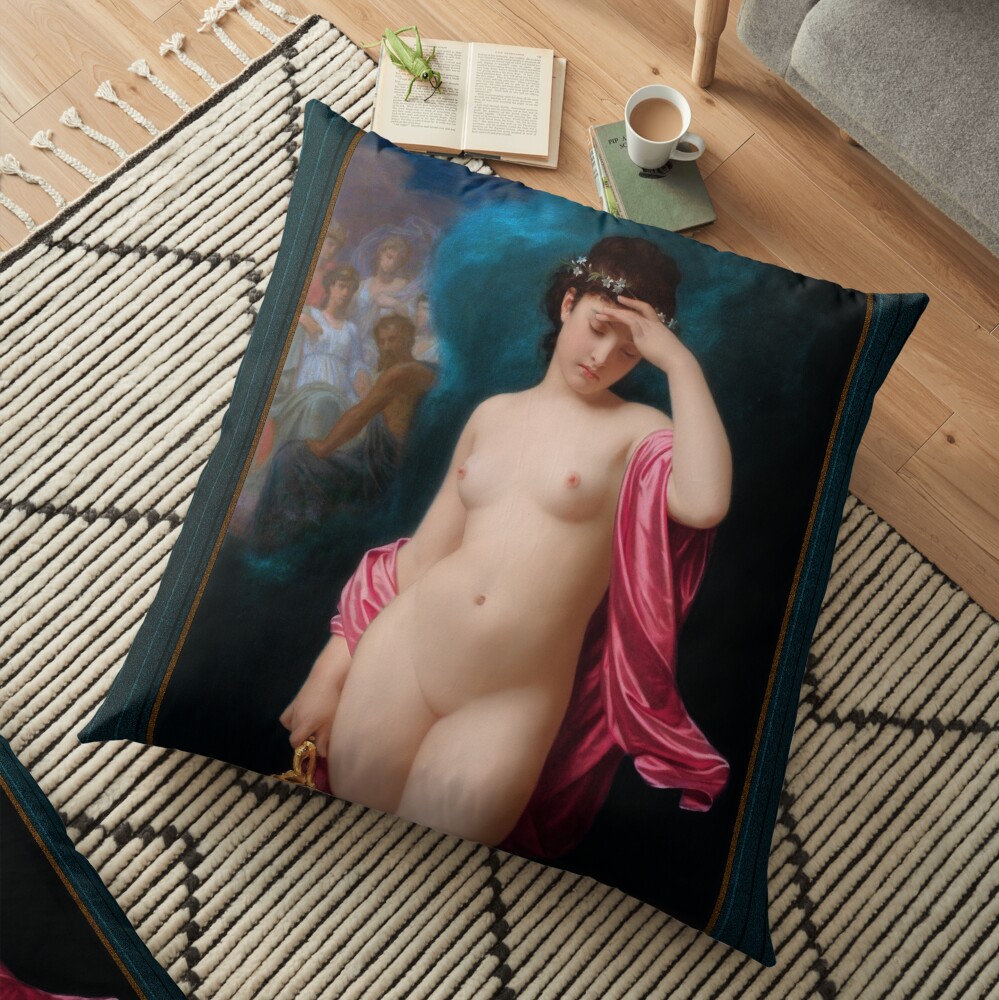
“Hebe po upadku,” painted by the French artist Hugues Merle w 1880, captures a mythological scene filled with emotion and classical beauty. Hugues Merle, urodzony w 1822 i przejście 1881, was known for his romantic interpretations of historical and mythological themes. Ta praca, depicting the Greek goddess Hebe in a moment of vulnerability, is a prime example of Merle’s skill in blending sensuality with divine mythological elements, characteristic of his romantic style. The scene is dramatic yet serene, offering a glimpse into a world of gods, piękno, and timeless human emotion.
Spis treści
Główny temat: Hebe, the Goddess of Youth
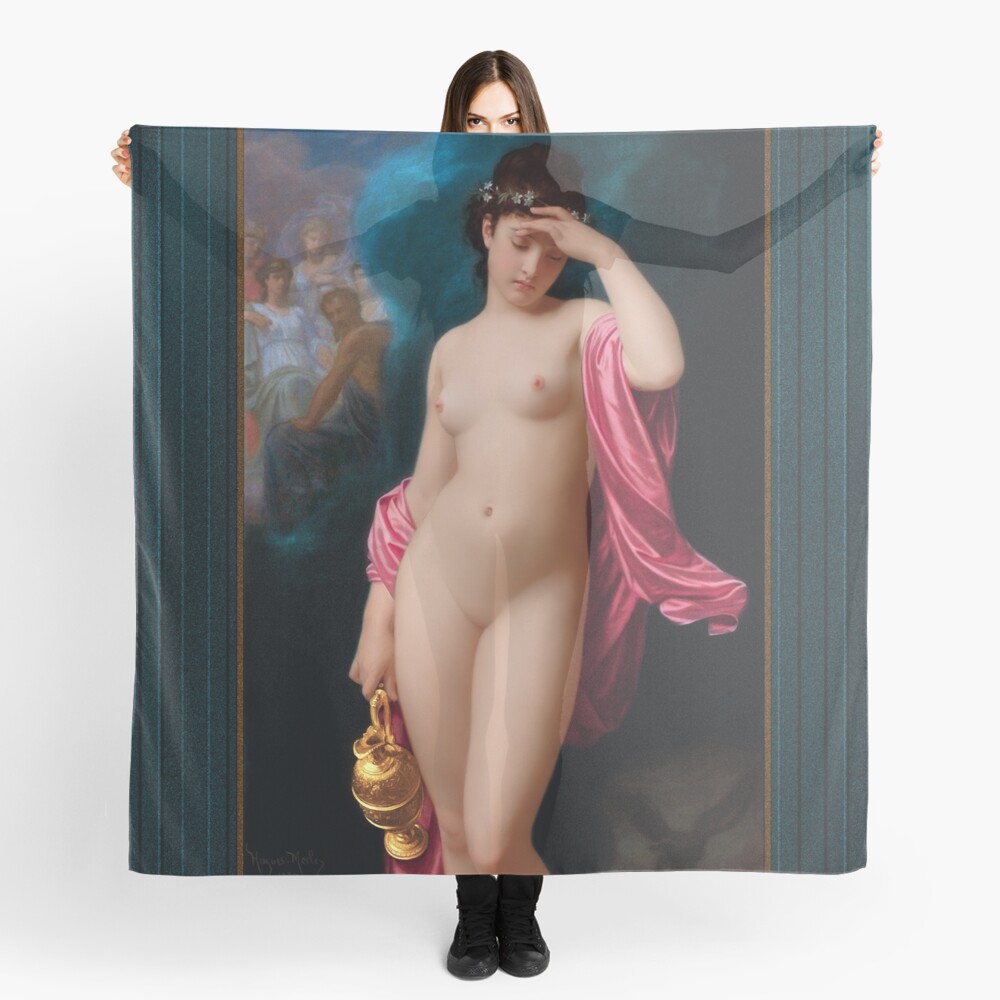
At the heart of the painting is Hebe, the goddess of youth, as she stands in a vulnerable pose, slightly recoiling, her right hand resting upon her forehead as though in deep reflection or in reaction to a sudden event. She is nude except for a flowing robe of rich pink, draped over her left shoulder and wrapping around her body. Her posture suggests a moment of contemplation or perhaps the aftermath of an emotional experience. Hebe’s youthfulness is emphasized by her delicate features, youthful face, and graceful stance. Her physical form, soft yet strong, is idealized according to classical beauty standards, making her seem divine, untouched by the harshness of mortality.
Her expression is one of subtle sadness, perhaps indicating the sorrow after a fall—whether literal or symbolic. This moment might refer to Hebe’s fall from grace in a mythological context or a broader interpretation of youth and innocence lost. The slight tilt of her head and the downward gaze suggest introspection or regret, as she processes the reality of her situation.
The Objects and Symbols: The Golden Goblet
In Hebe’s left hand, she holds a golden goblet, an object of great significance in ancient myth. The goblet could be interpreted as a symbol of her role as the cupbearer to the gods, serving nectar to the Olympian deities. The choice of a golden vessel imbues the piece with a sense of divine luxury, further elevating Hebe’s status as a celestial being. The delicate yet heavy design of the goblet contrasts with the purity and softness of her skin, symbolizing the tension between earthly desires and the ethereal nature of the gods.
The faint background figures are also significant, though they are less detailed and appear more ethereal, suggesting other deities or spiritual entities that hover on the edge of Hebe’s consciousness. These figures may represent gods or nymphs who witness the goddess’s plight, perhaps offering a subtle hint of support or simply standing as distant observers.
Teren: A Dreamlike Setting
The background of the painting is a swirl of blues and purples, with ethereal clouds and soft glowing light. These dreamlike elements add to the otherworldly quality of the scene, transforming the landscape into an almost celestial space. The terrain is devoid of any realistic earthly elements; there are no trees, no earth, no clear horizon line. Zamiast , it is as though the goddess exists in a divine, liminal space, caught between two worlds—between mortality and immortality, between the known and the unknown.
This blurred, surreal background enhances the mythological tone of the painting, leaving Hebe suspended in an unearthly environment that could be interpreted as a representation of the divine realm. The contrasting softness of the background against Hebe’s vibrant figure highlights her as the focal point of the piece, directing the viewer’s attention to her emotional and physical presence.
Materiały i technika
Hugues Merle’s “Hebe po upadku” was likely created using oil paints on canvas, as was common during the late 19th century for works that sought to achieve a high level of realism and detail. The artist’s attention to detail in Hebe’s facial expression, her flowing drapery, and the careful modeling of her figure shows the mastery of traditional techniques that Merle employed. His use of soft brushstrokes and a delicate color palette imbues the painting with a sense of calmness and grace, while also allowing for a rich texture and depth to the image.
The contrast between the smoothness of Hebe’s skin and the gentle ripples of her robe is achieved with skilled brushwork, demonstrating Merle’s proficiency in rendering fabric and flesh in a way that almost mimics life itself. This technique highlights the contrast between divine perfection and the fragile human condition, both of which are central to the painting’s theme.
Motyw: Młodzież, Vulnerability, and the Divine
The thematic focus of the painting revolves around the transient nature of youth and beauty, a common theme in Romantic and Classical art. Hebe, as a goddess of youth, embodies this fleeting moment of life that is forever captured in her image. Her vulnerability in the painting can be seen as a reminder of the fragility of life, even for the gods, who are often depicted as eternal and invincible. The moment of her fall suggests that no one, not even the divine, is immune to the forces of fate or the passing of time.
This exploration of vulnerability is further emphasized by the soft, almost melancholic expression on Hebe’s face, indicating a deeper emotional experience than simply the visual representation of a goddess. The golden goblet in her hand, her only tangible possession in the piece, serves as a reminder of her divine role, but it also suggests the transitory nature of her role and her status among the gods.
The background figures, though indistinct, add an element of support and reflection, reminding the viewer that even in moments of fall or loss, the divine world is filled with unseen forces and entities that shape the experience. Whether these figures represent other gods, spirits, or abstract entities is left to the interpretation of the viewer, further adding to the mystery and layered meaning of the piece.
Nastrój: A Sense of Quiet Reflection
The overall mood of the painting is one of calm introspection. Though Hebe’s body is poised in a moment of vulnerability, there is no sense of dramatic anguish. Zamiast , her pose, face, and the soft lighting suggest a quiet acceptance or a pensive pause. It’s as if the painting captures a brief, intimate moment in which the goddess reflects upon a fall—whether from grace or from a higher realm—before finding her way back to the divine world.
The subdued color palette, the ethereal background, and Hebe’s posture work together to evoke a mood of somber beauty, one that invites the viewer to ponder the complexities of divinity, młodzież, i upływ czasu.
To jest wyretuszowana sztuka cyfrowa reprodukcja starych mistrzów obrazu należącego do domeny publicznej, który jest dostępny w sprzedaży online jako płótno, metal, akryl, nadruk z drewna i walca.
To dzieło sztuki cyfrowej, podobnie jak wszystkie dzieła sztuki, które można znaleźć na stronie internetowej Xzendor7, można kupić online w różnych formatach materiałów, w tym odbitki na płótnie, wydruki akrylowe, metalowe nadruki, druki na drewnie, wydruki w ramkach, plakaty, oraz jako zwinięte wydruki na płótnie w różnych rozmiarach od 12 cale do 72 cale w zależności od rozmiaru rzeczywistej grafiki i sklepu z drukiem na żądanie, w którym zdecydujesz się kupić sztukę.
Grafika jest również dostępna na szerokiej gamie odzieży męskiej i damskiej, kubki, torby, szaliki, notesy i czasopisma oraz wiele produktów do dekoracji wnętrz.
Biografia artysty
Poniższe informacje pochodzą z Wikipedia.org i Rehs.com
Hugues Merle urodził się w 1822 w La Sône, Francja i około wieku 21 przybył do Paryża, we Francji, gdzie studiował malarstwo u francuskiego malarza historycznego i portrecisty Léona Cognieta (1794 – 1880).
Chociaż niewiele wiadomo o wczesnym życiu Huguesa, zakłada się, że otrzymał on pewien stopień wykształcenia artystycznego przed przybyciem do Paryża w 1970 roku 1843; ponieważ zaczął wystawiać na Salonie Paryskim w r 1847 swoim utworem Portrait de L’auteur i in 1848 wystawił utwór Légende des Willis.
Z biegiem czasu reputacja Huguesa jako portrecisty znacznie wzrosła w latach pięćdziesiątych XIX wieku; a jako odnoszący sukcesy i wybitny malarz był w stanie przyciągnąć poważnych miłośników sztuki, którzy chcieli zbudować swoje kolekcje dzieł sztuki.
Jednym z tych wczesnych kolekcjonerów sztuki był 4. markiz Hertford, Richarda Seymoura-Conwaya (1800-1870); który kupił jego zgłoszenie do salonu Czytając Biblię 1859.
W latach 60. XIX wieku, Lista kolekcjonerów klientów Hugues obejmowała nie tylko osoby z kontynentu europejskiego, ale także amerykańscy kolekcjonerzy, takich jak William Walters z Baltimore, który zamówił The Scarlet Letter.