

Gentlemen Prefer Blondes c1948
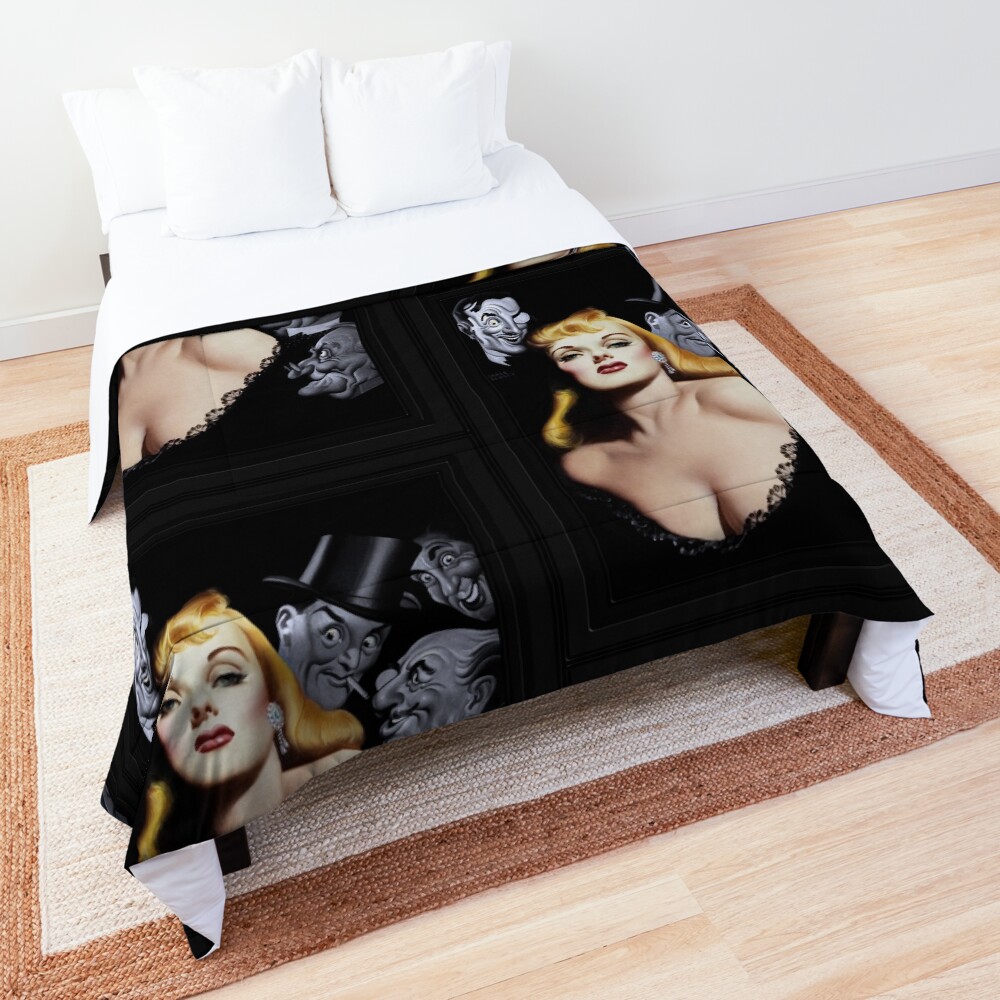
“Els senyors prefereixen les rosses,” creat a 1948 by the renowned American illustrator Earle Kulp Bergey (1901 – 1952), captures the allure of mid-century American pop culture and the golden age of Hollywood glamour. Bergey, known for his sultry and evocative depictions of women, channels the spirit of the era through this iconic piece, which epitomizes the classic pin-up style of the post-World War II era. L'obra d'art presenta un aspecte glamurós, bold figure at its core, flanked by an array of charismatic men, embodying the spirit of both the title and the theme. The composition reflects an era of sensuality, enginy, and lighthearted romance, characteristic of the mid-20th century.
Taula de continguts
El tema principal
La figura central a “Els senyors prefereixen Blondes” is a strikingly beautiful woman, her posture suggestive of confidence and allure. Ella mira directament a l'espectador, her full, plump lips slightly parted, giving her an air of both mystery and command. Her platinum blonde hair cascades in soft waves, its texture smooth and flowing, contributing to the feminine, almost ethereal quality of her appearance. A pair of dangling earrings shimmer beneath her delicate ear, catching the viewer’s eye, reinforcing the notion of opulence and beauty.
La seva vestimenta, a deep black dress trimmed with lace, accentuates her curves and frames her décolletage in a way that is both elegant and provocative. The dress’s high neckline contrasts with the plunging scoop at the front, revealing her fair, porcelain-like skin. This balance between modesty and sensuality creates an enticing juxtaposition that was a hallmark of pin-up art during this period.
In stark contrast to the polished, statuesque beauty of the woman, a collection of mischievous, almost caricature-like men encircle her. Aquestes xifres, with exaggerated facial expressions, evoke the playful, sometimes mischievous nature of male attention toward the female subject. Each man is drawn with exaggerated features—wide, almost cartoonish eyes, upturned lips in sly grins, and arched brows, giving them a whimsical, slightly sinister look. The men’s appearance is intentionally stylized, designed to enhance the seductive aura of the central woman while injecting an element of humor and farce.
Objectes i simbolisme
Bergey’s use of minimal yet impactful objects within the composition serves both to elevate the central figure and to add a sense of narrative depth. The woman is adorned with sparkling diamond earrings, signifying wealth, atractiu, i estat. These accessories, encara que petit, function as symbols of desirability, further emphasizing the woman’s exalted position in society. El seu vestit, with its fine lace details, hints at the sophistication of the time, a time when women’s fashion was both a form of self-expression and a tool for empowerment.
The men surrounding the woman, though depicted with exaggerated features, seem to be captivated by her presence. They lean in toward her, each trying to attract her attention in their own exaggerated manner. Their various expressions—from the coy, almost shy smile of one to the playful, knowing grin of another—evoke the humor and complexity of romantic dynamics. This interaction between the woman and her male admirers is emblematic of the playful flirtation that often defined the post-war era’s art, reflecting a world where women were both objects of admiration and, a vegades, the arbiters of their own fate.
Estil i tècnica
Earle Kulp Bergey’s artistic style in this piece reflects his mastery of the pin-up genre, a style known for its vibrant use of color, il·luminació dramàtica, and exaggerated forms. Bergey employs a combination of realism and stylization, creating figures that are at once recognizable yet idealized. The smooth contours of the woman’s face and body are rendered with soft, almost ethereal shading, contributing to the sensuality of her form. The men, malgrat això, are depicted with more caricatured, característiques angulars, a stark contrast that emphasizes their roles as playful bystanders to the woman’s commanding presence.
The artist’s use of deep, contrasting shadows heightens the drama of the piece. The background is dark, a subtle gradient of blacks and greys, providing the ideal backdrop to highlight the illuminated woman in the foreground. This contrast between light and dark adds depth to the painting, creating a sense of both intimacy and drama. The lighting itself is warm and soft, giving the entire composition a slightly dreamlike quality, as if the viewer is witnessing a moment suspended in time, frozen in a world of fantasy.
Tema i estat d’ànim
El tema de “Els senyors prefereixen les rosses” is unmistakably tied to the notion of beauty, encant, and the dynamics of attraction. The title itself alludes to the cultural perception of blonde women as desirable, an idea that was perpetuated by media and cinema during the time. The artwork plays with this perception, offering a playful yet biting commentary on how women, particularly those fitting the ideal of the time, were revered and sought after. The exaggerated expressions of the men around the woman reveal both their admiration and the absurdity of their pursuit, making the piece a light-hearted yet pointed commentary on the dynamics of flirtation and romantic attention.
The mood of the artwork is a blend of sensuality, humor, i misteri. The central woman exudes confidence and allure, yet her expression remains somewhat distant, leaving the viewer wondering whether she is truly engaged with the men around her or merely indulging in their attention. The men, al seu torn, are caught in a state of animated anticipation, suggesting a whimsical pursuit that is unlikely to reach any serious conclusion. This playful exchange between the sexes gives the piece a feeling of both joy and whimsy, reflecting the carefree nature of the era and the idea of unattainable yet desirable beauty.
Es tracta d’una reproducció de vells mestres d’art digital retocada d’una imatge de domini públic.
Aquesta creació d'art digital, com amb totes les obres d'art que es poden trobar al lloc web de Xzendor7, es poden comprar en línia en una varietat de formats de material, incloses impressions de llenç, impressions acríliques, estampes de metall, estampes de fusta, impressions emmarcades, cartells, i com impressions de llenços enrotllats en una varietat de mides de 12 polzades a 72 polzades depenent de la mida de l'obra d'art real i de la botiga d'impressió sota demanda on trieu comprar l'art.
L'obra d'art també està disponible en una àmplia gamma de roba d'home i dona, tasses, bosses, mocadors, quaderns i revistes i molts productes de decoració de la llar.
Sobre l'artista
Informació a continuació de Wikipedia.org
Earle K. Bergey (Agost 26, 1901 – Setembre 30, 1952) va ser un artista i il·lustrador nord-americà que va pintar portades per a milers de revistes de ficció i llibres de butxaca. Un dels artistes de ficció pulp més prolífics del segle XX, Bergey és reconegut per haver creat la portada icònica de Gentlemen Prefer Blondes per a la Biblioteca Popular a l’altura de la seva carrera a 1948.
Marcant l’inici de la gran influència de Bergey com a il·lustrador de butxaca nord-americà, aquesta pintura bomba va fer la tapa massiva de butxaca de la superproducció d’Anita Loos, Els senyors prefereixen les rosses (publicat com a Biblioteca Popular #221).
Earle K. Pintura de portada de Bergey per a Gentlemen Prefer Blondes, cap a 1948.
Bergey va néixer a Filadèlfia, Pennsylvania a A. Frank i Ella Kulp Bergey. Va assistir a l'Acadèmia de Belles Arts de Pennsylvania 1921 a 1926, acabar els estudis formals de l'Acadèmia a la primavera de 1926. Inicialment va anar a treballar als departaments d'art dels diaris de Filadèlfia, inclòs Public Ledger, i va dibuixar la tira còmica Deb Days in 1927. Al començament de la seva carrera, Bergey va contribuir amb moltes portades a les revistes pulp de l'editorial Fiction House.
A mitjans dels anys trenta, Bergey va fer una casa i un estudi al comtat de Bucks, Pennsilvània, i es va casar a 1935.
Al llarg de la dècada de 1930, Bergey va treballar com a autònom per a diverses editorials.
Les seves pintures cridaneres es van presentar principalment com a portades en una àmplia gamma de revistes de pasta, inclòs el romanç (Amor Emocionant, Amor popular, Romanços d'amor) així com detectiu, aventura, aviació, i westerns. Bergey va il·lustrar publicacions principals, com The Saturday Evening Post, durant aquest temps.
Durant la dècada de 1940, Bergey va continuar pintant portades per al romanç, esports, i revistes detectives pulp, i va començar a treballar en diverses revistes de ciència ficció, incloses les publicacions estàndard’ Històries estranyes, Històries sorprenents, i Capità Futur, i més tard per a la revista Fantastic Story.
La formació en belles arts de Bergey i el do destacat per representar l'anatomia el van convertir en un artista de referència en una diversitat de gèneres que requerien escenes amb moviment dramàtic., a partir de retrats esportius fotorealistes d'atletes famosos, inclòs Mickey Cochrane, Lou Gehrig, i Jim Thorpe a la seva signatura Bergey Girls que va aparèixer en polps arriscades durant la Depressió i en escenaris de ciència ficció de la Segona Guerra Mundial.
Les il·lustracions de l'artista de dones poc vestides que sobreviuen a l'espai exterior van servir d'inspiració per al vestit d'esclava de la princesa Leia a El retorn del Jedi., fins i tot el seu color i tall, i el sostenidor de llautó cònic de Madonna. Portades de ciència ficció de Bergey, de vegades descrit com “Bim, BÉ, Bum,” generalment presentava una dona amenaçada per un monstre d'ulls d'insectes, alienígena, o robot, amb un heroic astronauta masculí venint en la seva ajuda.
Les topes de bikini que portaven les noies de Bergey sovint s'assemblaven al metall coure, donant lloc a la frase “la noia del sostenidor de llautó,” utilitzat en referència a aquest tipus d'art. Els visionaris de la televisió i el cinema han estat influenciats pel treball de Bergey; Gene Roddenberry, per exemple, va proporcionar al seu dissenyador de producció per a Star Trek exemples de les cobertes de polpa futuristes de Bergey.
En 1948, Bergey va fer la transició a la indústria del llibre de rústica en ràpida expansió juntament amb artistes de pasta especialitzats com Rudolph Belarski., l'obra del qual sovint es confon amb la de Bergey. Mentre continuava pintant cobertes de pasta fins a la seva mort.