

Gentlemen Prefer Blondes c1948
“Les hommes préfèrent les blondes,” créé dans 1948 by the renowned American illustrator Earle Kulp Bergey (1901 – 1952), captures the allure of mid-century American pop culture and the golden age of Hollywood glamour. Bergey, known for his sultry and evocative depictions of women, channels the spirit of the era through this iconic piece, which epitomizes the classic pin-up style of the post-World War II era. L'œuvre présente un glamour, bold figure at its core, flanked by an array of charismatic men, embodying the spirit of both the title and the theme. The composition reflects an era of sensuality, esprit, and lighthearted romance, characteristic of the mid-20th century.
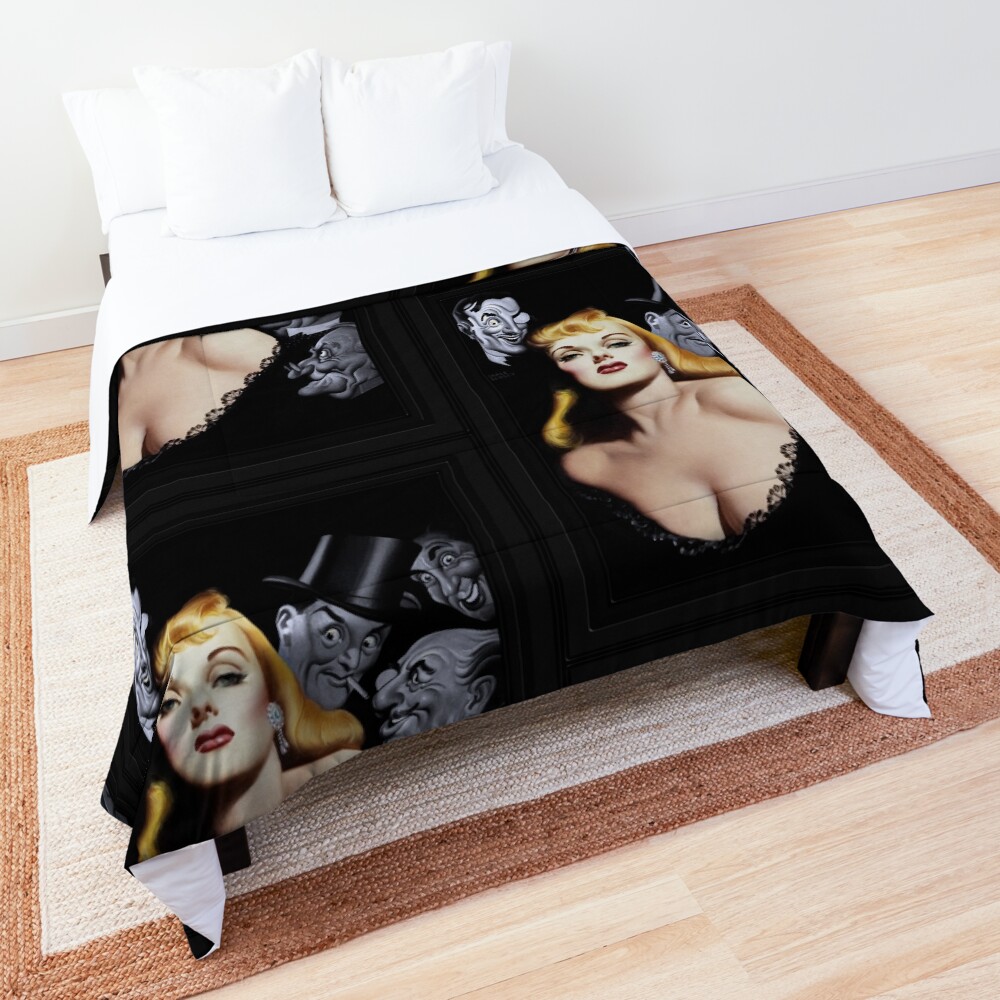
Table des matières
Le sujet principal
The central figure in “Gentlemen Prefer Blondes” is a strikingly beautiful woman, her posture suggestive of confidence and allure. Elle regarde directement le spectateur, her full, plump lips slightly parted, giving her an air of both mystery and command. Her platinum blonde hair cascades in soft waves, its texture smooth and flowing, contributing to the feminine, almost ethereal quality of her appearance. A pair of dangling earrings shimmer beneath her delicate ear, catching the viewer’s eye, reinforcing the notion of opulence and beauty.
Sa tenue, a deep black dress trimmed with lace, accentuates her curves and frames her décolletage in a way that is both elegant and provocative. The dress’s high neckline contrasts with the plunging scoop at the front, revealing her fair, porcelain-like skin. This balance between modesty and sensuality creates an enticing juxtaposition that was a hallmark of pin-up art during this period.
In stark contrast to the polished, statuesque beauty of the woman, a collection of mischievous, almost caricature-like men encircle her. Ces chiffres, with exaggerated facial expressions, evoke the playful, sometimes mischievous nature of male attention toward the female subject. Each man is drawn with exaggerated features—wide, almost cartoonish eyes, upturned lips in sly grins, and arched brows, giving them a whimsical, slightly sinister look. The men’s appearance is intentionally stylized, designed to enhance the seductive aura of the central woman while injecting an element of humor and farce.
Objets et symbolisme
Bergey’s use of minimal yet impactful objects within the composition serves both to elevate the central figure and to add a sense of narrative depth. The woman is adorned with sparkling diamond earrings, signifying wealth, séduire, et statut. These accessories, though small, function as symbols of desirability, further emphasizing the woman’s exalted position in society. Sa robe, with its fine lace details, hints at the sophistication of the time, a time when women’s fashion was both a form of self-expression and a tool for empowerment.
The men surrounding the woman, though depicted with exaggerated features, seem to be captivated by her presence. They lean in toward her, each trying to attract her attention in their own exaggerated manner. Their various expressions—from the coy, almost shy smile of one to the playful, knowing grin of another—evoke the humor and complexity of romantic dynamics. This interaction between the woman and her male admirers is emblematic of the playful flirtation that often defined the post-war era’s art, reflecting a world where women were both objects of admiration and, a l'heure, the arbiters of their own fate.
Style et technique
Earle Kulp Bergey’s artistic style in this piece reflects his mastery of the pin-up genre, a style known for its vibrant use of color, éclairage dramatique, and exaggerated forms. Bergey employs a combination of realism and stylization, creating figures that are at once recognizable yet idealized. The smooth contours of the woman’s face and body are rendered with soft, almost ethereal shading, contributing to the sensuality of her form. The men, pourtant, are depicted with more caricatured, caractéristiques angulaires, a stark contrast that emphasizes their roles as playful bystanders to the woman’s commanding presence.
The artist’s use of deep, contrasting shadows heightens the drama of the piece. The background is dark, a subtle gradient of blacks and greys, providing the ideal backdrop to highlight the illuminated woman in the foreground. This contrast between light and dark adds depth to the painting, creating a sense of both intimacy and drama. The lighting itself is warm and soft, giving the entire composition a slightly dreamlike quality, as if the viewer is witnessing a moment suspended in time, frozen in a world of fantasy.
Thème et humeur
Le thème de “Les hommes préfèrent les blondes” is unmistakably tied to the notion of beauty, charme, and the dynamics of attraction. The title itself alludes to the cultural perception of blonde women as desirable, an idea that was perpetuated by media and cinema during the time. The artwork plays with this perception, offering a playful yet biting commentary on how women, particularly those fitting the ideal of the time, were revered and sought after. The exaggerated expressions of the men around the woman reveal both their admiration and the absurdity of their pursuit, making the piece a light-hearted yet pointed commentary on the dynamics of flirtation and romantic attention.
The mood of the artwork is a blend of sensuality, humor, et mystère. The central woman exudes confidence and allure, yet her expression remains somewhat distant, leaving the viewer wondering whether she is truly engaged with the men around her or merely indulging in their attention. The men, in turn, are caught in a state of animated anticipation, suggesting a whimsical pursuit that is unlikely to reach any serious conclusion. This playful exchange between the sexes gives the piece a feeling of both joy and whimsy, reflecting the carefree nature of the era and the idea of unattainable yet desirable beauty.
Il s'agit d'une reproduction de maîtres anciens d'art numérique retouchée d'une image du domaine public.
Cette création d'art numérique, comme toutes les œuvres d'art disponibles sur le site Web Xzendor7, elles sont disponibles à l'achat en ligne dans une variété de formats de matériaux, y compris des impressions sur toile., impressions acryliques, impressions métalliques, gravures sur bois, impressions encadrées, affiches, et sous forme d'impressions sur toile roulées dans une variété de tailles de 12 pouces à 72 pouces en fonction de la taille de l'œuvre d'art réelle et de la boutique d'impression à la demande auprès de laquelle vous choisissez d'acheter l'art.
L’œuvre d’art est également disponible sur une large gamme de vêtements pour hommes et femmes., tasses, fourre-tout, écharpes, cahiers et journaux et de nombreux produits de décoration intérieure.
À propos de l'artiste
Info ci-dessous de Wikipedia.org
Earle K. Bergey (août 26, 1901 - Septembre 30, 1952) était un artiste et illustrateur américain qui a peint des couvertures pour des milliers de magazines de pulp fiction et de livres de poche. L'un des artistes de pulp fiction les plus prolifiques du 20e siècle, Bergey est reconnu pour avoir créé la couverture emblématique de Gentlemen Prefer Blondes pour Popular Library au plus fort de sa carrière dans 1948.
Marquant le début de la carrière très influente de Bergey en tant qu'illustrateur américain de livres de poche, cette peinture explosive a fait la couverture de masse du blockbuster d'Anita Loos, Les hommes préfèrent les blondes (publié en tant que bibliothèque populaire #221).
Earle K. La couverture de Bergey pour Gentlemen Prefer Blondes, environ 1948.
Bergey est né à Philadelphie, Pennsylvanie à A. Frank et Ella Kulp Bergey. Il a fréquenté l'Académie des beaux-arts de Pennsylvanie de 1921 à 1926, terminer ses études formelles à l'Académie au printemps de 1926. Il est d'abord allé travailler dans les départements artistiques des journaux de Philadelphie, notamment Public Ledger, et il a dessiné la bande dessinée Deb Days en 1927. Au début de sa carrière, Bergey a contribué de nombreuses couvertures aux magazines pulp de l'éditeur Fiction House.
Au milieu des années 1930, Bergey a construit une maison et un studio dans le comté de Bucks, Pennsylvanie, et il s'est marié en 1935.
Tout au long des années 1930, Bergey a travaillé en indépendant pour un certain nombre de maisons d'édition.
Ses peintures accrocheuses ont été principalement présentées comme couvertures sur un large éventail de magazines pulp, y compris la romance (Amour palpitant, Amour populaire, Romans d'amour) ainsi que détective, aventure, aviation, et westerns. Bergey a illustré des publications grand public, comme le Saturday Evening Post, pendant ce temps.
Au cours des années 1940, Bergey a continué à peindre des couvertures pour la romance, des sports, et magazines de détective pulp, et il a commencé à travailler sur un certain nombre de magazines de science-fiction, y compris les publications standard’ Histoires étranges, Histoires surprenantes, et Capitaine Futur, et plus tard pour Fantastic Story Magazine.
La formation en beaux-arts de Bergey et son don important pour la représentation de l'anatomie ont fait de lui un artiste incontournable dans une diversité de genres qui nécessitaient des scènes avec des mouvements dramatiques., à partir de portraits sportifs photo-réalistes d'athlètes célèbres dont Mickey Cochrane, Lou Gehrig, et Jim Thorpe à sa signature Bergey Girls qui est apparue sur des pâtes à risque tout au long de la dépression et dans des scénarios de science-fiction de la Seconde Guerre mondiale.
Les illustrations de l'artiste représentant des femmes légèrement vêtues survivant dans l'espace ont servi d'inspiration pour la tenue d'esclave de la princesse Leia dans Return of the Jedi, même sa couleur et sa coupe, et le soutien-gorge conique en laiton de Madonna. Les couvertures de science-fiction de Bergey, parfois décrit comme “Bim, BIEN, Clochard,” généralement en vedette une femme menacée par un monstre aux yeux d'insecte, extraterrestre, ou robot, avec un astronaute masculin héroïque venant à son aide.
Les hauts de bikini portés par les filles Bergey ressemblaient souvent à du métal cuivré, donnant lieu à la phrase “la fille au soutien-gorge en laiton,” utilisé en référence à ce genre d'art. Les visionnaires de la télévision et du cinéma ont été influencés par le travail de Bergey; Gène Roddenberry, par example, a fourni à son concepteur de production pour Star Trek des exemples de couvertures de pulpe futuristes de Bergey.
Dans 1948, Bergey a fait la transition vers l'industrie du livre de poche en pleine expansion avec des artistes de la pâte à papier qualifiés comme Rudolph Belarski, dont l'œuvre est souvent confondue avec celle de Bergey. Tout en continuant à peindre des couvertures de pulpe jusqu'à sa mort.