

Gentlemen Prefer Blondes c1948
“Gli uomini preferiscono le bionde,” creato in 1948 by the renowned American illustrator Earle Kulp Bergey (1901 – 1952), captures the allure of mid-century American pop culture and the golden age of Hollywood glamour. Bergey, known for his sultry and evocative depictions of women, channels the spirit of the era through this iconic piece, which epitomizes the classic pin-up style of the post-World War II era. The artwork features a glamorous, bold figure at its core, flanked by an array of charismatic men, embodying the spirit of both the title and the theme. The composition reflects an era of sensuality, wit, and lighthearted romance, characteristic of the mid-20th century.
Sommario
Il soggetto principale
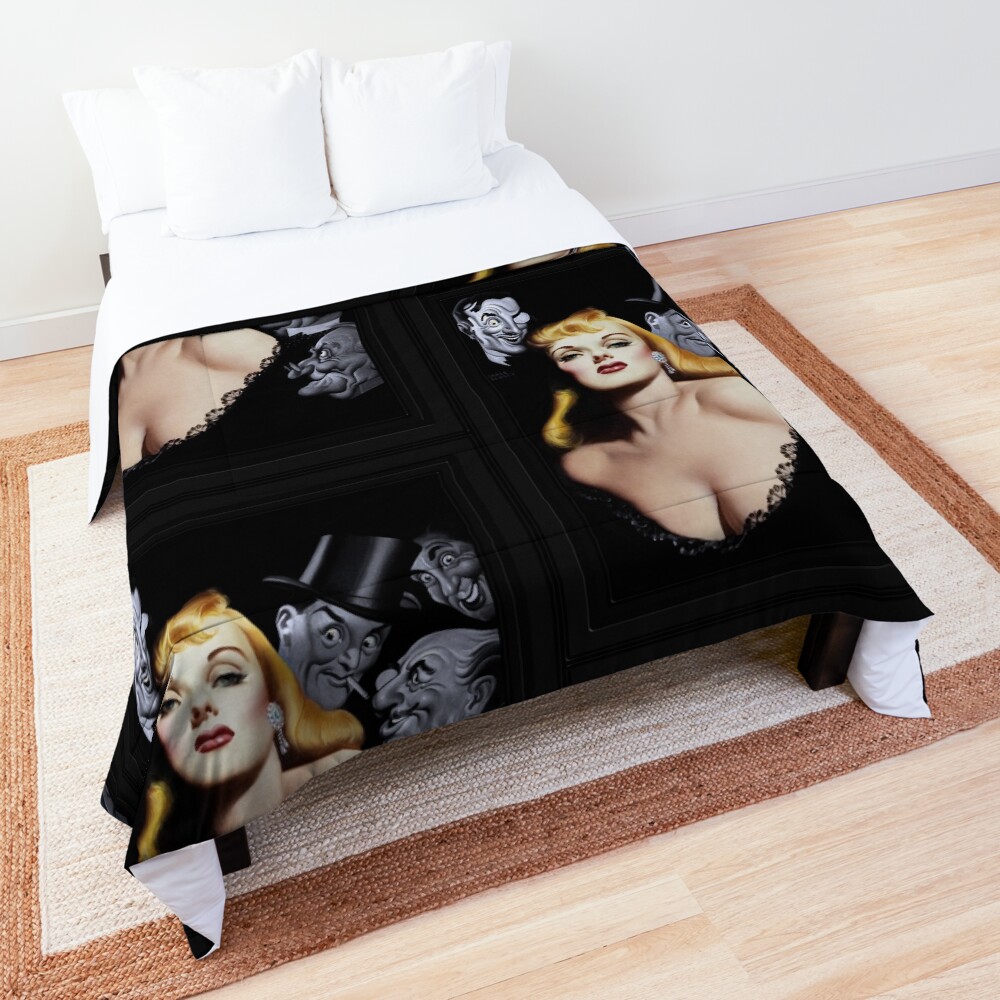
La figura centrale in “Gentlemen Prefer Blondes” is a strikingly beautiful woman, her posture suggestive of confidence and allure. Guarda direttamente lo spettatore, her full, plump lips slightly parted, giving her an air of both mystery and command. Her platinum blonde hair cascades in soft waves, its texture smooth and flowing, contributing to the feminine, almost ethereal quality of her appearance. A pair of dangling earrings shimmer beneath her delicate ear, catturare gli occhi dello spettatore, reinforcing the notion of opulence and beauty.
Il suo abbigliamento, a deep black dress trimmed with lace, accentuates her curves and frames her décolletage in a way that is both elegant and provocative. The dress’s high neckline contrasts with the plunging scoop at the front, revealing her fair, porcelain-like skin. This balance between modesty and sensuality creates an enticing juxtaposition that was a hallmark of pin-up art during this period.
In stark contrast to the polished, statuesque beauty of the woman, a collection of mischievous, almost caricature-like men encircle her. Queste figure, with exaggerated facial expressions, evoke the playful, sometimes mischievous nature of male attention toward the female subject. Each man is drawn with exaggerated features—wide, almost cartoonish eyes, upturned lips in sly grins, and arched brows, giving them a whimsical, slightly sinister look. The men’s appearance is intentionally stylized, designed to enhance the seductive aura of the central woman while injecting an element of humor and farce.
Oggetti e simbolismo
Bergey’s use of minimal yet impactful objects within the composition serves both to elevate the central figure and to add a sense of narrative depth. The woman is adorned with sparkling diamond earrings, signifying wealth, fascino, and status. These accessories, though small, function as symbols of desirability, further emphasizing the woman’s exalted position in society. Il suo vestito, with its fine lace details, hints at the sophistication of the time, a time when women’s fashion was both a form of self-expression and a tool for empowerment.
The men surrounding the woman, though depicted with exaggerated features, seem to be captivated by her presence. They lean in toward her, each trying to attract her attention in their own exaggerated manner. Their various expressions—from the coy, almost shy smile of one to the playful, knowing grin of another—evoke the humor and complexity of romantic dynamics. This interaction between the woman and her male admirers is emblematic of the playful flirtation that often defined the post-war era’s art, reflecting a world where women were both objects of admiration and, a volte, the arbiters of their own fate.
Stile e tecnica
Earle Kulp Bergey’s artistic style in this piece reflects his mastery of the pin-up genre, a style known for its vibrant use of color, illuminazione drammatica, and exaggerated forms. Bergey employs a combination of realism and stylization, creating figures that are at once recognizable yet idealized. The smooth contours of the woman’s face and body are rendered with soft, almost ethereal shading, contributing to the sensuality of her form. The men, tuttavia, are depicted with more caricatured, angular features, a stark contrast that emphasizes their roles as playful bystanders to the woman’s commanding presence.
The artist’s use of deep, contrasting shadows heightens the drama of the piece. The background is dark, a subtle gradient of blacks and greys, providing the ideal backdrop to highlight the illuminated woman in the foreground. This contrast between light and dark adds depth to the painting, creating a sense of both intimacy and drama. The lighting itself is warm and soft, giving the entire composition a slightly dreamlike quality, as if the viewer is witnessing a moment suspended in time, frozen in a world of fantasy.
Tema e umore
Il tema di “Gli uomini preferiscono le bionde” is unmistakably tied to the notion of beauty, fascino, and the dynamics of attraction. The title itself alludes to the cultural perception of blonde women as desirable, an idea that was perpetuated by media and cinema during the time. The artwork plays with this perception, offering a playful yet biting commentary on how women, particularly those fitting the ideal of the time, were revered and sought after. The exaggerated expressions of the men around the woman reveal both their admiration and the absurdity of their pursuit, making the piece a light-hearted yet pointed commentary on the dynamics of flirtation and romantic attention.
The mood of the artwork is a blend of sensuality, humor, and mystery. The central woman exudes confidence and allure, yet her expression remains somewhat distant, leaving the viewer wondering whether she is truly engaged with the men around her or merely indulging in their attention. The men, a sua volta, are caught in a state of animated anticipation, suggesting a whimsical pursuit that is unlikely to reach any serious conclusion. This playful exchange between the sexes gives the piece a feeling of both joy and whimsy, reflecting the carefree nature of the era and the idea of unattainable yet desirable beauty.
Questa è una riproduzione ritoccata di arte digitale dei vecchi maestri di un'immagine di pubblico dominio.
Questa creazione di arte digitale, come tutte le opere d'arte che si possono trovare sul sito Web di Xzendor7 è disponibile per l'acquisto online in una varietà di formati di materiali, comprese le stampe su tela, stampe acriliche, stampe in metallo, stampe su legno, stampe incorniciate, manifesti, e come stampe su tela arrotolata in una varietà di formati da 12 pollici a 72 pollici a seconda delle dimensioni dell'opera d'arte effettiva e del negozio di stampa su richiesta da cui scegli di acquistare l'arte.
L'opera d'arte è disponibile anche su un'ampia gamma di abbigliamento da uomo e da donna, tazze, borse, sciarpe, quaderni e diari e tanti prodotti per l'arredamento della casa.
Informazioni sull'artista
Informazioni sotto da Wikipedia.org
Earle K. Bergey (agosto 26, 1901 – settembre 30, 1952) era un artista e illustratore americano che dipinse copertine per migliaia di riviste di pulp fiction e libri tascabili. Uno dei più prolifici artisti di pulp fiction del XX secolo, Bergey è riconosciuto per aver creato l'iconica copertina di Gentlemen Prefer Blondes per Popular Library all'apice della sua carriera in 1948.
Segnando l'inizio della corsa molto influente di Bergey come illustratore tascabile americano, questo dipinto bomba ha fatto la copertina in brossura di massa del blockbuster di Anita Loos, Gli uomini preferiscono le bionde (pubblicato come Biblioteca Popolare #221).
Earle K. La copertina di Bergey per Gli uomini preferiscono le bionde, circa 1948.
Bergey è nato a Filadelfia, da Pennsylvania a A. Frank ed Ella Kulp Bergey. Ha frequentato la Pennsylvania Academy of the Fine Arts da 1921 per 1926, terminare gli studi formali dell'Accademia nella primavera del 1926. Inizialmente è andato a lavorare nei dipartimenti artistici dei giornali di Filadelfia tra cui Public Ledger, e ha disegnato il fumetto Deb Days in 1927. All'inizio della sua carriera, Bergey ha contribuito con molte copertine alle riviste pulp dell'editore Fiction House.
Verso la metà degli anni '30, Bergey ha costruito una casa e uno studio nella contea di Bucks, Pennsylvania, e si è sposato in 1935.
Per tutti gli anni '30, Bergey ha lavorato come freelance per diverse case editrici.
I suoi dipinti accattivanti erano principalmente presenti come copertine su una vasta gamma di riviste pulp, compreso il romanticismo (Amore emozionante, amore popolare, Romanzi d'amore) così come detective, avventura, aviazione, e western. Bergey ha illustrato le pubblicazioni principali, come The Saturday Evening Post, durante questo periodo.
Durante gli anni '40, Bergey ha continuato a dipingere copertine per il romanticismo, gli sport, e riviste pulp poliziesche, e ha iniziato a lavorare su una serie di riviste di fantascienza, incluse le pubblicazioni standard’ Storie strane, Storie sorprendenti, e Capitan Futuro, e in seguito per Fantastic Story Magazine.
La formazione artistica di Bergey e il dono saliente per la rappresentazione dell'anatomia lo hanno reso un artista di riferimento in una varietà di generi che richiedevano scene con movimento drammatico, da ritratti sportivi fotorealistici di atleti famosi tra cui Mickey Cochrane, Lou Gehrig, e Jim Thorpe alla sua firma Bergey Girls che è apparsa su pulp osé durante la Depressione e in scenari di fantascienza della seconda guerra mondiale.
Le illustrazioni dell'artista di donne poco vestite che sopravvivono nello spazio sono servite come ispirazione per l'abito da schiava della principessa Leia in Il ritorno dello Jedi, anche il suo colore e taglio, e il reggiseno in ottone conico di Madonna. Le copertine di fantascienza di Bergey, a volte descritto come “Bim, BENE, bum,” di solito rappresentava una donna minacciata da un mostro dagli occhi di cimice, alieno, o robot, con un eroico astronauta maschio che viene in suo aiuto.
I bikini-top indossati dalle ragazze Bergey spesso assomigliavano al metallo ramato, dando origine alla frase “la ragazza con il reggiseno d'ottone,” usato in riferimento a questo tipo di arte. I visionari in TV e al cinema sono stati influenzati dal lavoro di Bergey; Gene Roddenberry, Per esempio, ha fornito al suo scenografo per Star Trek esempi delle futuristiche copertine pulp di Bergey.
Nel 1948, Bergey è passato all'industria dei libri tascabili in rapida espansione insieme ad abili artisti pulp come Rudolph Belarski, il cui lavoro è spesso confuso con quello di Bergey. Pur continuando a dipingere copertine di pasta fino alla sua morte.