

Gentlemen Prefer Blondes c1948
“Herrer foretrekker blondiner,” opprettet i 1948 by the renowned American illustrator Earle Kulp Bergey (1901 – 1952), captures the allure of mid-century American pop culture and the golden age of Hollywood glamour. Bergey, known for his sultry and evocative depictions of women, channels the spirit of the era through this iconic piece, which epitomizes the classic pin-up style of the post-World War II era. The artwork features a glamorous, bold figure at its core, flanked by an array of charismatic men, embodying the spirit of both the title and the theme. The composition reflects an era of sensuality, wit, and lighthearted romance, characteristic of the mid-20th century.
Innholdsfortegnelse
Hovedemnet
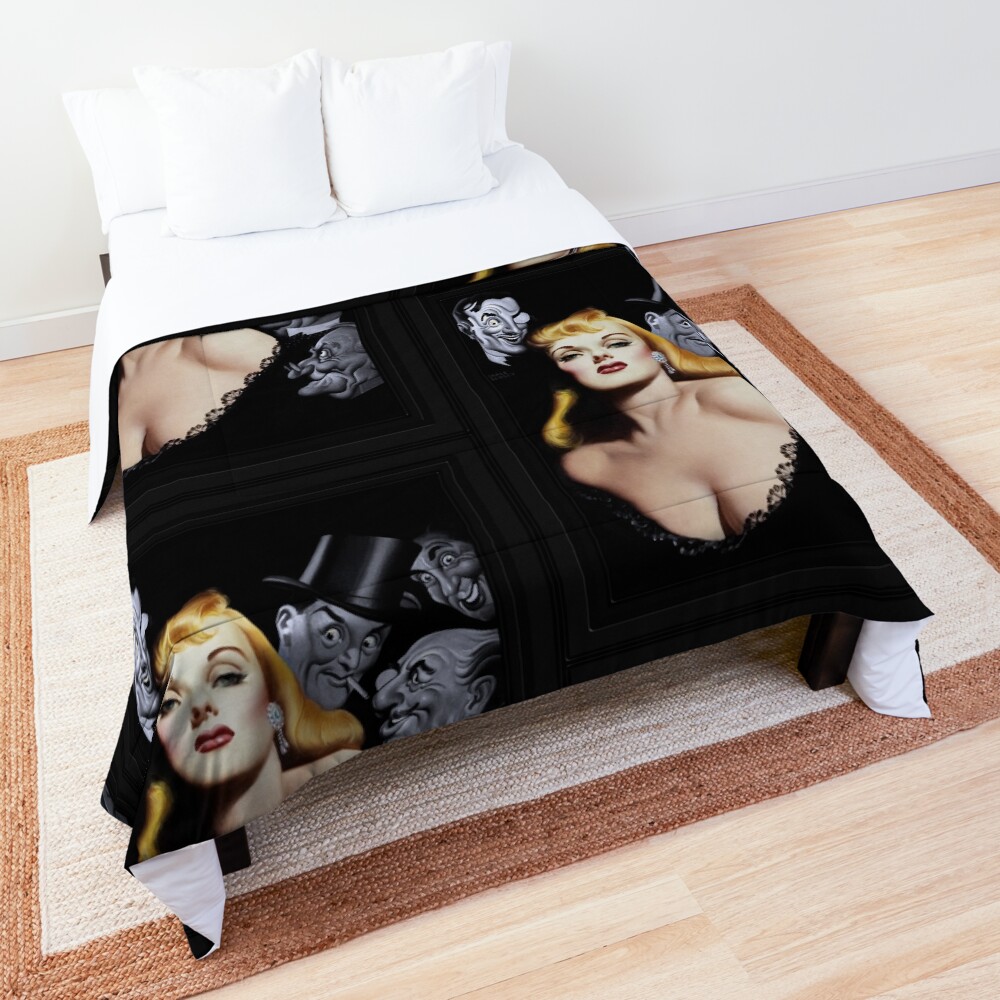
Den sentrale figuren i “Gentlemen Prefer Blondes” is a strikingly beautiful woman, her posture suggestive of confidence and allure. Hun stirrer direkte på betrakteren, her full, plump lips slightly parted, giving her an air of both mystery and command. Her platinum blonde hair cascades in soft waves, its texture smooth and flowing, contributing to the feminine, almost ethereal quality of her appearance. A pair of dangling earrings shimmer beneath her delicate ear, fanger seerens blikk, reinforcing the notion of opulence and beauty.
Antrekket hennes, a deep black dress trimmed with lace, accentuates her curves and frames her décolletage in a way that is both elegant and provocative. The dress’s high neckline contrasts with the plunging scoop at the front, revealing her fair, porselenslignende hud. This balance between modesty and sensuality creates an enticing juxtaposition that was a hallmark of pin-up art during this period.
In stark contrast to the polished, statuesque beauty of the woman, a collection of mischievous, almost caricature-like men encircle her. Disse tallene, with exaggerated facial expressions, evoke the playful, sometimes mischievous nature of male attention toward the female subject. Each man is drawn with exaggerated features—wide, almost cartoonish eyes, upturned lips in sly grins, and arched brows, giving them a whimsical, slightly sinister look. The men’s appearance is intentionally stylized, designed to enhance the seductive aura of the central woman while injecting an element of humor and farce.
Objekter og symbolikk
Bergey’s use of minimal yet impactful objects within the composition serves both to elevate the central figure and to add a sense of narrative depth. The woman is adorned with sparkling diamond earrings, signifying wealth, lokke, and status. These accessories, though small, function as symbols of desirability, further emphasizing the woman’s exalted position in society. Her dress, with its fine lace details, hints at the sophistication of the time, a time when women’s fashion was both a form of self-expression and a tool for empowerment.
The men surrounding the woman, though depicted with exaggerated features, seem to be captivated by her presence. They lean in toward her, each trying to attract her attention in their own exaggerated manner. Their various expressions—from the coy, almost shy smile of one to the playful, knowing grin of another—evoke the humor and complexity of romantic dynamics. This interaction between the woman and her male admirers is emblematic of the playful flirtation that often defined the post-war era’s art, reflecting a world where women were both objects of admiration and, at times, the arbiters of their own fate.
Stil og teknikk
Earle Kulp Bergey’s artistic style in this piece reflects his mastery of the pin-up genre, a style known for its vibrant use of color, dramatisk belysning, and exaggerated forms. Bergey employs a combination of realism and stylization, creating figures that are at once recognizable yet idealized. The smooth contours of the woman’s face and body are rendered with soft, almost ethereal shading, contributing to the sensuality of her form. The men, derimot, are depicted with more caricatured, angular features, a stark contrast that emphasizes their roles as playful bystanders to the woman’s commanding presence.
The artist’s use of deep, contrasting shadows heightens the drama of the piece. The background is dark, a subtle gradient of blacks and greys, providing the ideal backdrop to highlight the illuminated woman in the foreground. This contrast between light and dark adds depth to the painting, creating a sense of both intimacy and drama. The lighting itself is warm and soft, giving the entire composition a slightly dreamlike quality, as if the viewer is witnessing a moment suspended in time, frozen in a world of fantasy.
Tema og stemning
Temaet for “Herrer foretrekker blondiner” is unmistakably tied to the notion of beauty, charm, and the dynamics of attraction. The title itself alludes to the cultural perception of blonde women as desirable, an idea that was perpetuated by media and cinema during the time. The artwork plays with this perception, offering a playful yet biting commentary on how women, particularly those fitting the ideal of the time, were revered and sought after. The exaggerated expressions of the men around the woman reveal both their admiration and the absurdity of their pursuit, making the piece a light-hearted yet pointed commentary on the dynamics of flirtation and romantic attention.
The mood of the artwork is a blend of sensuality, humor, og mystikk. The central woman exudes confidence and allure, yet her expression remains somewhat distant, leaving the viewer wondering whether she is truly engaged with the men around her or merely indulging in their attention. The men, etter tur, are caught in a state of animated anticipation, suggesting a whimsical pursuit that is unlikely to reach any serious conclusion. This playful exchange between the sexes gives the piece a feeling of both joy and whimsy, reflecting the carefree nature of the era and the idea of unattainable yet desirable beauty.
Dette er en retusjert digital kunst som gamle mestere gjengir av et offentlig domenebilde.
Denne digitale kunstkreasjonen, som med alle kunstverkene som finnes på Xzendor7-nettstedet, er det tilgjengelig for kjøp online i en rekke materialformater, inkludert lerretstrykk, akryltrykk, metalltrykk, treutskrifter, innrammede trykk, plakater, og som rullede lerret utskrifter i en rekke størrelser fra 12 tommer til 72 tommer avhengig av størrelsen på det faktiske kunstverket og print on demand-butikken du velger å kjøpe kunsten fra.
Kunstverket er også tilgjengelig på et bredt utvalg av herre- og dameklær, krus, totes, skjerf, notatbøker og journaler og mange hjemmeinnredningsprodukter.
Om kunstneren
Info nedenfor fra Wikipedia.org
Earle K. Bergey (august 26, 1901 - september 30, 1952) var en amerikansk kunstner og illustratør som malte omslagskunst for tusenvis av papirmagasiner og pocketbøker. En av de mest produktive massefiksjonskunstnerne på 1900 -tallet, Bergey er anerkjent for å lage det ikoniske omslaget til Gentlemen Prefer Blondes for Popular Library på høyden av sin karriere i 1948.
Markerer starten på Bergeys svært innflytelsesrike løp som en amerikansk illustrasjon med pocketbøker, dette bombeskallemaleriet laget massen til pocketboken til Anita Loos blockbuster, Herrer foretrekker blondiner (utgitt som populært bibliotek #221).
Earle K. Bergeys forsidemaleri for Gentlemen Prefer Blondes, cirka 1948.
Bergey ble født i Philadelphia, Pennsylvania til A.. Frank og Ella Kulp Bergey. Han gikk på Pennsylvania Academy of Fine Arts fra 1921 til 1926, avsluttet formelle akademistudier våren 1926. Han begynte først å jobbe i kunstavdelingene i avisene i Philadelphia, inkludert Public Ledger, og han tegnet tegneserien Deb Days inn 1927. Tidlig i karrieren, Bergey bidro med mange forsider til massemagasinene til forlaget Fiction House.
I midten av 1930-årene, Bergey laget et hjem og studio i Bucks County, Pennsylvania, og han giftet seg i 1935.
Gjennom 1930 -tallet, Bergey jobbet frilans for en rekke forlag.
Hans iøynefallende malerier ble hovedsakelig omtalt som omslag på et bredt utvalg av massemagasiner, inkludert romantikk (Spennende kjærlighet, Populær kjærlighet, Elsker romanser) så vel som detektiv, eventyr, luftfart, og vestlige. Bergey illustrerte vanlige publikasjoner, for eksempel The Saturday Evening Post, i løpet av denne tiden.
I løpet av 1940 -årene, Bergey fortsatte å male omslag for romantikk, sport, og blader for detektivmasse, og han begynte å jobbe med en rekke science fiction -blader, inkludert standardpublikasjoner’ Merkelige historier, Oppsiktsvekkende historier, og Captain Future, og senere for Fantastic Story Magazine.
Bergeys kunstopplæring og fremtredende gave for å skildre anatomi gjorde ham til en kunstner på tvers av et mangfold av sjangre som krevde scener med dramatisk bevegelse, fra fotorealistiske sportsportretter av kjente idrettsutøvere inkludert Mickey Cochrane, Lou Gehrig, og Jim Thorpe til sin signatur Bergey Girls som dukket opp på risque massas gjennom depresjonen og i science fiction -scenarier fra andre verdenskrig.
Kunstnerens illustrasjoner av skarpt kledde kvinner som overlevde i verdensrommet tjente som inspirasjon for prinsesse Leias slave-jente-antrekk i Return of the Jedi, selv fargen og snittet, og Madonnas koniske messing -messing. Bergeys science fiction -omslag, noen ganger beskrevet som “Bim, VI VIL, Boms,” vanligvis inneholdt en kvinne som ble truet av et Bug-Eyed Monster, romvesen, eller robot, med en heroisk mannlig astronaut som kommer til hjelp for henne.
Bikinitopper som ble brukt av Bergey-jenter lignet ofte kobberholdig metall, gir opphav til uttrykket “jenta i messing -bh,” brukt i referanse til denne typen kunst. Visjonærer i TV og film har blitt påvirket av Bergeys arbeid; Gene Roddenberry, for eksempel, provided his production designer for Star Trek with examples of Bergey’s futuristic pulp covers.
I 1948, Bergey gjorde overgangen til den raskt voksende pocketindustrien sammen med dyktige fruktkjøttkunstnere som Rudolph Belarski, hvis arbeid ofte forveksles med Bergeys. Mens han fortsatte å male fruktkjøttdeksler til han døde.