

Séquoias géants de Californie c1874
“Séquoias géants de Californie c1874” par le peintre américain Albert Bierstadt (1830 – 1902) est une représentation majestueuse de la grandeur impressionnante de la nature, capturé grâce au talent d'un artiste éminent de l'Hudson River School. Peint 1874, l'œuvre d'art représente un paysage naturel intact avec d'imposants, des arbres anciens qui évoquent un sentiment d'émerveillement et de respect pour le monde naturel. La scène vibrante plonge le spectateur dans l'immensité de la nature sauvage californienne., où les séquoias colossaux se dressent comme des sentinelles silencieuses dans un environnement tranquille, bosquet ombragé. Le travail de Bierstadt met l’accent sur le contraste entre les petites figures humaines dans l’immense environnement naturel, améliorer la perception du spectateur de la taille monumentale et de l’intemporalité du paysage.
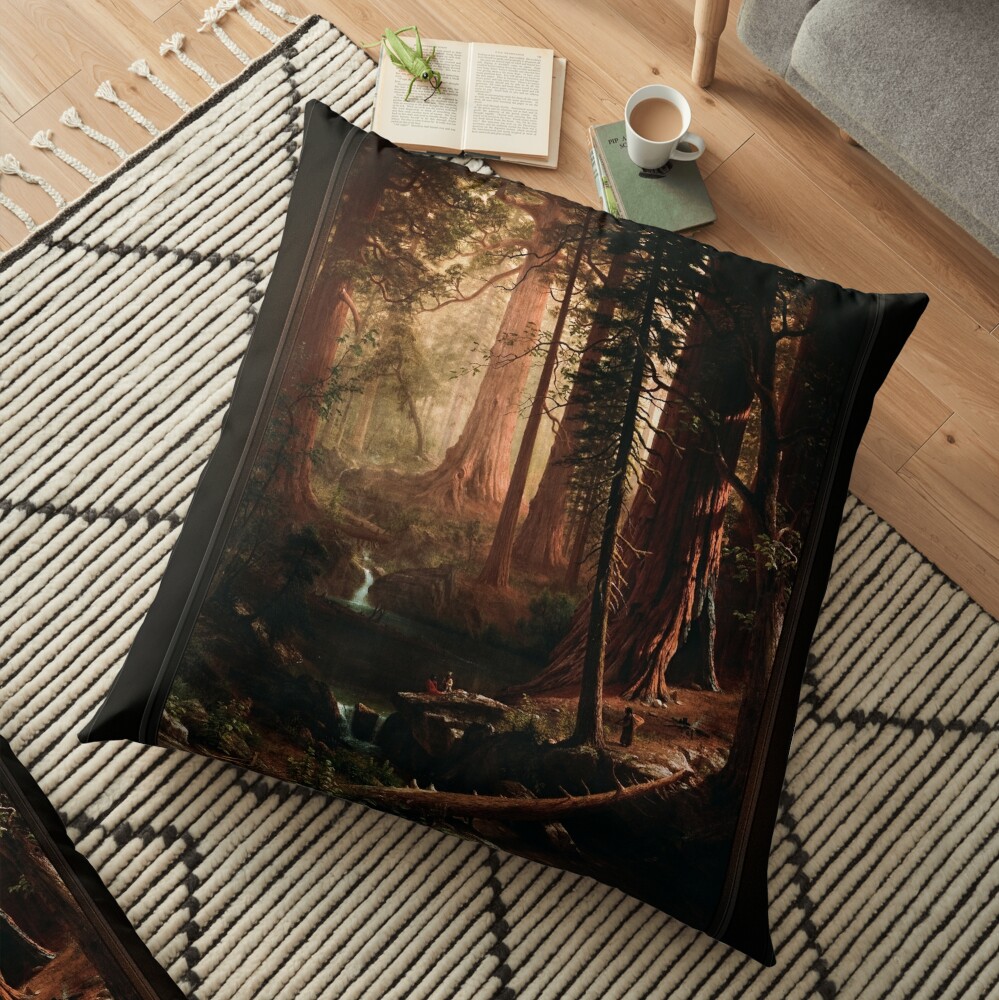
Table des matières
Sujet et composition
The central subject of Bierstadt’s painting is the towering Giant Redwood trees, their immense trunks and branches creating a dramatic, vertical composition that draws the viewer’s eye upward, emphasizing their colossal size. Les arbres, some reaching well beyond the top of the frame, dominer la scène, showcasing their grandiose stature with incredible realism. The rich tones of the bark, transitioning from deep browns to fiery oranges, are highlighted by the soft, dappled light filtering through the canopy above. The play of light and shadow serves to magnify the textures of the trees, which are rendered with remarkable attention to detail.
At the base of the redwoods, the dense undergrowth of ferns, moss, and smaller vegetation adds depth to the painting, creating a lush foreground that contrasts with the towering trees behind. In the lower left corner, two human figures are present, dressed in period-appropriate attire, perhaps indicating the presence of explorers or settlers, adding scale and narrative to the natural scene. Their small size against the backdrop of the towering trees emphasizes the immensity of nature, a common theme in Bierstadt’s works. The figures’ peaceful interaction with the environment also suggests a harmonious coexistence with the wild, untouched world they inhabit.
Caractéristiques du terrain et du paysage
Bierstadt’s depiction of the terrain in “Séquoias géants de Californie” is an idyllic and serene wilderness, dominated by towering redwoods that define the composition. The artist’s meticulous brushwork captures the undulating terrain of the forest floor, which is filled with rocks, fallen branches, and verdant undergrowth. A creek meanders through the center, adding movement and life to the otherwise still landscape. The water’s reflection mirrors the vibrant colors of the surrounding trees, enhancing the overall sense of tranquility and connection within the ecosystem.
The composition is further enriched by the interplay between light and shadow, as the sun filters through the canopy above, casting a soft glow over the terrain. This light not only highlights the redwood trees but also illuminates the creek, giving it a shimmering quality that contrasts beautifully with the darker, shaded areas of the painting. En arrière-plan, the forest extends into a distant horizon, with more towering trees fading into the mist, suggesting the vastness and mystery of the wilderness.
Matériaux et techniques
Albert Bierstadt was known for his mastery of light and his ability to create vivid, almost photographic renditions of natural landscapes. Dans cette pièce, his technique is evident in the careful rendering of the trees, the play of light across the forest floor, and the delicate balance of shadow and illumination. The artist’s use of color, particularly in the rich hues of the redwood bark and the verdant green of the foliage, creates a striking contrast that draws attention to the immensity of the trees while simultaneously invoking a sense of peace and harmony within the natural world.
Bierstadt’s use of light is particularly noteworthy. Le chaud, golden hues that spill across the landscape create an almost ethereal atmosphere, where the trees seem to glow with a life of their own. The soft glow that bathes the figures in the foreground suggests that they are part of the landscape, rather than intruders in this pristine environment. This use of light enhances the painting’s mood, evoking a sense of wonder and reverence for the natural world. The fine details of the trees’ bark, l'eau ondulante, and the subtle textures of the foliage showcase Bierstadt’s technical prowess and his ability to imbue a scene with a sense of grandeur.
Style et humeur
Le style de “Séquoias géants de Californie” is firmly rooted in the tradition of the Hudson River School, a movement known for its romanticized depictions of the American wilderness. Bierstadt was a key figure within this school, and his work often featured vast, untouched landscapes that conveyed a sense of the sublime. Dans ce tableau, the mood is one of awe and reverence. The towering redwoods, baigné d'une douce lumière, évoquent un sentiment de majesté tranquille et d'intemporalité. Les personnages du tableau, bien que petit, semblent être en harmonie avec leur environnement, comme s'ils faisaient partie de ce vaste, monde éternel.
L'ambiance reflète également l'époque à laquelle Bierstadt peignait : le milieu du XIXe siècle., lorsque le public américain était de plus en plus fasciné par la beauté naturelle du pays. Les séquoias, symboles à la fois des merveilles naturelles et de la frontière américaine, étaient un sujet qui a profondément trouvé un écho auprès du public contemporain. La peinture capture non seulement la grandeur physique des séquoias mais aussi la puissance émotionnelle du paysage., ce qui en fait un hommage approprié à la nature sauvage intacte de l'Ouest.
Conclusion
d'Albert Bierstadt “Séquoias géants de Californie” est un rendu époustouflant et magistral de l’une des merveilles les plus impressionnantes de la nature. Grâce à son travail au pinceau complexe, attention particulière à la lumière, et un profond respect pour le monde naturel, Bierstadt invite le spectateur à entrer dans une nature sauvage sereine et monumentale, où la présence intemporelle des séquoias est à la fois humiliante et inspirante. L’ambiance de révérence et de crainte du tableau est aussi pertinente aujourd’hui qu’elle l’était au XIXe siècle., nous rappelant la beauté durable du monde naturel et la place que nous y occupons.
“Séquoias géants de Californie c1874” par le peintre américain Albert Bierstadt (1830 – 1902) est une représentation majestueuse de la grandeur impressionnante de la nature, capturé grâce au talent d'un artiste éminent de l'Hudson River School. Peint 1874, l'œuvre d'art représente un paysage naturel intact avec d'imposants, des arbres anciens qui évoquent un sentiment d'émerveillement et de respect pour le monde naturel. La scène vibrante plonge le spectateur dans l'immensité de la nature sauvage californienne., où les séquoias colossaux se dressent comme des sentinelles silencieuses dans un environnement tranquille, bosquet ombragé. Le travail de Bierstadt met l’accent sur le contraste entre les petites figures humaines dans l’immense environnement naturel, améliorer la perception du spectateur de la taille monumentale et de l’intemporalité du paysage.
Sujet et composition
The central subject of Bierstadt’s painting is the towering Giant Redwood trees, their immense trunks and branches creating a dramatic, vertical composition that draws the viewer’s eye upward, emphasizing their colossal size. Les arbres, some reaching well beyond the top of the frame, dominer la scène, showcasing their grandiose stature with incredible realism. The rich tones of the bark, transitioning from deep browns to fiery oranges, are highlighted by the soft, dappled light filtering through the canopy above. The play of light and shadow serves to magnify the textures of the trees, which are rendered with remarkable attention to detail.
At the base of the redwoods, the dense undergrowth of ferns, moss, and smaller vegetation adds depth to the painting, creating a lush foreground that contrasts with the towering trees behind. In the lower left corner, two human figures are present, dressed in period-appropriate attire, perhaps indicating the presence of explorers or settlers, adding scale and narrative to the natural scene. Their small size against the backdrop of the towering trees emphasizes the immensity of nature, a common theme in Bierstadt’s works. The figures’ peaceful interaction with the environment also suggests a harmonious coexistence with the wild, untouched world they inhabit.
Caractéristiques du terrain et du paysage
Bierstadt’s depiction of the terrain in “Séquoias géants de Californie” is an idyllic and serene wilderness, dominated by towering redwoods that define the composition. The artist’s meticulous brushwork captures the undulating terrain of the forest floor, which is filled with rocks, fallen branches, and verdant undergrowth. A creek meanders through the center, adding movement and life to the otherwise still landscape. The water’s reflection mirrors the vibrant colors of the surrounding trees, enhancing the overall sense of tranquility and connection within the ecosystem.
The composition is further enriched by the interplay between light and shadow, as the sun filters through the canopy above, casting a soft glow over the terrain. This light not only highlights the redwood trees but also illuminates the creek, giving it a shimmering quality that contrasts beautifully with the darker, shaded areas of the painting. En arrière-plan, the forest extends into a distant horizon, with more towering trees fading into the mist, suggesting the vastness and mystery of the wilderness.
Matériaux et techniques
Albert Bierstadt was known for his mastery of light and his ability to create vivid, almost photographic renditions of natural landscapes. Dans cette pièce, his technique is evident in the careful rendering of the trees, the play of light across the forest floor, and the delicate balance of shadow and illumination. The artist’s use of color, particularly in the rich hues of the redwood bark and the verdant green of the foliage, creates a striking contrast that draws attention to the immensity of the trees while simultaneously invoking a sense of peace and harmony within the natural world.
Bierstadt’s use of light is particularly noteworthy. Le chaud, golden hues that spill across the landscape create an almost ethereal atmosphere, where the trees seem to glow with a life of their own. The soft glow that bathes the figures in the foreground suggests that they are part of the landscape, rather than intruders in this pristine environment. This use of light enhances the painting’s mood, evoking a sense of wonder and reverence for the natural world. The fine details of the trees’ bark, l'eau ondulante, and the subtle textures of the foliage showcase Bierstadt’s technical prowess and his ability to imbue a scene with a sense of grandeur.
Style et humeur
Le style de “Séquoias géants de Californie” is firmly rooted in the tradition of the Hudson River School, a movement known for its romanticized depictions of the American wilderness. Bierstadt was a key figure within this school, and his work often featured vast, untouched landscapes that conveyed a sense of the sublime. Dans ce tableau, the mood is one of awe and reverence. The towering redwoods, baigné d'une douce lumière, évoquent un sentiment de majesté tranquille et d'intemporalité. Les personnages du tableau, bien que petit, semblent être en harmonie avec leur environnement, comme s'ils faisaient partie de ce vaste, monde éternel.
L'ambiance reflète également l'époque à laquelle Bierstadt peignait : le milieu du XIXe siècle., lorsque le public américain était de plus en plus fasciné par la beauté naturelle du pays. Les séquoias, symboles à la fois des merveilles naturelles et de la frontière américaine, étaient un sujet qui a profondément trouvé un écho auprès du public contemporain. La peinture capture non seulement la grandeur physique des séquoias mais aussi la puissance émotionnelle du paysage., ce qui en fait un hommage approprié à la nature sauvage intacte de l'Ouest.
Conclusion
d'Albert Bierstadt “Séquoias géants de Californie” est un rendu époustouflant et magistral de l’une des merveilles les plus impressionnantes de la nature. Grâce à son travail au pinceau complexe, attention particulière à la lumière, et un profond respect pour le monde naturel, Bierstadt invite le spectateur à entrer dans une nature sauvage sereine et monumentale, où la présence intemporelle des séquoias est à la fois humiliante et inspirante. L’ambiance de révérence et de crainte du tableau est aussi pertinente aujourd’hui qu’elle l’était au XIXe siècle., nous rappelant la beauté durable du monde naturel et la place que nous y occupons.
Giant Redwood Trees of California est une reproduction de maîtres anciens d'art numérique retouchée d'une image du domaine public qui est disponible à l'achat en tant que impression sur toile.
Cette création d'art numérique, comme toutes les œuvres d'art disponibles sur le site Web Xzendor7, elles sont disponibles à l'achat en ligne dans une variété de formats de matériaux, y compris des impressions sur toile., impressions acryliques, impressions métalliques, gravures sur bois, impressions encadrées, affiches, et sous forme d'impressions sur toile roulées dans une variété de tailles de 12 pouces à 72 pouces en fonction de la taille de l'œuvre d'art réelle et de la boutique d'impression à la demande auprès de laquelle vous choisissez d'acheter l'art.
L’œuvre d’art est également disponible sur une large gamme de vêtements pour hommes et femmes., tasses, fourre-tout, écharpes, cahiers et journaux et de nombreux produits de décoration intérieure.
Biographie de l'artiste
Informations ci-dessous dérivées de Wikipedia.org
Albert Bierstadt est né à Solingen, Allemagne, le fils de Christine M. (Tillmans) et Henri Bierstadt, tonnelier; son frère était l'éminent photographe Edward Bierstadt.
Albert n'avait qu'un an, quand sa famille a immigré à New Bedford, Massachusetts en 1831. Tôt dans sa jeunesse, il a montré un talent et un goût pour créer des croquis au crayon intelligents.
À l'âge de 21, Albert a commencé à peindre à l'huile et en 1853 il est retourné en Allemagne et a commencé à étudier la peinture pendant plusieurs années à Düsseldorf; avec les membres de son école informelle de peinture.
Puis dans 1857 il est retourné à New Bedford Massachusetts, où il enseigne brièvement le dessin et la peinture avant de se consacrer à plein temps à la peinture, et en faisant plusieurs voyages de l'expansion vers l'ouest pour peindre des scènes de l'exploit.
Bien que d'autres artistes aient fait de même en enregistrant les sites de leur aventure, Bierstadt était le peintre le plus éminent d'entre eux, et le resta pour le reste du 19ème siècle, avec des images comme la Sierra Nevada.
Dans 1858, Bierstadt a exposé une grande peinture d'un paysage suisse à l'Académie nationale du design, qui lui a valu un accueil critique positif et un membre honoraire de l'Académie.
Bierstadt a commencé à peindre des scènes en Nouvelle-Angleterre et dans le nord de l'État de New York, y compris dans la vallée de la rivière Hudson. Il faisait partie d'un groupe d'artistes connu sous le nom de Hudson River School.
Dans 1859, Bierstadt a voyagé vers l'ouest en compagnie de Frederick W. Atterrisseur, un arpenteur-géomètre pour les États-Unis. gouvernement, voir ces paysages d'Amérique de l'ouest pour son travail.
Il est retourné dans un studio qu'il avait pris au Tenth Street Studio Building à New York avec des croquis pour de nombreuses peintures qu'il a ensuite terminées.. Dans 1860, il a été élu membre de la National Academy of Design; il a reçu des médailles en Autriche, Bavière, la Belgique, et l'Allemagne.
Dans 1863, Bierstadt a encore voyagé vers l'ouest, cette fois en compagnie de l'auteur Fitz Hugh Ludlow, dont il a épousé la femme plus tard. Le couple a passé sept semaines dans la vallée de Yosemite.
Tout au long des années 1860, Bierstadt a utilisé les études de ce voyage comme source de peintures à grande échelle pour l'exposition et il a continué à visiter l'Ouest américain tout au long de sa carrière.
Les immenses toiles qu'il a produites après ses voyages avec Lander et Ludlow l'ont établi comme le peintre prééminent du paysage américain de l'ouest.
La compétence technique de Bierstadt (que l'on peut voir dans la Sierra Nevada), gagné grâce à son étude du paysage européen, était crucial pour son succès en tant que peintre de l'Ouest américain et expliquait sa popularité dans la diffusion de vues des montagnes Rocheuses à ceux qui ne les avaient pas vues.