

Girl in Yellow Drapery
John William Godward’s “Girl in Yellow Drapery,” wedi'i greu yn 1901, presents a striking depiction of classical beauty, rendered with masterful detail. Godward, an artist known for his contributions to the Neoclassical style, captured the timeless grace of the ancient world in a manner that emphasizes harmony, harddwch, and serenity. Godward’s (1861 – 1922) works often reflect his deep admiration for the art of ancient Rome and Greece, blending idealized female forms with the architectural and natural elements of the classical world. His penchant for delicate color palettes, along with his skill in creating lifelike textures, is evident in this painting.

Tabl Cynnwys
Y prif bwnc: A Sleeping Figure of Serenity
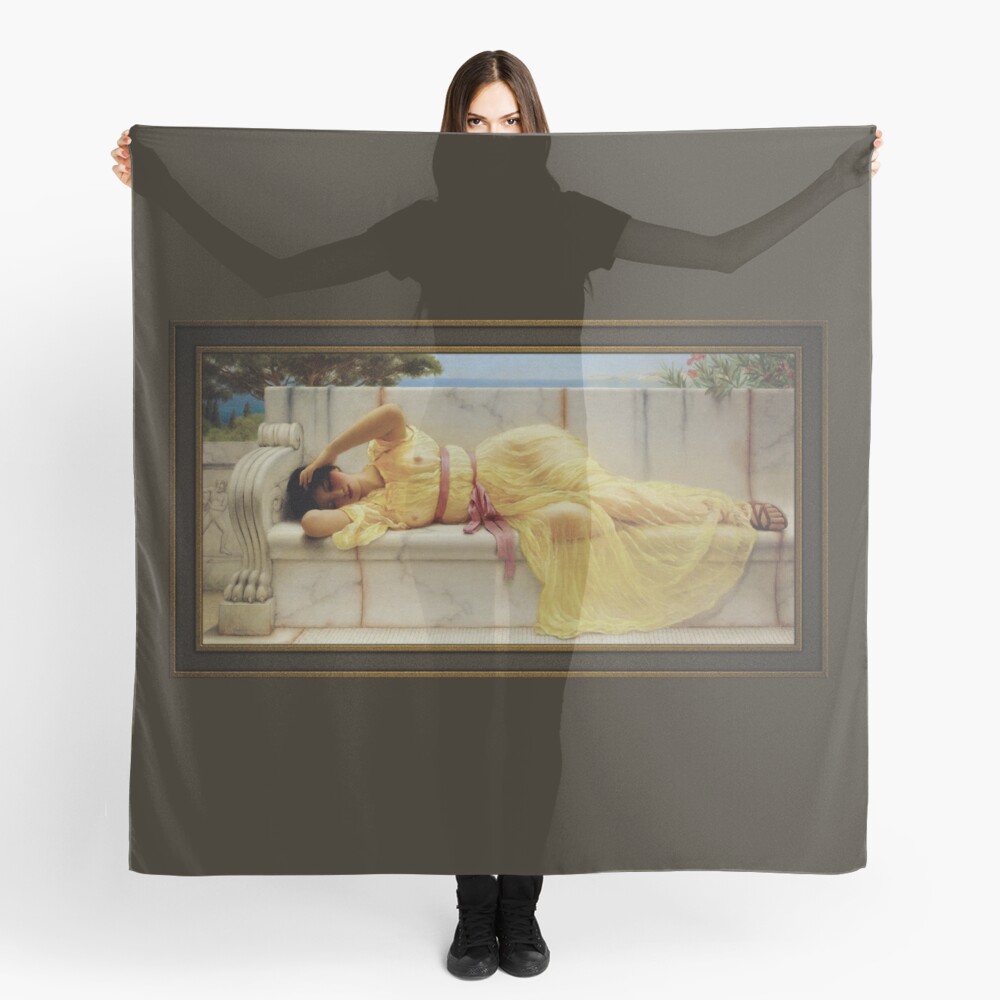
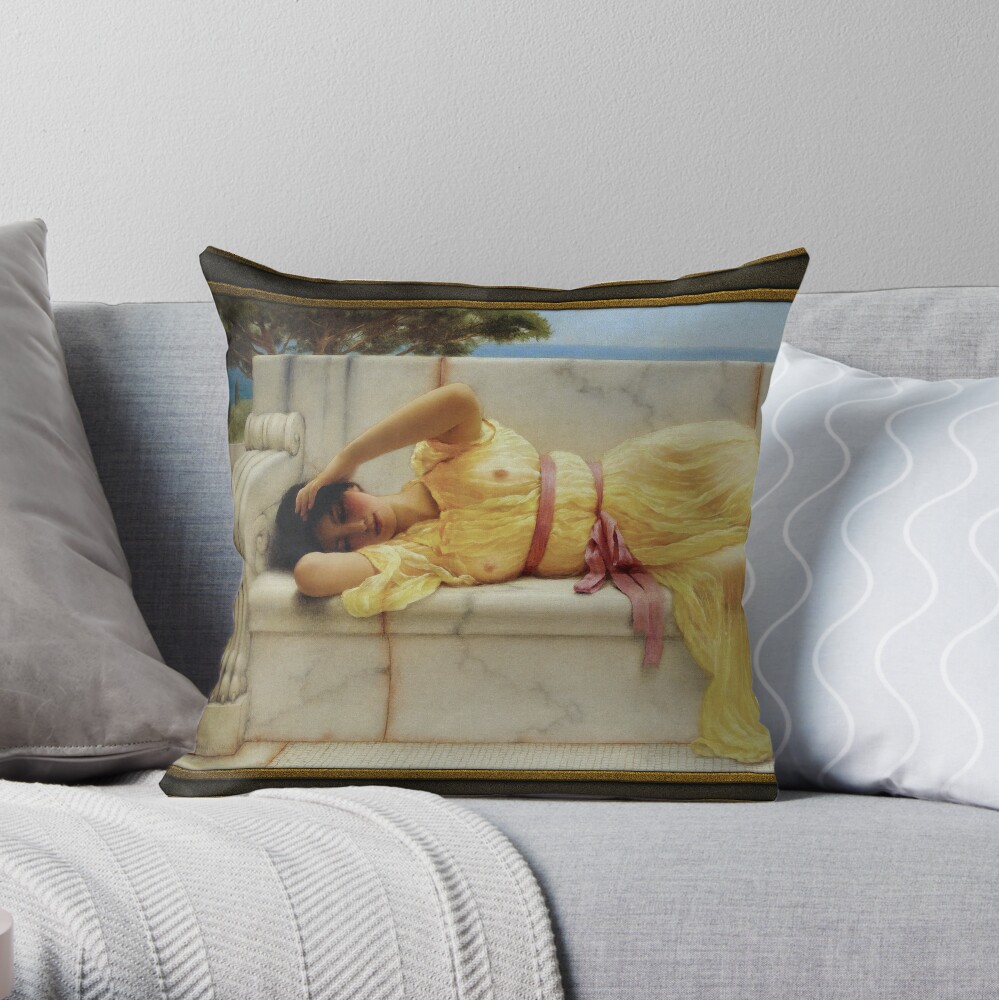
At the heart of the painting is a reclining young woman draped in a soft, flowing yellow gown that contrasts gracefully against the serene landscape. Mae'r girl’s pose suggests a moment of quiet rest, her head gently resting on her arm while her other hand lies across her forehead, seemingly shielding her eyes from the soft light.
Her physical form is captured with remarkable finesse, hi face is serene and perfectly sculpted, reflecting the idealized beauty that was a hallmark of Godward’s work. The pale yellow gown she wears is airy, almost translucent, fluttering gently around her form as if caressed by a soft breeze. The drapery, er mor dyner ac ysgafn ei liw, yn cario ymdeimlad o bwysau a dyfnder, yn dyst i astudiaeth ofalus yr artist o ffabrig ac anatomeg.
Yr Atmosffer: Tranquil and Timeless
Mae naws y paentiad yn un o lonyddwch, amseroldeb, a gras. Mae'n ymddangos bod y ffigwr mewn cyflwr dwfn, efallai yng nghanol nap neu freuddwyd dydd, heb ei gyffwrdd gan bryderon y byd tu allan. Mae'r meddalwch o'i dillad ac ystum tyner ei chorff yn ennyn ymdeimlad o gysgu heddychlon, tra bod absenoldeb unrhyw emosiwn neu weithred amlwg yn gadael y gwyliwr i brofi'r olygfa fel gwahoddiad i oedi a myfyrio. Godward, wrth ddal y foment hon, yn creu llonyddwch llonydd, lle mae amser yn ymddangos yn ataliedig.
The Architecture: Classical Influence
Y tu ôl i'r ffigwr, mae'r olygfa wedi'i fframio gan glasur mainc garreg sy'n cysylltu'r pwnc â byd gwareiddiad hynafol. Mae'r marmor mainc, with its slightly weathered, elegant columns and scrollwork, serves as a reminder of the classical heritage that influenced much of Godward’s work. The artist’s attention to architectural detail is remarkable, with the texture of the stone clearly articulated in the subtle shadows and light reflections. Mae'r colofnau, designed in the Corinthian style, suggest an elevated cultural and intellectual world, adding to the painting’s timeless quality.
The Natural Landscape: Calm and Expansive
Yn y cefndir, the viewer can see a peaceful vista that stretches out beyond the stone bench. The landscape is bathed in soft light, hinting at a horizon where the sea meets the sky. Although the colors of the sky are muted, y expansive nature of the scene provides a sense of space, suggesting an open, tranquil world that contrasts beautifully with the intimacy of the figure’s repose. Trees with a variety of lush greenery add to the sense of calm, their foliage subtly suggesting the warmth of an ancient Mediterranean climate.
The Medium and Technique: Fine Detail and Texture
Godward’s technical prowess is evident in the exquisite detailing of both the figure and the surrounding elements. The softness of the woman’s yellow gown contrasts with the rigid, almost tactile quality of the marble columns and bench. The use of light and shadow on the fabric emphasizes its delicate, flowing nature while the skin of the figure appears almost lifelike in its natural tone. Godward’s technique in blending light and shadow contributes to the sense of realism and depth, imbuing the work with an almost three-dimensional quality. His meticulous rendering of the textures—whether it is the smoothness of the stone, the transparency of the fabric, or the natural sheen of the skin—demonstrates his mastery of light and texture.
Godward’s Style and Themes: Classical Beauty Revisited
Mae arddull “Girl in Yellow Drapery” embodies the core ideals of Neoclassicism, a movement that sought to revive the aesthetics and ideals of ancient Greece and Rome. This style is characterized by its focus on idealized beauty, smooth forms, and an emphasis on proportion and harmony. Godward’s work is deeply infused with these principles, especially in his portrayal of the female figure, which is often idealized and posed in tranquil, relaxed settings. His subjects are frequently depicted in lush landscapes or classical architectural settings, as seen in this piece. Y paentiad hwn, yn arbennig, encapsulates Godward’s fascination with female beauty and classical antiquity.
The theme of a reclining figure, often a symbol of both sensuality and repose, further emphasizes the artist’s commitment to creating a harmonious, serene world in his works. The image of the young woman in Godward’s painting is not merely of a sleeping figure; it is a vision of calm and perfection, disconnected from the worries of the world and set within a timeless environment. It’s an invitation for the viewer to step into a space where beauty and stillness reign.
Nghasgliad: The Enduring Legacy of Godward’s Work
John William Godward’s “Girl in Yellow Drapery” is a fine example of the artist’s dedication to the Neoclassical style, illustrating his skill in portraying idealized beauty and his deep admiration for classical art forms. Through the careful depiction of the figure, the architectural elements, a byd natur, Godward creates a scene of serene elegance that has continued to captivate audiences long after its creation. His ability to evoke a mood of timeless peace, combined with his technical precision, ensures that this painting remains a significant work in the history of British art.
Girl in Yellow Drapery is a remastered digital art old masters reproduction of a public domain image that is available as a print cynfas ar-lein.
Y greadigaeth gelfyddyd ddigidol hon, fel gyda'r holl waith celf sydd i'w gael ar wefan Xzendor7 ar gael i'w brynu ar-lein mewn amrywiaeth o fformatau deunydd gan gynnwys printiau cynfas, printiau acrylig, printiau metel, printiau pren, printiau wedi'u fframio, posteri, ac fel printiau cynfas wedi'u rholio mewn amrywiaeth o feintiau o 12 modfedd i 72 modfeddi yn dibynnu ar faint y gwaith celf gwirioneddol a'r siop argraffu ar alw y byddwch yn dewis prynu'r celf ohoni.
Mae’r gwaith celf hefyd ar gael ar ystod eang o ddillad dynion a merched, mygiau, totes, sgarffiau, llyfrau nodiadau a chyfnodolion a llawer o gynhyrchion addurno cartref.
Bio artist
Gwybodaeth Isod O Wikipedia.org
John William Godward oedd yr hynaf o bump o blant, ac fe'i enwyd ar ôl ei dad John a'i dad-cu William.
Arddangosodd yn yr Academi Frenhinol o 1887. Pan symudodd i'r Eidal gydag un o'i fodelau yn 1912, torrodd ei deulu bob cysylltiad ag ef a thorri ei ddelwedd o luniau teulu hyd yn oed. Dychwelodd Godward i Loegr yn 1921, bu farw yn 1922, ac wedi'i gladdu ym Mynwent Brompton, Gorllewin Llundain.
Un o'i baentiadau mwyaf adnabyddus yw Dolce Far Niente (1904), a brynwyd ar gyfer casgliad Andrew Lloyd Webber yn 1995. Fel yn achos sawl llun arall, Paentiodd Godward fwy nag un fersiwn; Yn yr achos hwn, yn gynharach (ac yn llai adnabyddus) 1897 fersiwn gyda pellach 1906 fersiwn.
Cyflawnodd hunanladdiad yn oed 61 a dywedir iddo ysgrifennu yn ei nodyn hunanladdiad hynny “nid yw'r byd yn ddigon mawr ar gyfer [y ddau] fy hun a Picasso”.
Ei deulu sydd wedi ymddieithrio, a oedd wedi anghymeradwyo ei fod yn dod yn arlunydd, yn cywilyddio o'i hunanladdiad a llosgi ei bapurau. Dim ond un ffotograff o Godward y gwyddys ei fod yn goroesi.
Roedd Godward yn Neo-Clasurydd Fictoraidd, ac felly, mewn theori, un o ddilynwyr Frederic Leighton. Fodd bynnag, mae'n gysylltiedig yn agosach â Syr Lawrence Alma-Tadema o ran arddull, y rhannodd ef â phenchant ar gyfer rendro pensaernïaeth Glasurol - yn benodol, nodweddion tirwedd statig wedi'u hadeiladu o farmor.
Mae'r mwyafrif helaeth o ddelweddau sy'n bodoli gan Godward yn cynnwys menywod mewn gwisg glasurol yn erbyn nodweddion tirwedd; er bod rhai ffigurau lled-noethlymun a hollol noethlymun wedi'u cynnwys yn ei oeuvre, enghraifft nodedig yw “Yn Y Tepidarium c1913”.
Teitl a rennir gyda phaentiad dadleuol alma-tasgema o'r un pwnc sy'n byw yn y “Oriel Gelf Lady Lever”. Mae'r teitlau yn adlewyrchu ffynhonnell ysbrydoliaeth Godward; a oedd yn wareiddiad clasurol, yn fwyaf nodedig Rhufain Hynafol; Pwnc yn rhwymo Duwward yn agos i Alma-Tadema yn artistig.
O ystyried bod ysgolheictod clasurol yn fwy eang ymhlith y gynulleidfa bosibl am ei luniau yn ystod ei oes nag yn yr oes sydd ohoni, Roedd ymchwil fanwl o fanylion yn bwysig er mwyn cyrraedd safle fel arlunydd yn y genre hwn.
Roedd Alma-Tadema yn archeolegydd yn ogystal ag arlunydd, a fynychodd safleoedd hanesyddol a chasglu arteffactau a ddefnyddiodd yn ddiweddarach yn ei luniau: Godward, hefyd, astudio manylion fel pensaernïaeth a gwisg, er mwyn sicrhau bod ei weithiau'n dwyn y stamp dilysrwydd.
Yn ychwanegol, Godward yn ofalus ac yn ofalus iawn wedi rhoi nodweddion pwysig eraill yn ei luniau, crwyn anifeiliaid y mae'r paentiadau ohonynt “Gorffwys Diwrnod hanner dydd C1910” a “Encil Cŵl C1910” yn cynnwys enghreifftiau o ddehongliad o'r fath yn ogystal â blodau gwyllt “Nerissa C1906” a “Blodau Haf C1903”.
Mae ymddangosiad menywod hardd mewn peri a astudiwyd mewn cymaint o gynfasau Godward yn achosi i lawer o newydd-ddyfodiaid ei weithiau ei gategoreiddio ar gam fel cyn-raphaelite, yn enwedig gan fod ei balet yn aml yn un bywiog o liwgar. Y dewis o bwnc (gwareiddiad hynafol yn erbyn, er enghraifft, Chwedl Arthuraidd) yn fwy cywir y neo-glasurwr Fictoraidd.
Yn yr un modd â nifer o beintwyr sy'n gyfoes ag ef, Roedd Godward yn ‘Breuddwydiwr Fictoraidd Uchel’, cynhyrchu delweddau o fyd delfrydol a rhamantus sydd, yn achos Godward ac Alma-Tadema, daeth i gael ei feirniadu fel golwg fyd-eang ar Fictoriaid mewn togas.
Godward “sefydlodd enw da yn gyflym am ei luniau o ferched ifanc mewn lleoliad clasurol a'i allu i gyfleu â sensitifrwydd a meistrolaeth dechnegol naws gweadau cyferbyniol cnawd, marmor, ffwr a ffabrigau.
Mae'n debyg bod Godward’s Penchant am greu gweithiau celf a osodwyd yn y cyfnod clasurol wedi dod o’r cyfnod amser y cafodd ei eni ynddo; gan mai hwn oedd yr adfywiad clasurol ar raddfa lawn olaf mewn paentiadau gorllewinol, a ffynnodd yn Lloegr o'r 1860au hyd at y 1890au.