

Girl in Yellow Drapery
John William Godward’s “Girl in Yellow Drapery,” oprettet i 1901, presents a striking depiction of classical beauty, rendered with masterful detail. Godward, an artist known for his contributions to the Neoklassisk stil, captured the timeless grace of the ancient world in a manner that emphasizes harmony, skønhed, and serenity. Godward’s (1861 – 1922) works often reflect his deep admiration for the art of ancient Rome and Greece, blending idealized female forms with the architectural and natural elements of the classical world. His penchant for delicate color palettes, along with his skill in creating lifelike textures, is evident in this painting.

Indholdsfortegnelse
Hovedemnet: A Sleeping Figure of Serenity
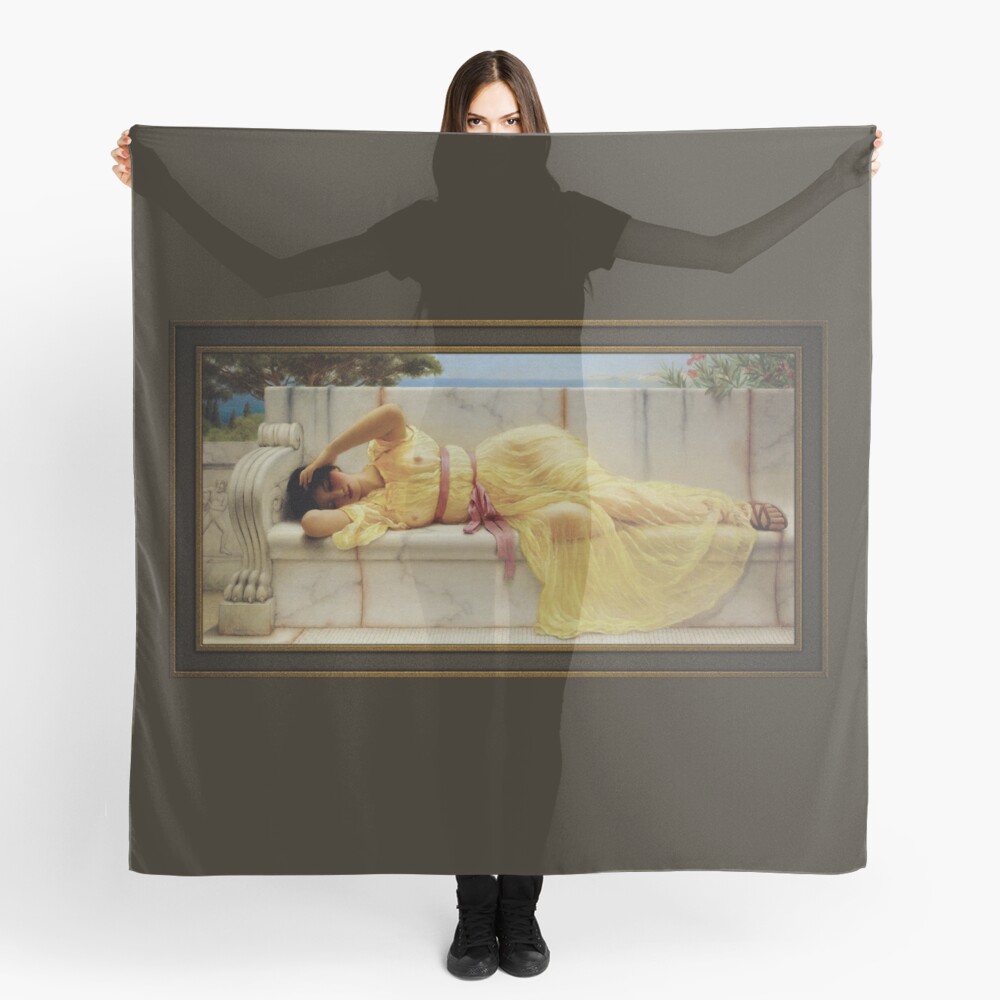
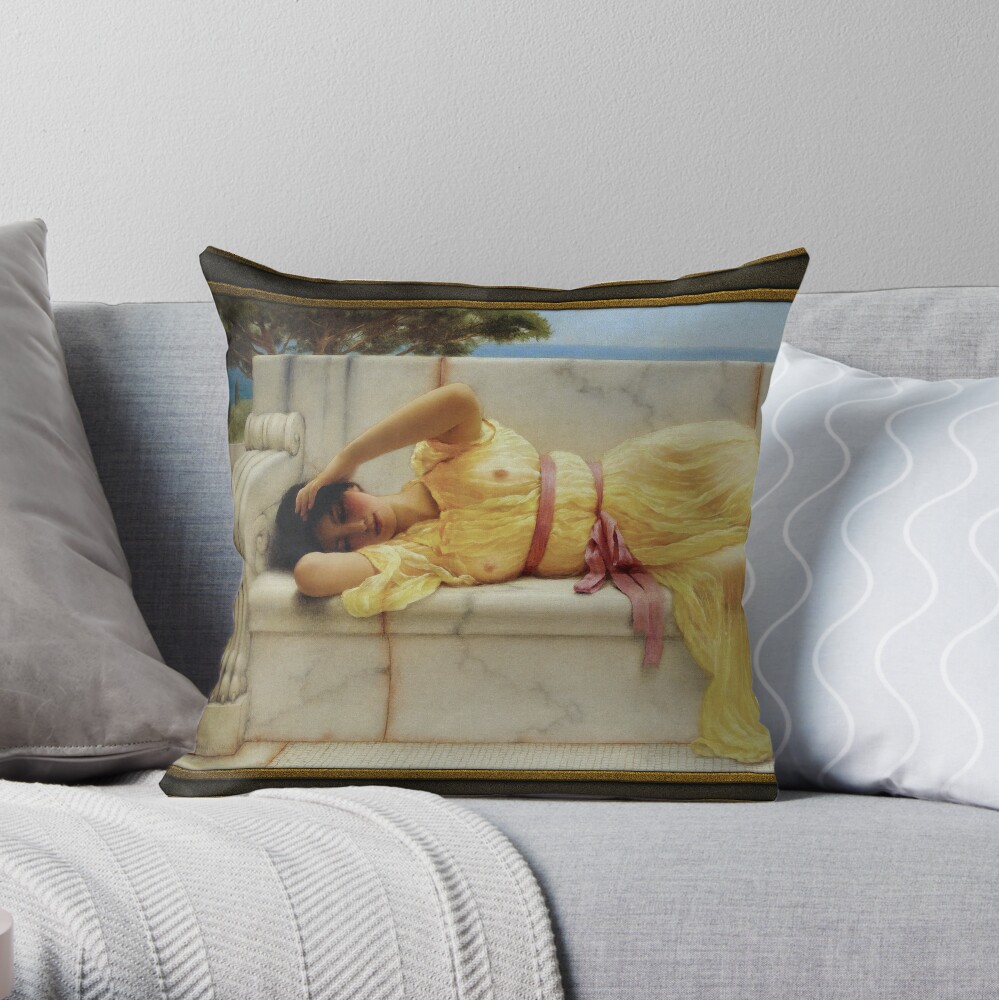
At the heart of the painting is a reclining young woman draped in a soft, flowing yellow gown that contrasts gracefully against the serene landscape. Det girl’s pose suggests a moment of quiet rest, her head gently resting on her arm while her other hand lies across her forehead, seemingly shielding her eyes from the soft light.
Her physical form is captured with remarkable finesse, hende ansigt is serene and perfectly sculpted, reflecting the idealized beauty that was a hallmark of Godward’s work. The pale yellow gown she wears is airy, almost translucent, fluttering gently around her form as if caressed by a soft breeze. The drapery, though delicate and light in color, carries with it a sense of weight and depth, a testament to the artist’s careful study of fabric and anatomy.
The Atmosphere: Tranquil and Timeless
The mood of the painting is one of tranquility, timelessness, og nåde. The figure appears to be in a state of deep repose, perhaps in the midst of a nap or daydream, untouched by the concerns of the outside world. Det softness of her drapery and the gentle pose of her body evoke an air of peaceful slumber, while the absence of any overt emotion or action leaves the viewer to experience the scene as an invitation to pause and reflect. Godward, in capturing this moment, creates a serene stillness, where time seems suspended.
The Architecture: Classical Influence
Behind the figure, the scene is framed by a classical stone bench that connects the subject to the world of ancient civilization. Det marmor bench, with its slightly weathered, elegant columns and scrollwork, serves as a reminder of the classical heritage that influenced much of Godward’s work. The artist’s attention to architectural detail is remarkable, with the texture of the stone clearly articulated in the subtle shadows and light reflections. Det columns, designed in the Corinthian style, suggest an elevated cultural and intellectual world, adding to the painting’s timeless quality.
The Natural Landscape: Calm and Expansive
I baggrunden, the viewer can see a peaceful vista that stretches out beyond the stone bench. The landscape is bathed in soft light, hinting at a horizon where the sea meets the sky. Although the colors of the sky are muted, det expansive nature of the scene provides a sense of space, suggesting an open, tranquil world that contrasts beautifully with the intimacy of the figure’s repose. Trees with a variety of lush greenery add to the sense of calm, their foliage subtly suggesting the warmth of an ancient Mediterranean climate.
The Medium and Technique: Fine Detail and Texture
Godward’s technical prowess is evident in the exquisite detailing of both the figure and the surrounding elements. The softness of the woman’s yellow gown contrasts with the rigid, almost tactile quality of the marble columns and bench. The use of light and shadow on the fabric emphasizes its delicate, flowing nature while the skin of the figure appears almost lifelike in its natural tone. Godward’s technique in blending light and shadow contributes to the sense of realism and depth, imbuing the work with an almost three-dimensional quality. His meticulous rendering of the textures—whether it is the smoothness of the stone, the transparency of the fabric, or the natural sheen of the skin—demonstrates his mastery of light and texture.
Godward’s Style and Themes: Classical Beauty Revisited
Stilen af “Girl in Yellow Drapery” embodies the core ideals of Nyklassicisme, a movement that sought to revive the aesthetics and ideals of ancient Greece and Rome. This style is characterized by its focus on idealized beauty, smooth forms, and an emphasis on proportion and harmony. Godward’s work is deeply infused with these principles, especially in his portrayal of the female figure, which is often idealized and posed in tranquil, relaxed settings. His subjects are frequently depicted in lush landscapes or classical architectural settings, as seen in this piece. Dette maleri, især, encapsulates Godward’s fascination with female beauty and classical antiquity.
The theme of a reclining figure, often a symbol of both sensuality and repose, further emphasizes the artist’s commitment to creating a harmonious, serene world in his works. The image of the young woman in Godward’s painting is not merely of a sleeping figure; it is a vision of calm and perfection, disconnected from the worries of the world and set within a timeless environment. It’s an invitation for the viewer to step into a space where beauty and stillness reign.
Konklusion: The Enduring Legacy of Godward’s Work
John William Godward’s “Girl in Yellow Drapery” is a fine example of the artist’s dedication to the Neoclassical style, illustrating his skill in portraying idealized beauty and his deep admiration for classical art forms. Through the careful depiction of the figure, the architectural elements, and the natural world, Godward creates a scene of serene elegance that has continued to captivate audiences long after its creation. His ability to evoke a mood of timeless peace, combined with his technical precision, ensures that this painting remains a significant work in the history of British art.
Girl in Yellow Drapery is a remastered digital art old masters reproduction of a public domain image that is available as a lærred print online.
Denne digitale kunstskabelse, som med alt det kunstværk, der kan findes på Xzendor7-webstedet, er det tilgængeligt for køb online i en række materialeformater, herunder lærredstryk, akryltryk, metaltryk, trætryk, indrammede tryk, plakater, og som rullede lærred udskriver i forskellige størrelser fra 12 tommer til 72 tommer afhængigt af størrelsen på det faktiske kunstværk og den print-on-demand-butik, du vælger at købe kunsten fra.
Kunstværket er også tilgængeligt på en bred vifte af mænds og kvinders beklædning, krus, totes, tørklæder, notesbøger og journaler og mange boligindretningsprodukter.
Kunstner Bio
Info nedenfor fra Wikipedia.org
John William Godward var den ældste af fem børn, og blev opkaldt efter hans far John og bedstefar William.
Han udstillede på Det Kongelige Akademi fra 1887. Da han flyttede til Italien med en af sine modeller i 1912, hans familie afbrød al kontakt med ham og klippede endda hans billede fra familiebilleder. Godward vendte tilbage til England i 1921, døde i 1922, og er begravet på Brompton Cemetery, Vest London.
Et af hans mest kendte malerier er Dolce far Niente (1904), som blev købt til samlingen af Andrew Lloyd Webber i 1995. Som i tilfældet med flere andre malerier, Godward malede mere end én version; I dette tilfælde, en tidligere (og mindre kendt) 1897 version med en yderligere 1906 version.
Han begik selvmord i en alder af 61 og siges at have skrevet i sit selvmordsbrev, at “verden er ikke stor nok til [begge] mig selv og en Picasso”.
Hans fremmedgjorte familie, som havde afvist, at han blev kunstner, skammede sig over sit selvmord og brændte hans papirer. Kun et fotografi af Godward vides at overleve.
Godward var en victoriansk nyklassicist, og derfor, i teorien, en tilhænger af Frederic Leighton. Imidlertid, han er mere stilistisk allieret med Sir Lawrence Alma-Tadema, med hvem han delte en forkærlighed for gengivelsen af klassisk arkitektur – i særdeleshed, statiske landskabstræk konstrueret af marmor.
Langt de fleste af Godwards eksisterende billeder viser kvinder i klassisk påklædning poseret mod landskabstræk; selvom der er nogle semi-nøgne og helt nøgne figurer inkluderet i hans oeuvre, et bemærkelsesværdigt eksempel “I Tepidarium c1913”.
En titel deles med et kontroversielt Alma-Tadema-maleri af samme emne, som findes i “Lady Lever kunstgalleri”. Titlerne afspejler Godwards inspirationskilde; som var klassisk civilisation, mest bemærkelsesværdigt det fra det gamle Rom; et emne, der kunstnerisk binder Godward tæt til Alma-Tadema.
I betragtning af at klassisk stipendium var mere udbredt blandt det potentielle publikum for hans malerier i hans levetid end i dag, omhyggelig undersøgelse af detaljer var vigtig for at opnå en position som kunstner i denne genre.
Alma-Tadema var både arkæolog og maler, som besøgte historiske steder og samlede artefakter, han senere brugte i sine malerier: Godward, også, studerede detaljer som arkitektur og kjole, for at sikre, at hans værker bar ægthedens præg.
Ud over, Godward gengav omhyggeligt og omhyggeligt andre vigtige træk i sine malerier, dyreskind, hvoraf malerierne “Middagshvile c1910” og “A Cool Retreat c1910” indeholder eksempler på en sådan gengivelse samt vilde blomster “Nerissa c1906” og “Sommerblomster c1903”.
Forekomsten af smukke kvinder i studerede positurer på så mange af Godwards lærreder får mange nybegyndere til hans værker til fejlagtigt at kategorisere ham som værende prærafaelit., Især da hans palette ofte er livligt farverig. Valget af emne (oldtidens civilisation versus, for eksempel, Arthuriansk legende) er mere korrekt den victorianske neo-klassicist.
Til fælles med talrige malere, der er samtidige med ham, Godward var en 'High Victorian Dreamer', producere billeder af en idealiseret og romantiseret verden, der, i tilfældet med både Godward og Alma-Tadema, kom til at blive kritiseret som et verdensbillede af victorianere i togaer.
Godward “etablerede hurtigt et ry for sine malerier af unge kvinder i klassiske omgivelser og hans evne til med følsomhed og teknisk beherskelse at formidle følelsen af kontrasterende teksturer af kød, marmor, pels og stoffer.
Godwards forkærlighed for at skabe kunstværker i den klassiske periode kom sandsynligvis fra den periode, hvor han blev født; da det var den sidste klassiske genoplivning i fuld skala i vestlige malerier, der blomstrede i England fra 1860'erne op til 1890'erne.