

Dolce Far Niente
“Dolce Far Niente,” created by the British painter John William Godward i 1904, embodies the essence of leisurely tranquility in classical art. John William Godward (1861 – 1922) is renowned for his dedication to depicting serene and opulent scenes inspired by ancient Rome and Greece, often focusing on beautiful women in idealized settings.
I dette maleri, Godward captures a moment of pure relaxation, where the subject reclines in a luxurious setting, offering the viewer a window into a world of unhurried elegance. Titlen, which translates from Italian as “The Sweetness of Doing Nothing,” is a fitting description of the painting’s mood. This theme of languor and contentment is a hallmark of Godward’s work and reflects a classical ideal of living in harmony with nature and luxury.
Indholdsfortegnelse
Hovedemnet: A Reclining Woman
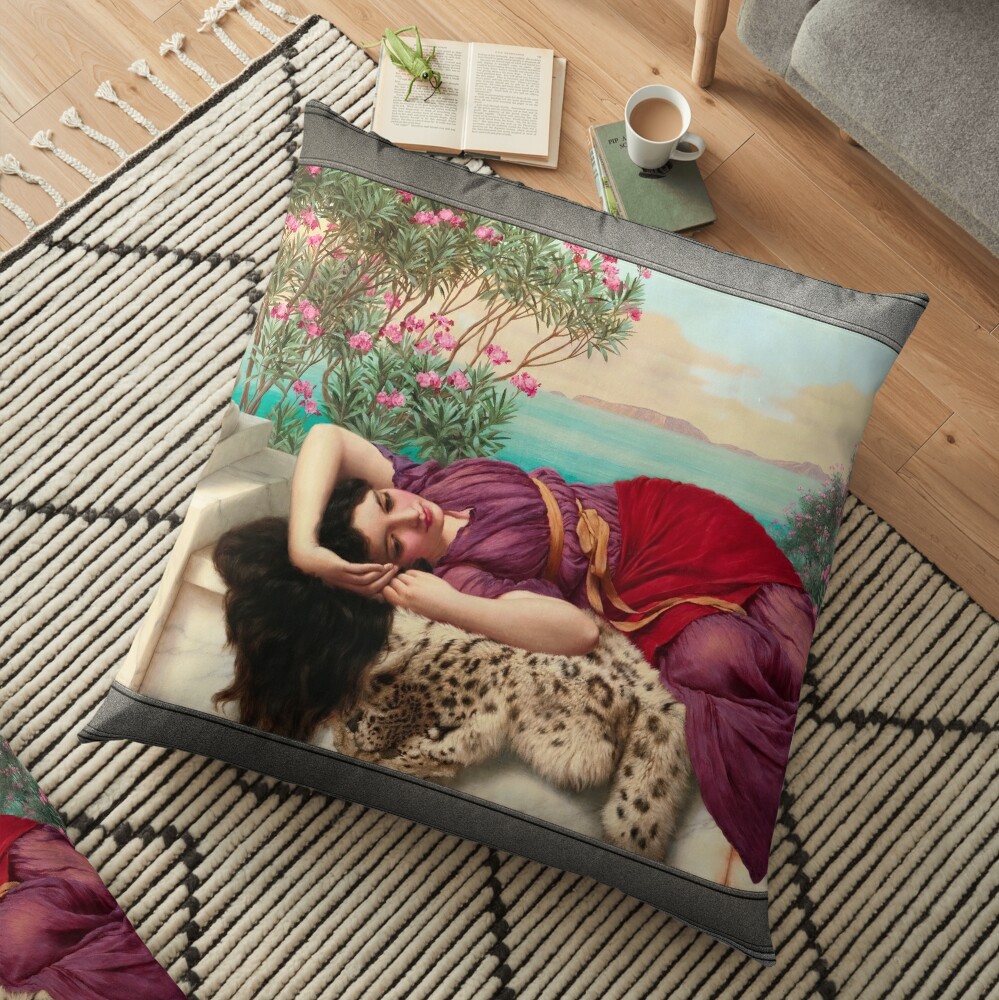
At the heart of the composition lies a young woman, the focal point of the painting. Draped in flowing, rich fabrics, she reclines languidly on a marble terrace. Her pose suggests both comfort and contemplation, her head resting gently on her right arm, while her other hand lies relaxed by her side. The woman’s attire is a blend of classical Greek and Roman influences, with a deep red robe cinched at the waist by a golden sash, flowing loosely around her body.
The fabric of her clothing flows with remarkable realism, draping gracefully over her form and pooling around her on the marble. The woman’s expressive face is calm and serene, exuding a sense of peace and satisfaction. Hendes lange, dark hair tumbles softly over her shoulder and down her back, enhancing her delicate beauty.
The figure is sculpted in a manner that emphasizes classical ideals of beauty, graceful, slender, and harmonious. The figure’s serene expression is a key aspect of Godward’s work, reinforcing the theme of repose and quiet indulgence. Her classical beauty is not only visual but also imbued with the quiet strength of timeless femininity. Her natural poise suggests an air of nobility or refinement, which Godward often associated with the ancient world.
Det omgivende miljø
The setting is a classical terrace that overlooks a tranquil, Mediterranean-style landscape. The woman is positioned in front of a marble railing, part of a larger architectural structure, perhaps an ancient villa or temple. The terrace’s polished marble surface reflects light beautifully, its smooth, lustrous quality enhancing the overall luxurious atmosphere. The colors of the marble subtly contrast with the rich hues of the woman’s attire, bringing attention to her figure.
Beyond the terrace, the landscape stretches into a serene view of the sea. The coastline is bathed in soft, golden sunlight, with distant hills rolling gently toward the horizon. This idyllic landscape evokes a sense of peace and isolation, where nature and human beauty coexist harmoniously. Several clusters of lush foliage, including pink and purple flowers, border the scene, enhancing the natural beauty of the environment. The plants are rendered with incredible attention to detail, their vibrant colors and intricate shapes adding depth and dimension to the scene.
The landscape, with its gentle slopes and clear skies, reinforces the theme of relaxation and the gentle passage of time. The sea, calm and expansive, suggests infinity and timelessness, while the distant hills provide a sense of tranquility and permanence. These natural elements frame the scene in a way that invites the viewer to contemplate the idyllic stillness of the moment.
Materialer og teknikker
Godward’s expertise in depicting texture and light is evident in his meticulous rendering of the materials in the painting. The marble terrace is finely detailed, its polished surface capturing the play of light and shadow in a way that heightens the realism of the scene. The luxurious fabrics of the woman’s attire are painted with such precision that one can almost feel the softness and weight of the cloth. The vivid reds and purples of her robe contrast beautifully with the more subdued tones of the landscape, drawing the viewer’s attention to her figure.
Godward’s brushwork is delicate and refined, with a focus on smooth surfaces and clarity of form. The light in the painting is soft and even, contributing to the overall sense of calm and timelessness. There are no harsh contrasts or sharp shadows, which emphasizes the restful mood of the piece. The artist’s use of color is also notable, as he employs a rich yet harmonious palette to evoke warmth and serenity. The overall composition is balanced, with each element of the scene working together to create a cohesive and pleasing visual experience.
The Style and Mood of the Artwork
“Dolce Far Niente” embodies the style of academic realism, a movement that prioritized the accurate depiction of human figures, classical themes, and idealized settings. Godward was a part of the late Victorian tradition, and his works often aligned with the aesthetic tastes of the time, which favored classical themes and polished finishes. The painting’s subject matter, a beautiful woman at rest in an idyllic classical setting, is typical of Godward’s oeuvre, where he often sought to create timeless moments of beauty and serenity.
The mood of the painting is one of complete relaxation and peace. There is no urgency or turmoil; i stedet, the viewer is invited to share in the quiet pleasure of the woman’s repose. This sense of timeless, unhurried contentment is central to the painting’s appeal. The serene landscape, the softness of the light, and the tranquility of the scene combine to evoke feelings of nostalgia for a more harmonious and slower-paced world. Temaet for “Dolce Far Niente” reminds the viewer of the simple joys of leisure, free from the pressures of modern life.
Konklusion
“Dolce Far Niente” is a masterful example of John William Godward’s ability to evoke the beauty of the classical world through the lens of academic realism. The painting captures a moment of pure relaxation, where the lines between the natural world and human beauty blur, creating a sense of timeless serenity. The luxurious setting, coupled with the delicate portrayal of the reclining woman, invites the viewer to step into a world where tranquility reigns and time seems to stand still.
Dolce Far Niente is a remastered digital art old masters reproduction of a public domain image that is available as a lærred print online.
Denne digitale kunstskabelse, som med alt det kunstværk, der kan findes på Xzendor7-webstedet, er det tilgængeligt for køb online i en række materialeformater, herunder lærredstryk, akryltryk, metaltryk, trætryk, indrammede tryk, plakater, og som rullede lærred udskriver i forskellige størrelser fra 12 tommer til 72 tommer afhængigt af størrelsen på det faktiske kunstværk og den print-on-demand-butik, du vælger at købe kunsten fra.
Kunstværket er også tilgængeligt på en bred vifte af mænds og kvinders beklædning, krus, totes, tørklæder, notesbøger og journaler og mange boligindretningsprodukter.
Kunstner Bio
Info nedenfor fra Wikipedia.org
John William Godward was the eldest of five children, og blev opkaldt efter hans far John og bedstefar William.
He exhibited at the Royal Academy from 1887. When he moved to Italy with one of his models in 1912, his family broke off all contact with him and even cut his image from family pictures. Godward returned to England in 1921, died in 1922, and is buried in Brompton Cemetery, West London.
Et af hans mest kendte malerier er Dolce far Niente (1904), som blev købt til samlingen af Andrew Lloyd Webber i 1995. Som i tilfældet med flere andre malerier, Godward malede mere end én version; I dette tilfælde, en tidligere (og mindre kendt) 1897 version med en yderligere 1906 version.
He committed suicide at the age of 61 and is said to have written in his suicide note that “the world is not big enough for [both] myself and a Picasso”.
His estranged family, who had disapproved of his becoming an artist, were ashamed of his suicide and burned his papers. Kun et fotografi af Godward vides at overleve.
Godward var en victoriansk nyklassicist, og derfor, i teorien, en tilhænger af Frederic Leighton. Imidlertid, han er mere stilistisk allieret med Sir Lawrence Alma-Tadema, with whom he shared a penchant for the rendering of Classical architecture – in particular, static landscape features constructed from marble.
The vast majority of Godward’s extant images feature women in classical dress posed against landscape features; although there are some semi-nude and fully nude figures included in his oeuvre, a notable example being “In The Tepidarium c1913”.
A title shared with a controversial Alma-Tadema painting of the same subject that resides in the “Lady Lever Art Gallery”. The titles reflect Godward’s source of inspiration; which was classical civilization, most notably that of Ancient Rome; a subject binding Godward closely to Alma-Tadema artistically.
Given that Classical scholarship was more widespread among the potential audience for his paintings during his lifetime than in the present day, meticulous research of detail was important in order to attain a standing as an artist in this genre.
Alma-Tadema was an archaeologist as well as a painter, who attended historical sites and collected artifacts he later used in his paintings: Godward, også, studied such details as architecture and dress, in order to ensure that his works bore the stamp of authenticity.
Ud over, Godward painstakingly and meticulously rendered other important features in his paintings, animal skins of which the paintings “Noon Day Rest c1910” og “A Cool Retreat c1910” contains examples of such rendition as well as wildflowers “Nerissa c1906” og “Summer Flowers c1903”.
The appearance of beautiful women in studied poses in so many of Godward’s canvases causes many newcomers to his works to categorize him mistakenly as being Pre-Raphaelite, particularly as his palette is often a vibrantly colorful one. The choice of subject matter (ancient civilization versus, for eksempel, Arthurian legend) is more properly that of the Victorian Neo-classicist.
In common with numerous painters contemporary with him, Godward was a ‘High Victorian Dreamer’, producing images of an idealized and romanticized world that, in the case of both Godward and Alma-Tadema, came to be criticized as a world-view of Victorians in togas.
Godward “quickly established a reputation for his paintings of young women in a classical setting and his ability to convey with sensitivity and technical mastery the feel of contrasting textures of flesh, marble, fur and fabrics.
Godward’s penchant for creating works of art set in the classical period probably came from the time period in which he was born; as it was the last full-scale classical revival in western paintings, that flourished in England from the 1860s up until the 1890s.