

Girl in Yellow Drapery
John William Godward’s “Girl in Yellow Drapery,” erstellt in 1901, presents a striking depiction of classical beauty, rendered with masterful detail. Gottwärts, an artist known for his contributions to the Neoklassizistisch Stil, captured the timeless grace of the ancient world in a manner that emphasizes harmony, Schönheit, und Gelassenheit. Gottwärts'S (1861 – 1922) works often reflect his deep admiration for the art of ancient Rome and Greece, blending idealized female forms with the architectural and natural elements of the classical world. His penchant for delicate color palettes, along with his skill in creating lifelike textures, is evident in this painting.

Inhaltsverzeichnis
Das Hauptthema: A Sleeping Figure of Serenity
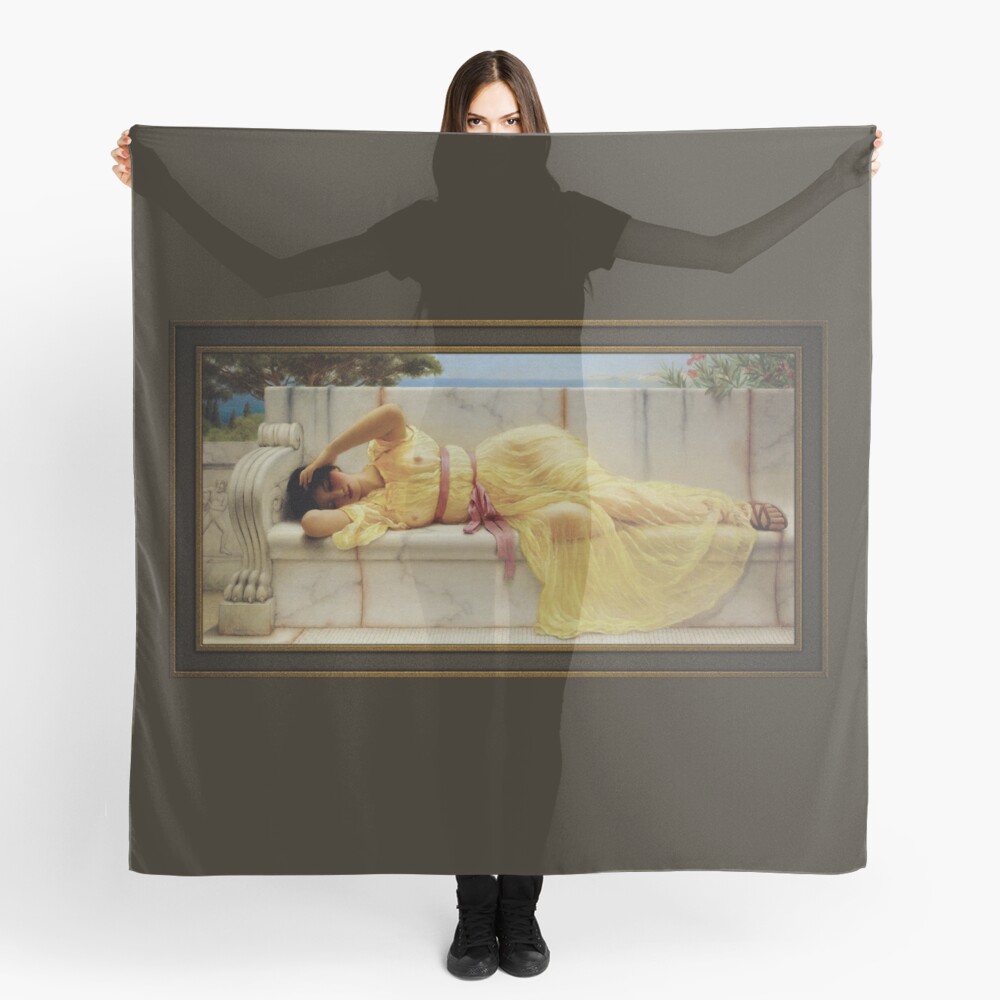
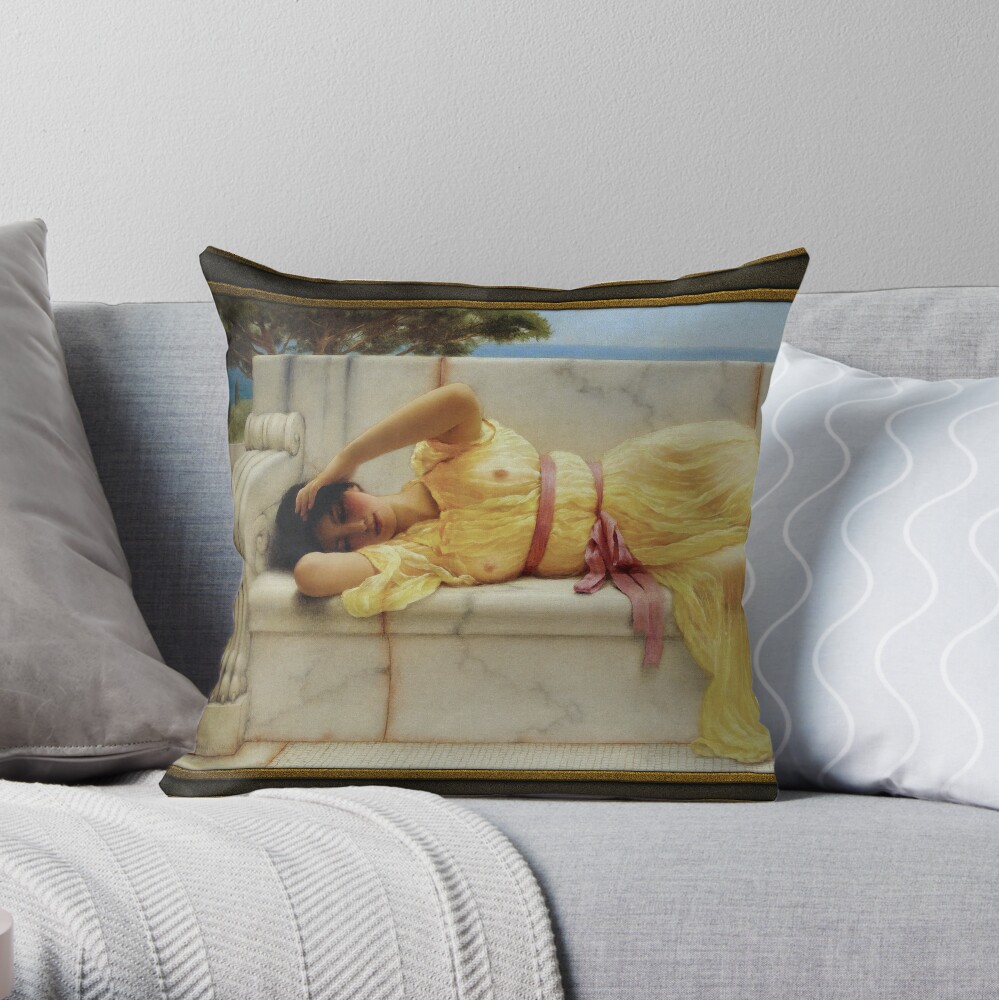
At the heart of the painting is a reclining young woman draped in a soft, flowing yellow gown that contrasts gracefully against the serene landscape. Das girl’s pose suggests a moment of quiet rest, her head gently resting on her arm while her other hand lies across her forehead, seemingly shielding her eyes from the soft light.
Her physical form is captured with remarkable finesse, Sie Gesicht is serene and perfectly sculpted, reflecting the idealisierte Schönheit that was a hallmark of Godward’s work. The pale yellow gown she wears is airy, almost translucent, fluttering gently around her form as if caressed by a soft breeze. Die Vorhänge, though delicate and light in color, carries with it a sense of weight and depth, a testament to the artist’s careful study of fabric and anatomy.
The Atmosphere: Tranquil and Timeless
Die Stimmung des Gemäldes ist von Ruhe geprägt, Zeitlosigkeit, und Gnade. The figure appears to be in a state of deep repose, perhaps in the midst of a nap or daydream, untouched by the concerns of the outside world. Das Weichheit of her drapery and the gentle pose of her body evoke an air of peaceful slumber, while the absence of any overt emotion or action leaves the viewer to experience the scene as an invitation to pause and reflect. Gottwärts, in capturing this moment, creates a serene stillness, where time seems suspended.
The Architecture: Classical Influence
Hinter der Figur, the scene is framed by a classical stone bench that connects the subject to the world of ancient civilization. Das Marmor bench, with its slightly weathered, elegant columns and scrollwork, serves as a reminder of the classical heritage that influenced much of Godward’s work. The artist’s attention to architectural detail is remarkable, with the texture of the stone clearly articulated in the subtle shadows and light reflections. Das Spalten, designed in the Corinthian style, suggest an elevated cultural and intellectual world, adding to the painting’s timeless quality.
The Natural Landscape: Calm and Expansive
Im Hintergrund, the viewer can see a peaceful vista that stretches out beyond the stone bench. The landscape is bathed in soft light, hinting at a horizon where the sea meets the sky. Although the colors of the sky are muted, das expansive nature of the scene provides a sense of Raum, suggesting an open, tranquil world that contrasts beautifully with the intimacy of the figure’s repose. Bäume with a variety of lush greenery add to the sense of calm, their foliage subtly suggesting the warmth of an ancient Mediterranean climate.
The Medium and Technique: Fine Detail and Texture
Godward’s technical prowess is evident in the exquisite detailing of both the figure and the surrounding elements. The softness of the woman’s yellow gown contrasts with the rigid, almost tactile quality of the marble columns and bench. The use of light and shadow on the fabric emphasizes its delicate, flowing nature while the skin of the figure appears almost lifelike in its natural tone. Godward’s technique in blending light and shadow contributes to the sense of realism and depth, imbuing the work with an almost three-dimensional quality. His meticulous rendering of the textures—whether it is the smoothness of the stone, the transparency of the fabric, or the natural sheen of the skin—demonstrates his mastery of light and texture.
Godward’s Style and Themes: Classical Beauty Revisited
Der Stil von “Girl in Yellow Drapery” embodies the core ideals of Neoklassizismus, a movement that sought to revive the aesthetics and ideals of ancient Greece and Rome. This style is characterized by its focus on idealized beauty, smooth forms, and an emphasis on proportion and harmony. Godward’s work is deeply infused with these principles, especially in his portrayal of the female figure, which is often idealized and posed in tranquil, relaxed settings. His subjects are frequently depicted in lush landscapes or classical architectural settings, as seen in this piece. Dieses Bild, insbesondere, encapsulates Godward’s fascination with female beauty and classical antiquity.
The theme of a reclining figure, often a symbol of both sensuality and repose, further emphasizes the artist’s commitment to creating a harmonious, serene world in his works. The image of the young woman in Godward’s painting is not merely of a sleeping figure; it is a vision of calm and perfection, disconnected from the worries of the world and set within a timeless environment. It’s an invitation for the viewer to step into a space where beauty and stillness reign.
Abschluss: The Enduring Legacy of Godward’s Work
John William Godward’s “Girl in Yellow Drapery” is a fine example of the artist’s dedication to the Neoclassical style, illustrating his skill in portraying idealized beauty and his deep admiration for classical art forms. Through the careful depiction of the figure, the architectural elements, and the natural world, Godward creates a scene of serene elegance that has continued to captivate audiences long after its creation. His ability to evoke a mood of timeless peace, combined with his technical precision, ensures that this painting remains a significant work in the history of British art.
Girl in Yellow Drapery is a remastered digital art old masters reproduction of a public domain image that is available as a Leinwanddruck online.
Diese digitale Kunstschöpfung, Wie alle Kunstwerke, die auf der Xzendor7-Website zu finden sind, können sie online in einer Vielzahl von Materialformaten einschließlich Leinwanddrucken erworben werden, Acryldrucke, Metalldrucke, Holzdrucke, gerahmte Drucke, Plakate, und als gerollte Leinwanddrucke in verschiedenen Größen von 12 Zoll zu 72 Zoll, abhängig von der Größe des tatsächlichen Kunstwerks und dem Print-on-Demand-Shop, in dem Sie das Kunstwerk kaufen möchten.
Das Kunstwerk ist auch auf einer breiten Palette von Herren- und Damenbekleidung erhältlich, Tassen, Tragetaschen, Schals, Notizbücher und Tagebücher sowie viele Heimdekorationsprodukte.
Biografie des Künstlers
Info unten von Wikipedia.org
John William Godward war das älteste von fünf Kindern, und wurde nach seinem Vater John und Großvater William benannt.
Er stellte in der Royal Academy aus 1887. Als er mit einem seiner Models nach Italien zog 1912, seine Familie brach den Kontakt zu ihm ab und schnitt sogar sein Bild aus Familienbildern. Godward kehrte nach England zurück 1921, starb in 1922, und ist auf dem Brompton Cemetery begraben, West London.
Eines seiner bekanntesten Gemälde ist Dolce far Niente (1904), die für die Sammlung von Andrew Lloyd Webber in . gekauft wurde 1995. Wie bei mehreren anderen Gemälden, Godward hat mehr als eine Version gemalt; in diesem Fall, ein früherer (und weniger bekannt) 1897 Version mit einem weiteren 1906 Ausführung.
Er beging Selbstmord im Alter von 61 und soll in seinem Abschiedsbrief geschrieben haben, dass “die welt ist nicht groß genug für [beide] ich und ein Picasso”.
Seine entfremdete Familie, der es missbilligt hatte, Künstler zu werden, schämten sich für seinen Selbstmord und verbrannten seine Papiere. Nur ein Foto von Godward ist überliefert.
Godward war ein viktorianischer Neoklassizist, und deshalb, in der Theorie, ein Anhänger von Frederic Leighton. jedoch, er ist stilistisch enger mit Sir Lawrence Alma-Tadema verbunden, mit denen er eine Vorliebe für die Wiedergabe klassischer Architektur teilte – insbesondere, statische Landschaftselemente aus Marmor.
Die überwiegende Mehrheit der erhaltenen Bilder von Godward zeigt Frauen in klassischer Kleidung, die sich vor Landschaftselementen posieren; obwohl es einige halbnackte und vollständig nackte Figuren in seinem Oeuvre gibt, ein bemerkenswertes Beispiel ist “Im Tepidarium c1913”.
Ein Titel, der mit einem umstrittenen Alma-Tadema-Gemälde des gleichen Themas geteilt wird, das in der “Lady Lever Art Gallery”. Die Titel spiegeln Godwards Inspirationsquelle wider; das war die klassische Zivilisation, vor allem das des antiken Roms; ein Thema, das Godward künstlerisch eng an Alma-Tadema bindet.
Angesichts der Tatsache, dass die klassische Wissenschaft zu seinen Lebzeiten unter dem potenziellen Publikum seiner Gemälde weiter verbreitet war als heute, akribische Detailrecherche war wichtig, um sich als Künstler in diesem Genre zu behaupten.
Alma-Tadema war sowohl Archäologin als auch Malerin, der historische Stätten besuchte und Artefakte sammelte, die er später in seinen Gemälden verwendete: Gottwärts, auch, studierte Details wie Architektur und Kleidung, um sicherzustellen, dass seine Werke den Stempel der Authentizität tragen.
In Ergänzung, Godward hat in seinen Gemälden sorgfältig und akribisch andere wichtige Merkmale wiedergegeben, Tierhäute, deren Gemälde “Mittagsruhe c1910” und “Ein kühler Rückzug c1910” enthält Beispiele für eine solche Wiedergabe sowie Wildblumen “Nerissa c1906” und “Sommerblumen c1903”.
Das Erscheinen schöner Frauen in einstudierten Posen auf so vielen Gemälden von Godward führt dazu, dass viele Neulinge in seinen Werken ihn fälschlicherweise als Präraffaeliten einstufen, Zumal seine Palette oft eine leuchtend bunte ist. Die Themenwahl (alte Zivilisation versus, beispielsweise, Arthurianische Legende) ist eher die des viktorianischen Neoklassizisten.
Gemeinsam mit zahlreichen Malern seiner Zeit, Godward war ein „hoher viktorianischer Träumer“, Bilder einer idealisierten und romantisierten Welt zu produzieren, die, sowohl bei Godward als auch bei Alma-Tadema, wurde als Weltbild der Viktorianer in Togas kritisiert.
Gottwärts “machte sich schnell einen Namen für seine Gemälde junger Frauen in einem klassischen Ambiente und seine Fähigkeit, mit Sensibilität und technischer Meisterschaft das Gefühl kontrastierender Texturen von Fleisch zu vermitteln, Marmor, Fell und Stoffe.
Godwards Vorliebe, Kunstwerke der Klassik zu schaffen, stammt wahrscheinlich aus der Zeit, in der er geboren wurde; da es die letzte umfassende klassische Wiederbelebung in der westlichen Malerei war, die in England von den 1860er bis in die 1890er Jahre blühte.