

Go Your Way c1833
“당신의 길을 가십시오 (당신의 길을 통과)” is an exquisite 초상화 drawing created by French painter Henri Grevedon in 1833. 출생 1776 그리고 지나가는 것 1860, Grevedon was a prominent artist during the early 19th century, known for his detailed and emotive works that often portrayed the elegance and refinement of the era. This piece is a masterful example of Grevedon’s ability to capture the grace and subtlety of French fashion and the poignant elegance of women in the Romantic period.
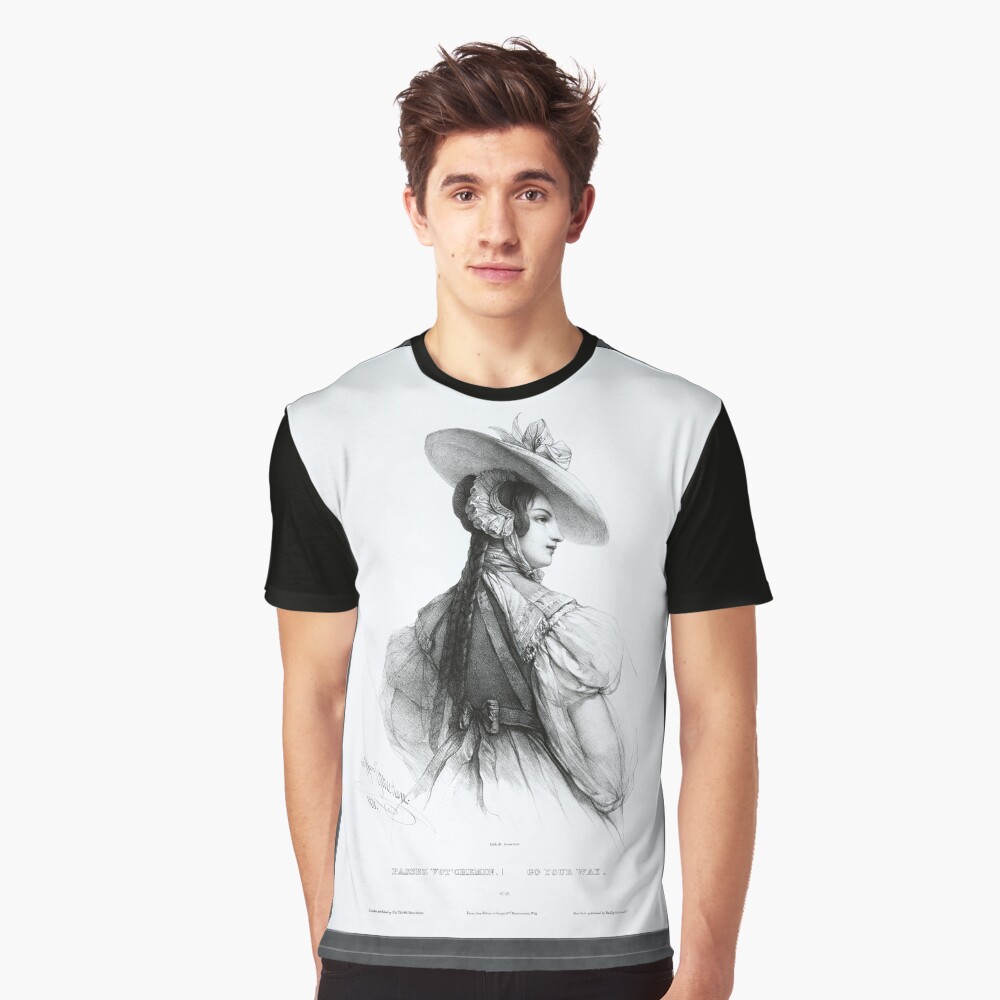
The drawing portrays a woman dressed in an elaborate ensemble, her figure captured in profile as she gazes over her shoulder, her expression enigmatic. The artist has rendered her with an air of independence and confidence, the underlying theme of the piece suggesting a sense of liberation or a personal journey. 제목 “당신의 길을 가십시오” suggests a narrative of individual empowerment, an assertion of autonomy in the face of society’s expectations. The phrase “당신의 길을 통과,” which translates to “Go your way,” reinforces this interpretation, possibly alluding to the idea of a woman making her own path in the world.
목차
주제와 구성
The central subject of the artwork is the elegantly dressed woman, who is portrayed with delicate features and a graceful posture. The artist has carefully captured her profile, focusing on the smoothness of her complexion and the flowing nature of her attire. She wears an oversized, wide-brimmed hat adorned with ribbon and a floral accent, which is a hallmark of the 19th-century French fashion. Her attire is a lavish gown with intricate folds and lace details, indicative of the luxurious textiles popular in that period. The flowing hair, neatly braided and cascading down her back, suggests both youth and sophistication, emphasizing her refined beauty.
The posture of the woman is particularly striking—her head turned to the side, suggesting a sense of motion or contemplation. There is a subtle yet unmistakable narrative suggested by the way she seems to be turning away from the viewer, as if on the verge of stepping away or heading off into the distance. This creates an illusion of dynamism within the artwork, as though the subject is about to take her next step into the unknown.
Grevedon’s meticulous attention to detail is evident in the folds of the woman’s gown, each crease and shadow carefully drawn to indicate both texture and movement. 부드러운, sweeping lines of her dress contrast with the sharp, delicate details of her accessories and the sweeping floral decorations in her hat. This use of detail enhances the overall realism and depth of the drawing, ensuring that every element serves to highlight the subject’s grace.
Style and Materials
The style of this work is characteristic of the Romantic period, a movement that emphasized emotion, 개인주의, and the beauty of the natural world. The focus on the feminine figure and the sensuous drapery of the gown are typical of Romantic art, which often celebrated the human form and the beauty of personal expression. Grevedon’s choice of using pencil and ink gives the work a soft, 천상의 품질, lending an almost tactile sense to the textures in the gown and the fluid lines of the woman’s hair. The choice of monochrome enhances the focus on the intricate details without the distraction of color, allowing the viewer to fully appreciate the delicate shading and contour of the subject.
The overall mood of the piece is one of quiet introspection, combined with a sense of movement and a personal journey. The delicate shading and soft linework convey a quiet, almost meditative stillness, while the woman’s poised stance and the slight twist of her body suggest anticipation and the promise of action. The stark, simple background serves to further isolate the subject, placing all focus on the woman herself and her emotional narrative.
주제와 분위기
이 작품의 주제는 자유가 제한되는 시대에 개인의 자율성과 여성의 조용한 강인함에 대한 생각을 중심으로 전개됩니다.. 제목 “당신의 길을 가십시오” 독립 선언으로 해석될 수 있다., 시청자가 주제의 길을 자신이 선택한 길로 생각하도록 촉구합니다., 사회가 강요하는 것보다. The phrase “당신의 길을 통과” 예술 작품에 반항과 자기 결정의 느낌을 불어넣습니다.. 이것, 인물의 구도와 자세가 어우러져, 자신의 미래를 고민하는 여성을 암시합니다, 어쩌면 인생을 바꾸는 결정을 내리기 직전일 수도 있습니다..
작품의 분위기는 차분하고 명상적입니다.. 부드러운 라인과 섬세한 렌더링이 우아한 느낌을 전달합니다., 여성의 표정과 자세는 조용한 회복력을 불러일으킵니다.. 그녀의 태도에는 거의 신비한 특성이 있습니다., 마치 깊은 생각에 잠긴 듯, 아직 그녀의 운명을 향해 나아갈 준비가 되어있습니다. 명백한 서술이나 맥락이 없기 때문에 시청자가 자신의 해석을 투영할 수 있습니다., 개인적인 여정과 권한 부여를 탐구하면서 작품을 시대를 초월하게 만듭니다..
결론
“당신의 길을 가십시오 (당신의 길을 통과)” 기술적 숙달과 깊은 감정적 공명을 결합한 19세기 프랑스 예술의 놀라운 예입니다.. 패션의 디테일을 표현하는 앙리 그레브동의 기술, 조직, 절제되고 우아한 감정의 표현은 낭만주의 시대의 본질을 포착하는 동시에 개인주의의 주제를 탐구합니다., 권한 부여, 그리고 인생의 여정. 주제의 우아함, 세부 사항에 대한 세심한 관심, 그리고 연상시키는 분위기는 이 작품을 개인 자율성의 아름다움에 대한 시대를 초월한 반영으로 만듭니다..
이것은 공개 도메인 이미지의 리마스터링된 디지털 아트 올드 마스터 복제입니다. Boucher는 Guay의 작품으로 일련의 그림을 그리고 Madame de Pompadour가 조각하여 호의를 받는 궁정에게 잘 묶인 책으로 배포했습니다..
아티스트 약력
피에르 루이 앙리 그레브동(Pierre Louis Henri Grevedon)은 프랑스 화가이다., 판화 제작자, 석판화가이자 초안가인 이 시대의 13 프랑스 화가 Jean Baptiste Regnault의 작업실에서 공부했습니다. (1754 – 1829) Ecole des Beaux-Arts de Paris 및 파리 살롱에서 전시 1824 NS 1859.
세의 나이에 30 에 1806 그는 러시아를 여행했다, 그곳에서 그는 상트페테르부르크 아카데미의 조교가 되었습니다.; 그가 지금까지 머물렀던 곳 1812, 그 때 그는 스톡홀름으로 여행을 갔다., 스웨덴; 그런 다음 영국 런던으로 이동하여 마침내 파리로 돌아갑니다., 프랑스 1816.
얼마 지나지 않아 그는 그림보다 그에게 더 잘 어울리는 석판화 예술에 자신의 재능을 바쳤습니다.; 이 노력으로 자신의 이름을 알리다; 주로 프랑스 석판화가이자 판화가인 Charles Motte의 스튜디오에서 일하고 있습니다. (1785 – 1836) 1820년대 동안.
그의 명성이 높아짐에 따라 그는 연예계의 인물 목록을 모았습니다., 여기에는 La Malibran과 같은 여배우와 댄서가 포함되었습니다., 루실 그란, 패니 엘슬러, 레이첼 ,탈리오니, Léontine Fay 외 다수.
그가 있을 때 56 1월에 살 1832, 그는 Legion of Honor의 슈발리에 칭호를 받았습니다.; 이는 군인과 민간인 모두에게 수여되는 프랑스 최고의 공로 훈장입니다., 나폴레옹 보나파르트가 설립한 (1769 – 1821) 에 1802.