

Goddess of Water
Goddess of Water by Russian Painter Konstantin Makovsky (1839 – 1915); arbenigo mewn paentiadau Hanesyddol Rwsiaidd yn dangos golwg ddelfrydol ar fywyd Rwseg yn y canrifoedd diwethaf.
Y paentiad “Goddess of Water” is a masterful depiction of the divine beauty and power of water through classical mythology. The artist’s rich use of color, dramatic lighting, and careful attention to detail create a vivid and serene representation of the goddess of water as she is transported by swans across a vast oceanic expanse.
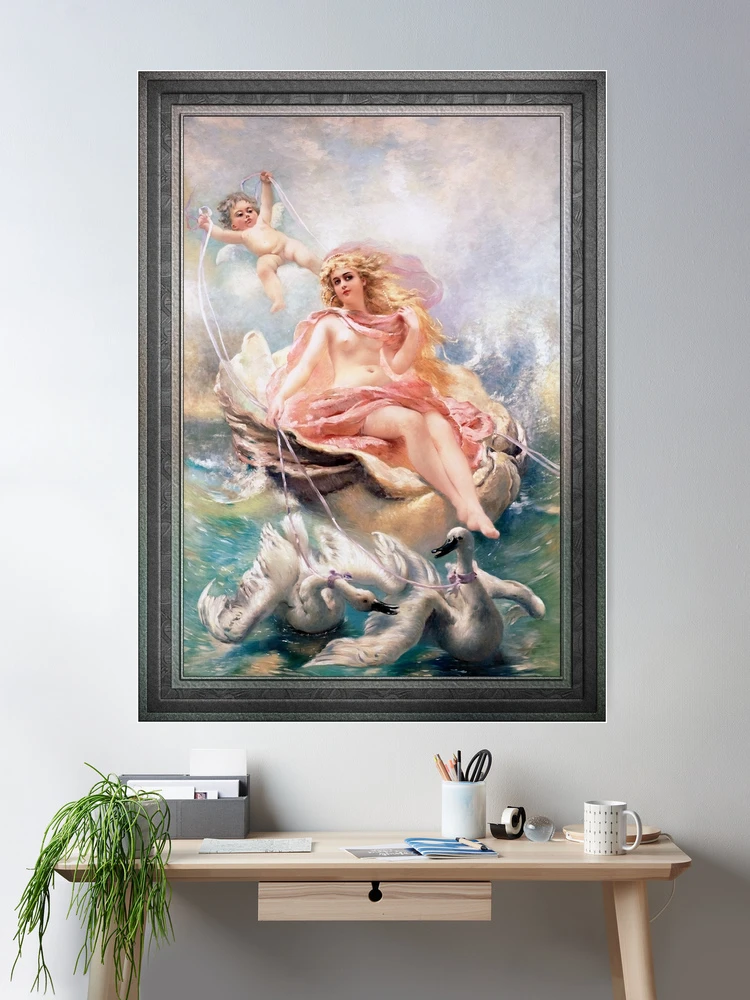
The central figure in the artwork is the goddess herself, a beautiful woman with flowing golden locks, her body partially draped in a pink and soft mauve sheer cloth that clings delicately to her form, revealing the curves of her body.
The goddess is seated serenely in a boat-like structure made of what appears to be soft seashells, floating on undulating waves, with a faint glow surrounding her, symbolizing her divine nature. Ei hwyneb, calm and composed, carries an air of grace and timeless beauty, reinforcing the ethereal nature of her character.
Y tu ôl iddi, a cherubic figure, a child-like angel, is tethered to the goddess by ribbons, symbolizing a divine connection between the mortal and the immortal. This child, whose face expresses innocence and purity, seems to guide or assist in the goddess’s journey across the waters.
The angel holds onto ribbons that extend out into the air, tethering the goddess to the swans pulling her vessel. The gentle hands of the cherub grasp the flowing ribbons with precision, and his childlike features lend a sense of playful innocence to the otherwise tranquil scene.
The swans, regal and powerful, are the carriers of the goddess, their long necks extending gracefully through the scene, and their white feathers rendered with a soft, almost glowing light, enhancing their majestic appearance.
The swans pull the boat forward, seemingly in motion as the ripples of water, shown through the smooth, soft waves, reflect the calmness of the scene. The swans’ presence in mythology often symbolizes purity and spiritual grace, which complements the goddess’s serene and powerful nature.
The background of the painting is a vast and dreamy oceanic landscape, wedi ymdrochi yn feddal, warm light, as if the sun itself is fading into the horizon. Y dwr, although calm and peaceful, seems to ripple with the movement of the swans, adding life and a sense of motion to the otherwise still moment. The sky above is filled with soft, billowy clouds, reminiscent of a serene and timeless world where the goddess’s presence is natural and eternal.
The mood of the painting is peaceful, thawel, and divine. The soft pastel colors used in the piece lend a sense of tranquility, while the glowing light surrounding the goddess and the angel enhances the mystical nature of the scene. There is a harmony in the painting that speaks to the balance of the elements—water, air, and earth—through the goddess’s gentle interaction with the swans, the water, and the sky.
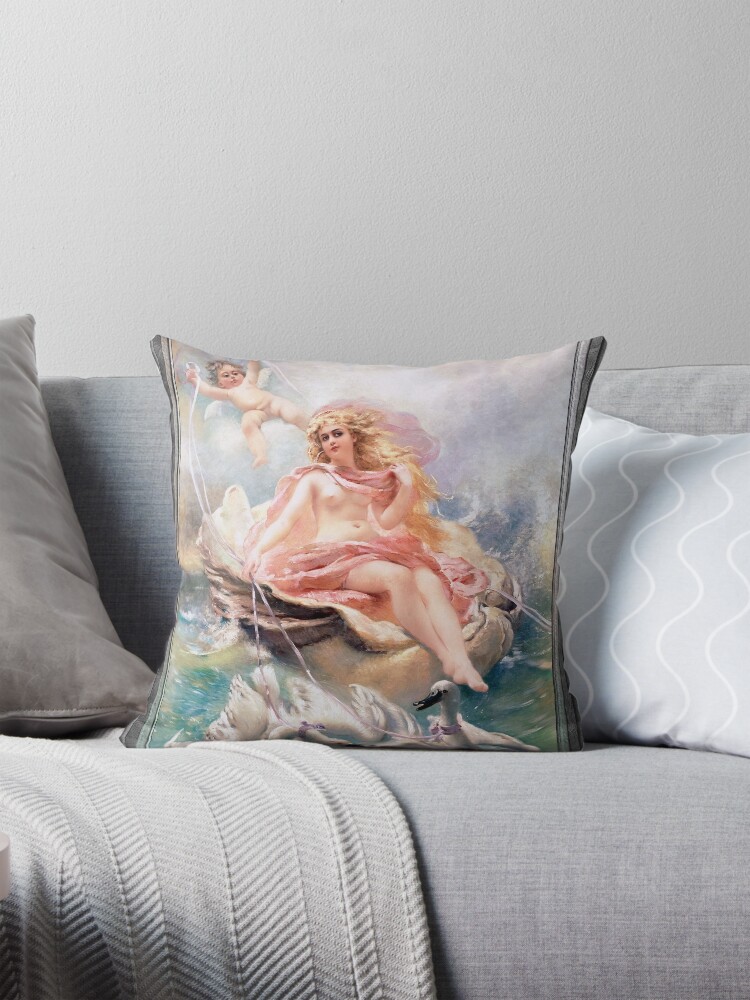
Makovsky’s mastery of classical techniques shines through in the detailed depiction of the figures, gweadau, and natural elements. The soft texture of the goddess’s flowing hair, the delicate folds of her clothing, and the smoothness of the swans’ feathers all demonstrate his skill in bringing the ethereal into the visual realm. Y golau, radiant atmosphere throughout the artwork communicates the theme of purity, dwyfoldeb, and the eternal cycle of nature.
The theme of water as a symbol of life, purdeb, and fertility is prevalent in the painting. The goddess of water, accompanied by the cherubic guide and the swans, creates a powerful and harmonious image of nature’s beauty and divine intervention.
Water in mythological contexts often represents fluidity, newid, and the nurturing aspects of life, all of which are conveyed through the painting’s serene depiction of the goddess as she floats effortlessly across the waters.
This painting embodies the 19th-century Russian fascination with classical themes, blending mythological subjects with a refined and sophisticated approach to realism. It showcases a period of artistic exploration that was both romantic and idealized, drawing on ancient mythological figures to embody ideals of beauty, harddaf, and divine connection with nature.
I gloi, “Goddess of Water” is a masterpiece that combines the beauty of nature with the divine, creu tawelwch, mystical atmosphere that is both timeless and transcendent. The detailed execution, the symbolic presence of the goddess, angel, and swans, and the soft, flowing colors make this piece a vivid representation of classical mythology, encapsulating the quiet power of water as an eternal, life-giving force.
Gwybodaeth Islaw sy'n Deillio o Wikipedia.org
Roedd Konstantin Makovsky yn arlunydd dylanwadol o Rwseg, yn gysylltiedig â'r “Peredvizhniki (Crwydriaid)”. Llawer o'i ddarluniau hanesyddol, megis Dan y Goron (1889) a elwir hefyd yn The Russian Bride's Attire a Before the Wedding, yn dangos golwg ddelfrydol ar fywyd Rwsiaidd y canrifoedd blaenorol. Mae'n cael ei ystyried yn aml yn gynrychiolydd celf Academaidd.
Ganed Konstantin Makovsky ym Moscow. Ei dad oedd y ffigwr celf Rwsiaidd ac arlunydd amatur, Yegor Ivanovich Makovsky. Cyfansoddwr oedd ei fam, a gobeithiai y byddai ei mab un diwrnod yn dilyn yn ei throed. Aeth ei frodyr iau Vladimir a Nikolay a'i chwaer Alexandra ymlaen hefyd i fod yn beintwyr.
Yn 1851 Aeth Makovsky i Ysgol Peintio Moscow, Cerflunio a Phensaernïaeth lle daeth yn fyfyriwr gorau, cael yr holl wobrau sydd ar gael yn hawdd. Ei athrawon oedd Karl Bryullov a Vasily Tropinin. Gellir esbonio tueddiadau Makovsky i Rhamantiaeth ac effeithiau addurniadol gan ddylanwad Bryullov.
Er mai celf oedd ei angerdd, ystyriodd hefyd yr hyn yr oedd ei fam am iddo ei wneud. Aeth i chwilio am gyfansoddwyr y gallai gyfeirio atynt, ac yn gyntaf aeth i Ffrainc. Cyn, roedd wedi bod yn hoff o gerddoriaeth glasurol erioed, a gwrandawodd ar lawer o ddarnau. Roedd yn aml yn dymuno cael newid y dôn, neu arddull rhai ohonynt i'w gwneud yn fwy pleserus. Yn ddiweddarach yn ei fywyd daeth yn wir.
Yn 1858 Ymunodd Makovsky â'r Imperial Academy of Arts yn St Petersburg. O 1860 cymerodd ran yn arddangosfeydd yr Academi gyda phaentiadau fel Curing of the Blind (1860) ac Asiantau'r Dmitry Ffug yn lladd mab Boris Godunov (1862). Yn 1863 Cynhaliodd Makovsky a thri ar ddeg o fyfyrwyr eraill brotest yn erbyn gosodiad yr Academi o bynciau o fytholeg Sgandinafaidd yn y gystadleuaeth am Fedal Aur Fawr yr Academia.; gadawodd pawb yr academi heb ddiploma ffurfiol.
Daeth Makovsky yn aelod o gwmni cydweithredol (artel) o artistiaid dan arweiniad Ivan Kramskoi, yn nodweddiadol yn cynhyrchu paentiadau Wanderers ar fywyd bob dydd (Gweddw 1865, Gwerthwr penwaig 1867, etc.). O 1870 roedd yn un o sylfaenwyr y Gymdeithas Arddangosfeydd Celf Teithiol a pharhaodd i weithio ar baentiadau a oedd yn ymwneud â bywyd bob dydd.. Arddangosodd ei weithiau yn arddangosfeydd yr Academia ac yn Arddangosfeydd Celf Teithiol y Crwydriaid.
Bu newid sylweddol yn ei arddull ar ôl teithio i'r Aifft a Serbia yng nghanol y 1870au. Newidiodd ei ddiddordebau o broblemau cymdeithasol a seicolegol i broblemau artistig lliwiau a siâp.
Yn y 1880au daeth yn awdur ffasiynol ar bortreadau a phaentiadau hanesyddol. Yn Ffair y Byd o 1889 ym Mharis derbyniodd y Fedal Aur Fawr am ei luniau Death of Ivan the Terrible, Barn Paris, a Demon a Tamara. Roedd yn un o'r artistiaid Rwsiaidd a gafodd ei werthfawrogi a'i dalu fwyaf ar y pryd. Roedd llawer o feirniaid democrataidd yn ei ystyried yn wrthuniad o'r Wanderers’ delfrydau, cynhyrchu (fel Henryk Siemiradzki) gweithiau trawiadol ond bas,[2] tra bod eraill yn ei weld fel rhagflaenydd Argraffiadaeth Rwsiaidd.
Lladdwyd Makovsky yn 1915 pan gafodd ei gerbyd ceffyl ei daro gan dram trydan yn St Petersburg.