

The Russian Brides Attire
The Russian Brides Attire c1889 by Russian Painter Konstantin Makovsky (1839 – 1915); arbenigo mewn paentiadau Hanesyddol Rwsiaidd yn dangos golwg ddelfrydol ar fywyd Rwseg yn y canrifoedd diwethaf.
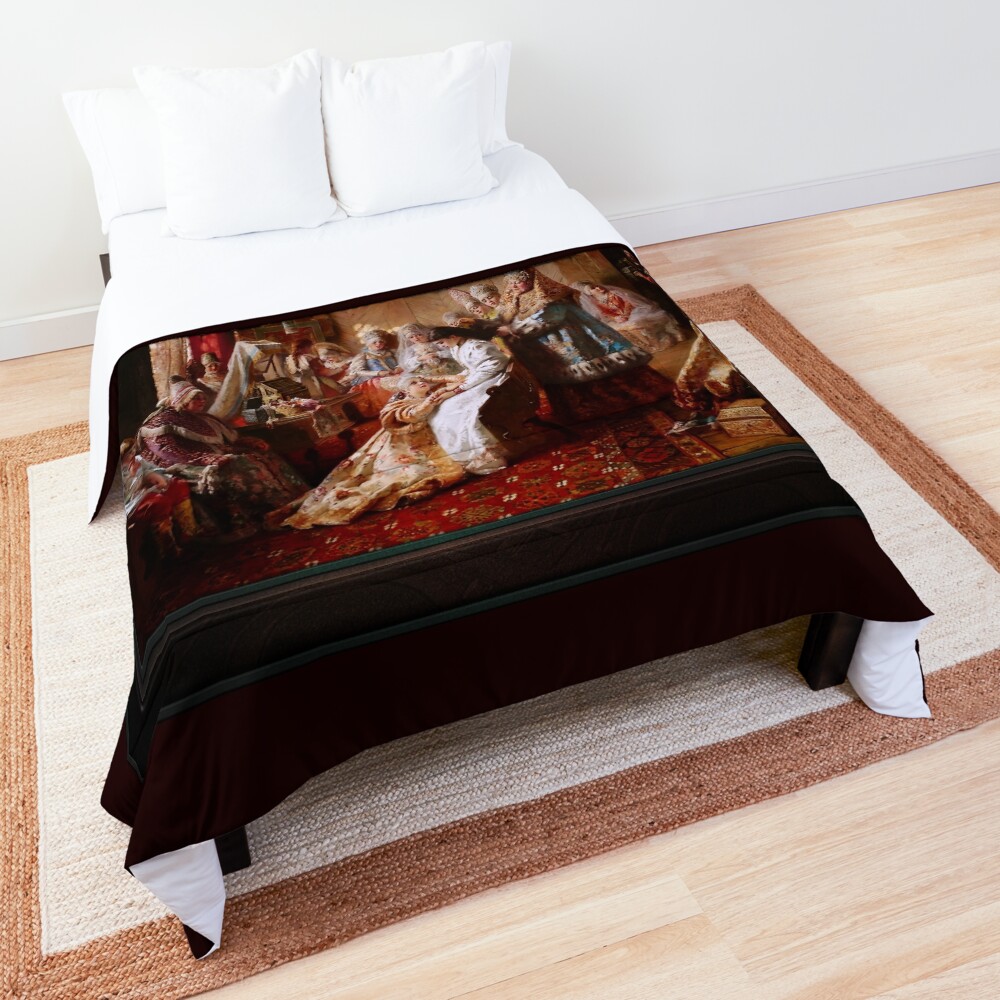
Konstantin Makovsky’s The Russian Brides Attire (1889) presents a captivating glimpse into the ceremonial preparations of a Russian bride in a traditional 19th-century setting. The scene is set within an intimate, richly adorned room where the bride-to-be, poised in anticipation, is surrounded by her closest family and friends. This historical genre painting, rooted deeply in Russian culture, reflects both the bride’s personal moment and the social customs of the time.
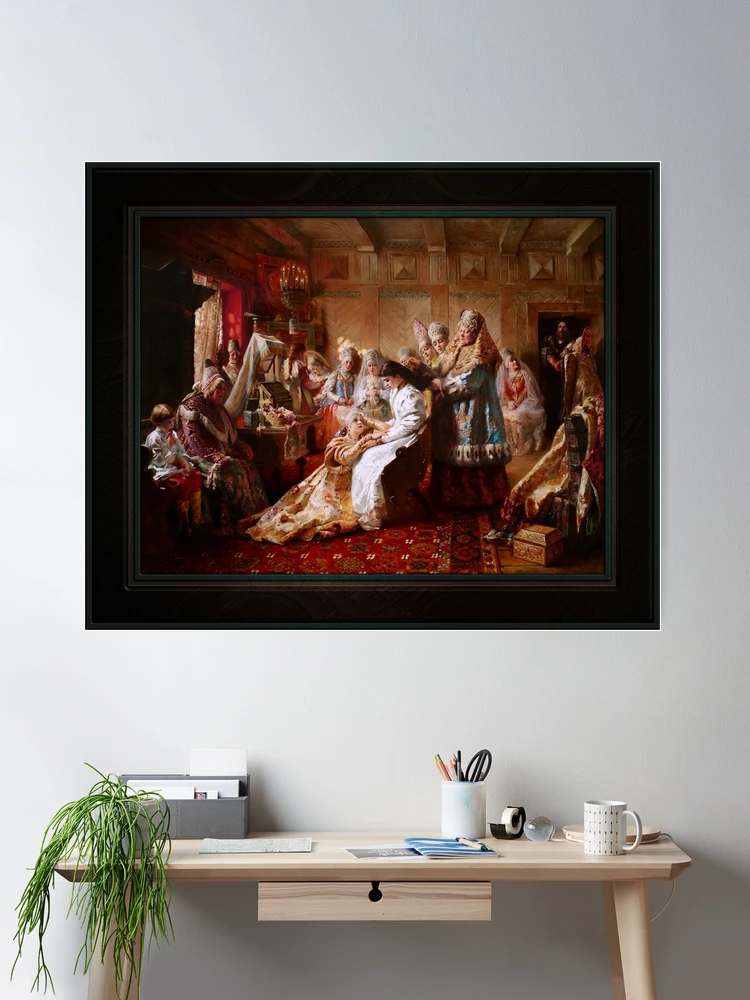
At the heart of the painting sits the young bride, dressed in an opulent, meticulously detailed gown of traditional Russian wedding attire. The intricacies of her attire are striking; every fold and embellishment in her richly embroidered dress echoes the skill and craftsmanship of the period. The gown’s texture, enhanced by the gentle play of light, emphasizes its luxurious fabric, hinting at the bride’s high social standing.
Y gŵn, with its intricate patterns and vibrant colors, combines tradition with beauty, setting her apart as the central figure in the composition. Ei mynegiant, serene yet tinged with the anticipation of the upcoming union, contributes to the painting’s overall sense of reverence for this momentous life event.
The surrounding figures enhance the emotional depth of the scene. Bridesmaids, family members, and an attentive mother are present, each contributing to the bride’s preparations. The bridal party’s clothing is also detailed, showcasing the opulence typical of the Russian aristocracy during the era.
These individuals are all engaged in the intimate tasks of finalizing the bride’s appearance, with one figure seated at the bride’s feet, holding her hands tenderly—a subtle gesture of familial connection and support. Mewn cyferbyniad, a young man, possibly the groom, appears at the threshold of the room, holding a gift box. His presence is restrained, his access to the bride’s space halted by a gentle but firm barrier, as custom would dictate.
The setting further complements the mood of the painting. The room is lavishly decorated, with dark, rich tones contrasting against the soft glow of candlelight and the bride’s radiant attire. This use of light symbolizes both the bride’s purity and the solemnity of the occasion.
The opulent, antique furniture and the delicate furnishings suggest an upper-class household, indicative of the wealth and status of the bride’s family. These elements come together to transport the viewer to the Russian nobility’s private spaces, where tradition and social rituals were deeply ingrained.
Makovsky’s approach to the painting reflects his expertise in academic art and historical realism, grounded in his training and experience with the Peredvizhniki (Crwydriaid) symudiad. Known for portraying the everyday lives of Russians, Makovsky’s work in Gwisg y Briodferch Rwsiaidd transcends mere documentation, offering an emotional portrait of a pivotal moment in a young woman’s life. His mastery of detail, lliw, and light conveys a sense of reverence for the traditions of Russian weddings, while the gentle interactions between the figures in the scene imbue the work with a sense of warmth and familial love.
The mood of the painting is one of quiet anticipation, ceremonial dignity, and a deep respect for cultural traditions. The bride is presented not just as the central figure in a social ritual, but as a symbol of purity, parhad, and heritage.
The work conveys a mixture of joy and solemnity, emphasizing the gravity of the wedding ceremony while celebrating the familial bonds that are integral to it. The groom, awaiting his bride’s arrival, is a figure of patience and longing, and the space between the bride and groom symbolizes the sacredness and exclusivity of the pre-wedding ritual.
O ran arddull, Gwisg y Briodferch Rwsiaidd is a quintessential example of Russian academic realism. Makovsky’s technique, with its sharp focus on the textures of fabrics, the naturalism of facial expressions, and the subtle play of light, creates a vivid, almost tangible atmosphere.
The figures are carefully posed to convey a sense of unity and purpose, while the careful rendering of the bride’s dress and the surrounding details showcases the artist’s skill in depicting texture and material.
Thematically, the work explores the cultural importance of the Russian wedding, which was more than just a personal event—it was a public and familial milestone. Through the artist’s portrayal of the bride’s attire, the familial interaction, and the ceremonial anticipation, the viewer is invited to witness an intimate, yet highly structured moment in Russian society. The painting also highlights the role of tradition in Russian culture, where customs surrounding marriage were highly ritualized and carefully observed.
Gwisg y Briodferch Rwsiaidd is not only a visual narrative of a traditional wedding but also an insightful reflection of the values and customs of 19th-century Russian aristocracy. It stands as a testament to Konstantin Makovsky’s ability to blend historical accuracy with emotional depth, offering the viewer a vivid portrayal of Russian cultural heritage at its most beautiful and ceremonial.
Mae hwn yn atgynhyrchiad hen feistri celf ddigidol wedi'i atgynhyrchu o ddelwedd parth cyhoeddus.
Gwybodaeth Islaw sy'n Deillio o Wikipedia.org
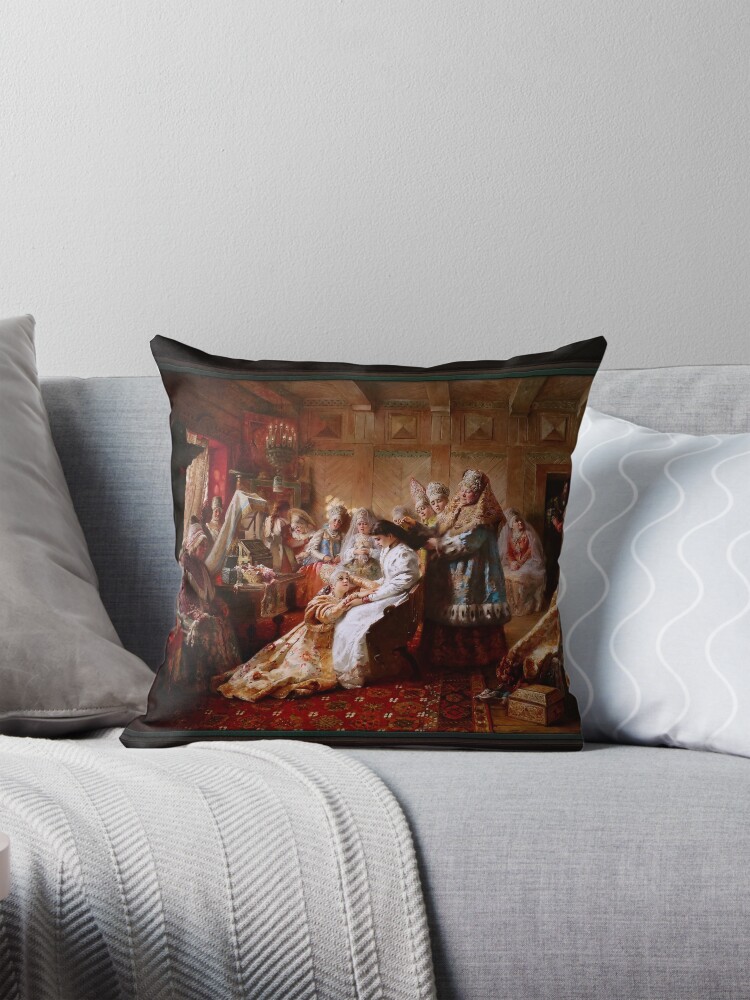
Roedd Konstantin Makovsky yn arlunydd dylanwadol o Rwseg, yn gysylltiedig â'r “Peredvizhniki (Crwydriaid)”. Llawer o'i ddarluniau hanesyddol, megis Dan y Goron (1889) a elwir hefyd yn The Russian Bride's Attire a Before the Wedding, yn dangos golwg ddelfrydol ar fywyd Rwsiaidd y canrifoedd blaenorol. Mae'n cael ei ystyried yn aml yn gynrychiolydd celf Academaidd.
Ganed Konstantin Makovsky ym Moscow. Ei dad oedd y ffigwr celf Rwsiaidd ac arlunydd amatur, Yegor Ivanovich Makovsky. Cyfansoddwr oedd ei fam, a gobeithiai y byddai ei mab un diwrnod yn dilyn yn ei throed. Aeth ei frodyr iau Vladimir a Nikolay a'i chwaer Alexandra ymlaen hefyd i fod yn beintwyr.
Yn 1851 Aeth Makovsky i Ysgol Peintio Moscow, Cerflunio a Phensaernïaeth lle daeth yn fyfyriwr gorau, cael yr holl wobrau sydd ar gael yn hawdd. Ei athrawon oedd Karl Bryullov a Vasily Tropinin. Gellir esbonio tueddiadau Makovsky i Rhamantiaeth ac effeithiau addurniadol gan ddylanwad Bryullov.
Er mai celf oedd ei angerdd, ystyriodd hefyd yr hyn yr oedd ei fam am iddo ei wneud. Aeth i chwilio am gyfansoddwyr y gallai gyfeirio atynt, ac yn gyntaf aeth i Ffrainc. Cyn, roedd wedi bod yn hoff o gerddoriaeth glasurol erioed, a gwrandawodd ar lawer o ddarnau. Roedd yn aml yn dymuno cael newid y dôn, neu arddull rhai ohonynt i'w gwneud yn fwy pleserus. Yn ddiweddarach yn ei fywyd daeth yn wir.
Yn 1858 Ymunodd Makovsky â'r Imperial Academy of Arts yn St Petersburg. O 1860 cymerodd ran yn arddangosfeydd yr Academi gyda phaentiadau fel Curing of the Blind (1860) ac Asiantau'r Dmitry Ffug yn lladd mab Boris Godunov (1862). Yn 1863 Cynhaliodd Makovsky a thri ar ddeg o fyfyrwyr eraill brotest yn erbyn gosodiad yr Academi o bynciau o fytholeg Sgandinafaidd yn y gystadleuaeth am Fedal Aur Fawr yr Academia.; gadawodd pawb yr academi heb ddiploma ffurfiol.
Daeth Makovsky yn aelod o gwmni cydweithredol (artel) o artistiaid dan arweiniad Ivan Kramskoi, yn nodweddiadol yn cynhyrchu paentiadau Wanderers ar fywyd bob dydd (Gweddw 1865, Gwerthwr penwaig 1867, etc.). O 1870 roedd yn un o sylfaenwyr y Gymdeithas Arddangosfeydd Celf Teithiol a pharhaodd i weithio ar baentiadau a oedd yn ymwneud â bywyd bob dydd.. Arddangosodd ei weithiau yn arddangosfeydd yr Academia ac yn Arddangosfeydd Celf Teithiol y Crwydriaid.
Bu newid sylweddol yn ei arddull ar ôl teithio i'r Aifft a Serbia yng nghanol y 1870au. Newidiodd ei ddiddordebau o broblemau cymdeithasol a seicolegol i broblemau artistig lliwiau a siâp.
Yn y 1880au daeth yn awdur ffasiynol ar bortreadau a phaentiadau hanesyddol. Yn Ffair y Byd o 1889 ym Mharis derbyniodd y Fedal Aur Fawr am ei luniau Death of Ivan the Terrible, Barn Paris, a Demon a Tamara. Roedd yn un o'r artistiaid Rwsiaidd a gafodd ei werthfawrogi a'i dalu fwyaf ar y pryd. Roedd llawer o feirniaid democrataidd yn ei ystyried yn wrthuniad o'r Wanderers’ delfrydau, cynhyrchu (fel Henryk Siemiradzki) gweithiau trawiadol ond bas,[2] tra bod eraill yn ei weld fel rhagflaenydd Argraffiadaeth Rwsiaidd.
Lladdwyd Makovsky yn 1915 pan gafodd ei gerbyd ceffyl ei daro gan dram trydan yn St Petersburg.