

GODs Creatures
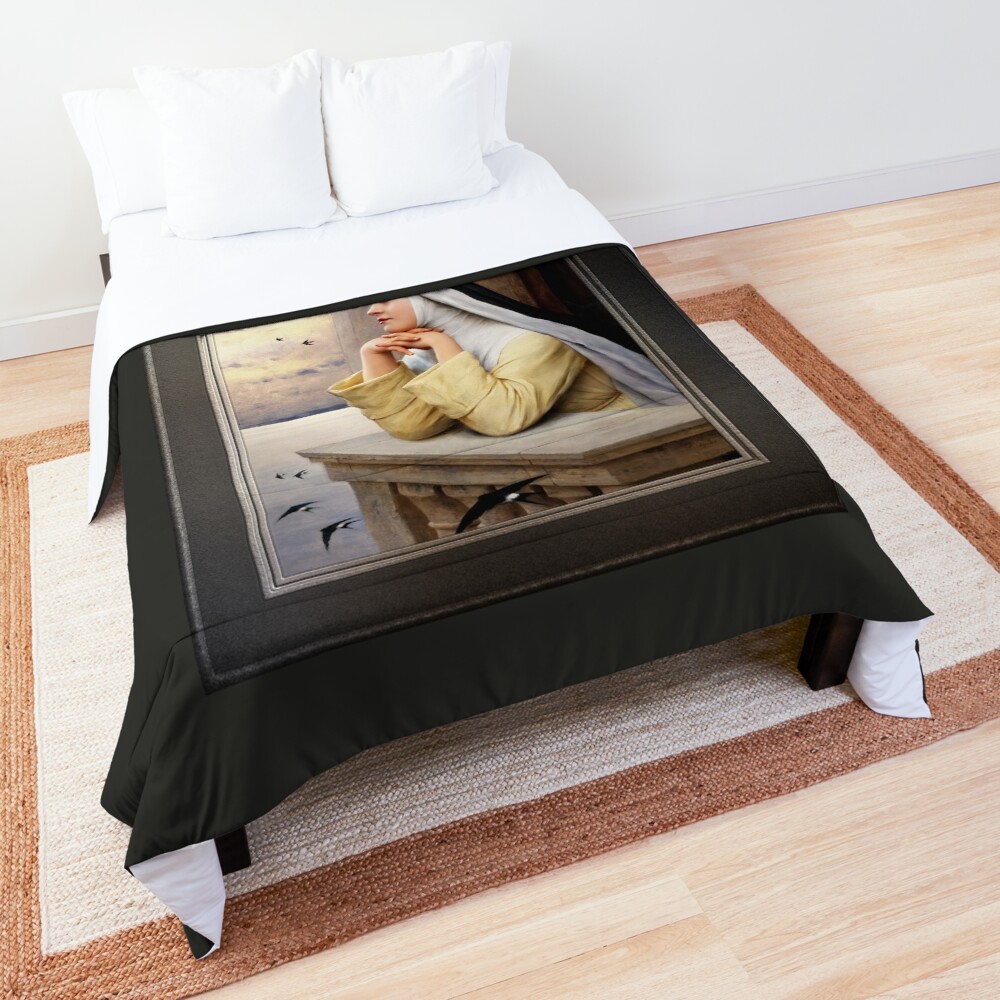
“GODs Creatures,” gemaakt in 1913 by the Italian artist Eugen von Blaas (1843 – 1931), presents a contemplative and serene scene that reflects both the emotional and spiritual elements typical of his style. Known for his exquisite technique and deep focus on human emotion, Blaas captures a moment of peaceful reflection. Deze religious work of art portrays a young woman in a contemplative posture, framed by an open window with an expansive view of the sky. Her eyes are softly cast downward, in gedachten verzonken, while the quiet landscape outside contrasts sharply with the internal stillness she exudes.
Inhoudsopgave
Hoofdonderwerp: A Contemplative Figure
At the heart of the composition is the figure of a young woman, a model of serenity and elegance, dressed in a flowing white and yellow habit, typical of early 20th-century religious attire. She appears to be deep in thought, with her hands gently clasped together in a posture of quiet contemplation. The painting focuses not only on her appearance but on her emotional state, reflected in the serene yet somber look on her face. Her expression is one of internal peace, but with an underlying sense of longing, perhaps for a deeper connection with the divine or nature.
Blaas’s handling of the woman’s facial features is delicate and meticulous, allowing the viewer to perceive a quiet vulnerability in her eyes and posture. Her youthfulness, combined with the gentle folds of her religious garb, lends an ethereal quality to her presence.
The face is rendered with exceptional realism, exhibiting fine detail in the skin tones, the subtle play of light and shadow on her features, and the soft texture of the fabric she wears. It is clear that Blaas’s intent was to evoke not just the appearance of a figure in a moment of stillness, but to express the feeling of solitude and contemplation that often accompanies moments of prayer and reflection.
Objecten en terrein
De instelling van “GOD’s Creatures” is as important as the figure itself. The woman is positioned at an open window, with the stone framework of the structure framing her profile. The window sill appears to be made of stone, possibly marble, and is decorated with faintly carved lines that echo the simplicity and elegance of the woman’s attire. The stonework reflects the spiritual and historical context of the setting, suggesting a place of meditation or a retreat, possibly within a monastery or a religious sanctuary.
Outside the window, the sky is filled with soft, billowing clouds, and a series of birds are seen soaring across the expanse. These birds, rendered in delicate detail, seem to represent freedom and divine presence.
The birds appear to glide effortlessly across the sky, their flight symbolizing the connection between the earthly and the divine, a recurring theme in religious and spiritual art. The backdrop conveys a sense of vastness and the beauty of nature, as if inviting the viewer to look beyond the confines of the stone structure and into the boundless possibilities that lie beyond.
Blaas’s choice to include these birds underscores a spiritual connection with God’s creatures, evoking a sense of peace and reverence for the natural world. This inclusion is subtle yet significant, drawing the viewer’s attention to the interwoven relationship between humanity and the divine.
Stijl en techniek
Eugen von Blaas’s style is rooted in academic realism, en “GOD’s Creatures” showcases his skill in creating lifelike human figures and environments. His detailed rendering of the woman’s face, attire, and surroundings demonstrates his technical mastery of light, schaduw, en textuur.
The artist’s use of soft, blended brushstrokes enhances the atmospheric effect, creating a calm, dreamlike quality to the painting. The contrast between the detailed, realistic rendering of the woman and the slightly more impressionistic treatment of the landscape further emphasizes the inner world of the figure, placing the focus squarely on her emotional state.
The background and the foreground are not overly busy, maintaining a balance between realism and abstraction. This subtle blending between the figure and the environment encourages a meditative response from the viewer, inviting them to contemplate the subject’s inner life while also appreciating the natural beauty surrounding her.
The attention to detail in the textures of the woman’s clothing and the stonework suggests a high level of craftsmanship, typical of Blaas’s work, where every element is rendered with a deep sense of care and precision.
Thema en stemming
The overall theme of “GOD’s Creatures” is one of reflection and spiritual tranquility. The title itself evokes a connection between the human figure and the divine creation of nature, with the woman symbolizing both the spiritual and human elements that are central to Blaas’s work.
The figure’s contemplative nature and the tranquil setting suggest a deep connection to faith, natuur, and the divine. The presence of birds outside the window reinforces the notion of God’s creatures and their role in the world, symbolizing purity, freedom, and divine grace.
The mood of the painting is calm and introspective. The soft tones, the serene expression on the woman’s face, and the expansive, peaceful sky outside create a quiet atmosphere of contemplation. This mood is reinforced by the restrained color palette, which uses warm, muted tones to convey a sense of calm, while the birds flying in the distance provide a subtle but important element of movement, breaking the stillness with their flight.
Blaas captures a moment that feels timeless, evoking the sense that this moment of quiet reflection could exist at any time, in any place. The combination of the figure’s tranquility and the surrounding natural beauty creates a sense of unity between humanity and the divine, suggesting that both the human soul and the natural world are interconnected in a peaceful, harmonious existence.
Conclusie
In “GOD’s Creatures,” Eugen von Blaas has created a work of art that beautifully encapsulates themes of spiritual reflection, connection to nature, and emotional serenity. Through his masterful technique and thoughtful composition, Blaas invites the viewer into a meditative space where the figure of the woman serves as both an individual and a representative of the broader human experience.
The artwork encourages contemplation not only of the divine but also of the natural world, highlighting the intimate relationship between humanity and the creatures that share this world. The peaceful mood, combined with the careful attention to detail and the symbolic use of birds, creates a work that speaks to the soul, evoking a sense of calm and spiritual unity.
This is a retouched digital art old masters reproduction of a public domain image that is available online as a opgerolde afdruk.
Bio -kunstenaar
Info hieronder van Wikipedia.org
Hij werd geboren in Albano, in de buurt van Rome, aan een Tiroolse vader en Italiaanse moeder. Zijn vader Karl, ook een schilder, was zijn leraar. Zijn moeder, Agnesina Auda, was een welgestelde Romeinse vrouw. Het gezin verhuisde naar Venetië toen Karl professor werd aan de Academie van Venetië. Hij schilderde vaak taferelen in Venetië, maar ook portretten en religieuze schilderijen.
Onder zijn werken zijn De huwelijksvorm in de sacristie; Bingo in Campielo in Venetië; Een poppenscène in een school; en La Ninetta. De kunstcriticus Luigi Chirtani, toen het schilderij werd tentoongesteld in de Mostra Nazionale di Venezia, beschreef het als mooi, vleiend, zeer, gestreeld, schoongemaakt, gepolijst, wasvrouw in een schilderij van Mr. Blaas, de favoriete portrettist van grote Venetiaanse aristocraten, dressed in gala satin, glanzende sieraden, kapsels van de rijken.
Zijn kleurrijke en nogal theatrale periodebeelden van de Venetiaanse samenleving, bijv. Op het balkon (1877; Prive collectie), waren heel anders in vergelijking met delicate pastels en etsen van de binnenplaatsen, balkon en grachten van het moderne Venetië.
Eugene de Blaas’ schilderijen werden tentoongesteld in de Koninklijke Academie, Maatschappij voor Schone Kunsten, Nieuwe galerij en Arthur Tooth and Sons Gallery in Londen, en ook in de Walker Art Gallery in Liverpool